
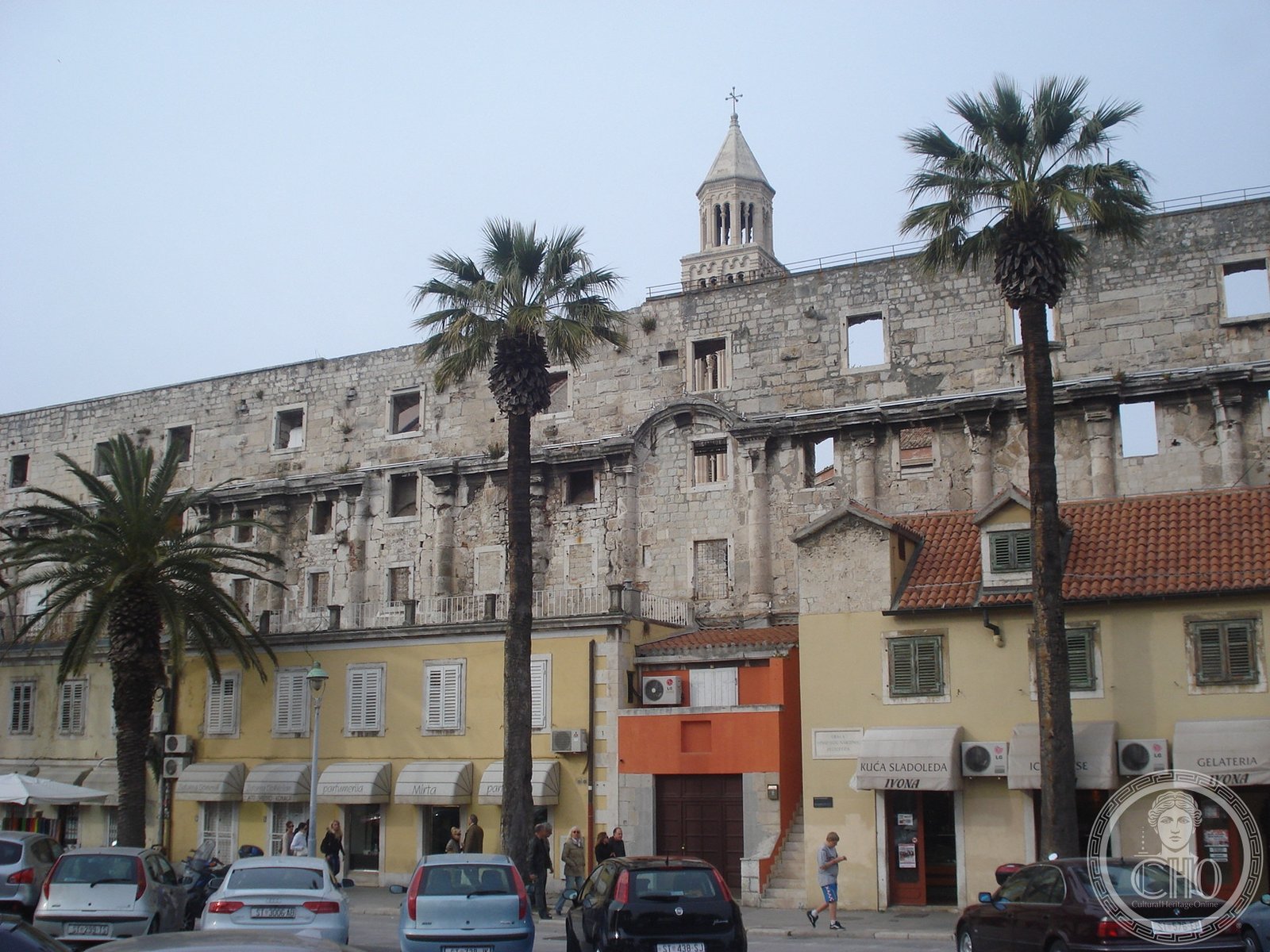
Diocletian’s Palace — Observatory of Cultural Policies
Diocletian’s Palace in Split, Croatia, is one of the best-preserved Roman imperial residences in the world, built between 295 and 305 AD as the retirement complex of Emperor Diocletian. Today the palace forms the living historic core of Split, a UNESCO World Heritage Site since 1979, where medieval churches, Renaissance palaces, Baroque fountains, and modern residences are layered within the original Roman walls — making it both an active city neighbourhood and one of the Mediterranean’s most extraordinary architectural ensembles.
At a glance
- Type
- Roman imperial palace and historic urban complex
- Period
- c. 295–305 AD (Roman construction); continuously inhabited and modified to the present
- Style
- Roman imperial architecture; subsequent medieval, Renaissance, and Baroque interventions
- Location
- Split (Spalato), Dalmatia, Croatia
- Coordinates
- 43.5082° N, 16.4401° E
- UNESCO
- World Heritage Site — Historic Complex of Split with the Palace of Diocletian (1979)
Overview
Diocletian’s Palace covers approximately 30,000 square metres along the Split waterfront and was originally conceived not as a palace in the conventional sense but as a combination of imperial residence and military garrison, enclosed within monumental walls reinforced by towers. After Diocletian’s death in 316 AD the complex passed through successive owners before being settled in the 7th century by refugees fleeing the destruction of nearby Salona, who transformed the Roman structures into a self-contained city. The resulting layering of civilisations within a single walled enclosure is unique in the Mediterranean world and has made Split a laboratory for the study of urban continuity from antiquity to the present.
History
Emperor Diocletian, born in nearby Salona to a family of modest origins, ordered the construction of his retirement palace around 295 AD and occupied it following his historic abdication in 305 AD — the only Roman emperor to voluntarily relinquish power. The palace was designed by architects drawing on both Roman and eastern (possibly Anatolian) traditions, producing an innovative blend of military fortification and palatial luxury. After the fall of the Western Roman Empire the palace served successively as residence for the Ostrogothic king Odoacer, Byzantine military headquarters, and from the 7th century as the core of the medieval city of Split. The early medieval inhabitants converted Diocletian’s mausoleum into a cathedral — today Split Cathedral, one of the world’s oldest Christian churches in continuous use.
What you see
The palace perimeter walls, standing up to 26 metres high, define a roughly rectangular enclosure 215 m × 180 m, pierced by four original gates — the Porta Aurea (Golden Gate) to the north being the grandest surviving example. Within the walls, the Peristyle — the colonnaded ceremonial court before the emperor’s apartments — remains the dramatic centrepiece of the complex, still framed by its original Corinthian columns. Diocletian’s mausoleum, converted into the Cathedral of Saint Domnius in the 7th century, retains its original octagonal form and magnificent Roman frieze; the adjacent baptistery is a converted Roman temple of Jupiter. The substructure of the southern imperial apartments (the Vestibule and subterranean halls) can be toured separately and offers one of the most evocative experiences of intact Roman spatial sequences anywhere in Europe.
Cultural significance
Diocletian’s Palace is exceptional in world heritage terms for combining outstanding universal value as a Roman monument with unbroken urban vitality — it is not a ruin but a living city, where approximately 3,000 people still reside within the Roman walls. Its influence on European architectural history was profound: Robert Adam’s survey of the palace in 1757 directly inspired the Neoclassical movement in Britain, and motifs from the palace’s arcaded colonnade appear throughout Georgian architecture. The complex exemplifies the UNESCO principle of living heritage, demonstrating that outstanding ancient monuments and contemporary urban life need not be incompatible.
Practical information
- Address
- Dioklecijanova ul. 1, 21000 Split, Croatia
- Opening hours
- The palace precinct is accessible at all times (it is a living city centre); individual monuments (substructure, cathedral, treasury) have their own visiting hours — check Split Tourism Board website
- Admission
- The streets and Peristyle are free; entry fees apply to the substructure halls, cathedral treasury, and specific museums within the palace
Getting there
Split is the main transport hub of Dalmatia and is well connected by air (Split Airport, 25 km west), ferry (daily services from Ancona, Pescara, and Rijeka), and coach from Zagreb (approx. 5 hours). The palace opens directly onto the waterfront Riva promenade, a 10-minute walk from the ferry terminal and the bus/coach station. Within Split, the palace is central to all city transport routes.
Sources & resources
Find it on the map
See this place and what’s around it →Historical events at this place (1)
📷 Diventa un fotografo di Cultural Heritage Online
Condividi le tue foto dei luoghi: restano pubblicate con la tua firma come autore. Più vengono viste, più ti fai conoscere — e presto un concorso premierà le foto più apprezzate.
Accedi o registrati gratis per aggiungere una foto