
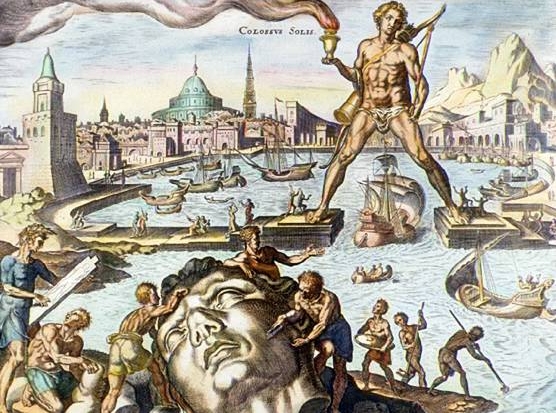
Colossus of Rhodes
The Colossus of Rhodes was a gigantic bronze statue of the sun god Helios, erected at the harbour of Rhodes on the island of Rhodes, Greece, around 280 BCE. Standing approximately 33 metres tall, it was one of the Seven Wonders of the Ancient World and the tallest statue of the ancient world, built by the Rhodians to celebrate their successful defence against the siege of Demetrius I Poliorcetes in 305–304 BCE. It stood for only 54 years before being toppled by an earthquake in 226 BCE.
At a glance
- Type
- Ancient colossal bronze statue; one of the Seven Wonders of the Ancient World (destroyed)
- Period
- Constructed c. 294–282 BCE; completed c. 280 BCE; destroyed by earthquake 226 BCE; remains sold as scrap bronze c. 654 CE
- Style
- Hellenistic; colossal bronze casting
- Location
- Harbour of Rhodes, island of Rhodes, Dodecanese, Greece
- Coordinates
- 36.4511° N, 28.2265° E
Overview
The Colossus of Rhodes was commissioned by the city-state of Rhodes following its successful year-long resistance to the siege of Demetrius Poliorcetes in 305–304 BCE, when the besieging army abandoned its equipment on the island. The Rhodians sold this equipment and used the proceeds to fund the statue as a thank-offering to Helios, their patron god. Designed by the sculptor Chares of Lindos, a student of Lysippos, the statue is described in ancient sources as representing Helios standing with one hand raised to shade his eyes — though the popular image of it straddling the harbour entrance is a later, unsubstantiated legend.
History
Chares of Lindos began construction around 294 BCE, with the statue cast in bronze sections built up around an iron and stone armature framework; the project took approximately twelve years. At its completion around 280 BCE, it was immediately recognised as a Wonder of the world. An earthquake in 226 BCE cracked the statue at the knees and brought it to the ground. The Ptolemaic pharaoh Ptolemy III offered to fund its reconstruction, but the Rhodians declined — an oracle had warned against rebuilding. The fallen statue lay in place for centuries: Pliny the Elder, writing in the 1st century CE, noted that few people could wrap their arms around the fallen thumb. Around 654 CE, Arab forces who captured Rhodes sold the remaining bronze as scrap to a Jewish merchant from Edessa, reportedly requiring 900 camels to carry it away.
What you see
Nothing survives of the original Colossus. The harbour entrance to Rhodes's Mandraki Harbour — the most commonly cited location for the statue — is marked today by two columns topped by a bronze deer and a doe, the heraldic symbols of Rhodes. The Medieval City of Rhodes, inscribed as a UNESCO World Heritage Site in 1988, preserves the remarkable urban fabric of the Knights Hospitaller who ruled the island 1309–1522, including the Palace of the Grand Master and the Street of the Knights. The Archaeological Museum of Rhodes displays Hellenistic sculpture and artefacts that provide context for the cultural world that created the Colossus.
Cultural significance
The Colossus of Rhodes has exerted an extraordinary influence on the imagination of Western civilisation: it is among the most frequently invoked of the Seven Wonders, referenced by writers from Strabo to Shakespeare (Julius Caesar, I.ii: “He doth bestride the narrow world / Like a Colossus”). Its symbolic status as a monument to civic pride and military resilience made it a reference point for colossal public statuary in every subsequent era, including the proposal — eventually realised differently — that influenced the design of the Statue of Liberty. The name “colossus” (from the Greek kolossos) entered European languages as the term for any gigantic statue.
Practical information
- Site today
- Mandraki Harbour, Rhodes Town, Rhodes, Greece — the harbour columns are freely visible; no entry fee
- Archaeological Museum of Rhodes
- Plateia Argyrokastrou, Rhodes Town — check official website for current hours and admission fees
- Medieval City
- Rhodes Old Town (UNESCO World Heritage Site) — freely walkable; individual monuments may charge entry
Getting there
Rhodes is served by Diagoras International Airport (RHO), with direct flights from Athens, major European cities, and Middle Eastern hubs — particularly frequent in summer. Ferry services connect Rhodes to Piraeus (Athens), Crete, and other Aegean and Dodecanese islands. Within Rhodes Town, Mandraki Harbour is within easy walking distance of the medieval city walls and the main bus terminal. The island also has a network of buses connecting Rhodes Town with major villages and ancient sites such as Lindos.
Sources & resources
Find it on the map
See this place and what’s around it →📷 Diventa un fotografo di Cultural Heritage Online
Condividi le tue foto dei luoghi: restano pubblicate con la tua firma come autore. Più vengono viste, più ti fai conoscere — e presto un concorso premierà le foto più apprezzate.
Accedi o registrati gratis per aggiungere una foto