
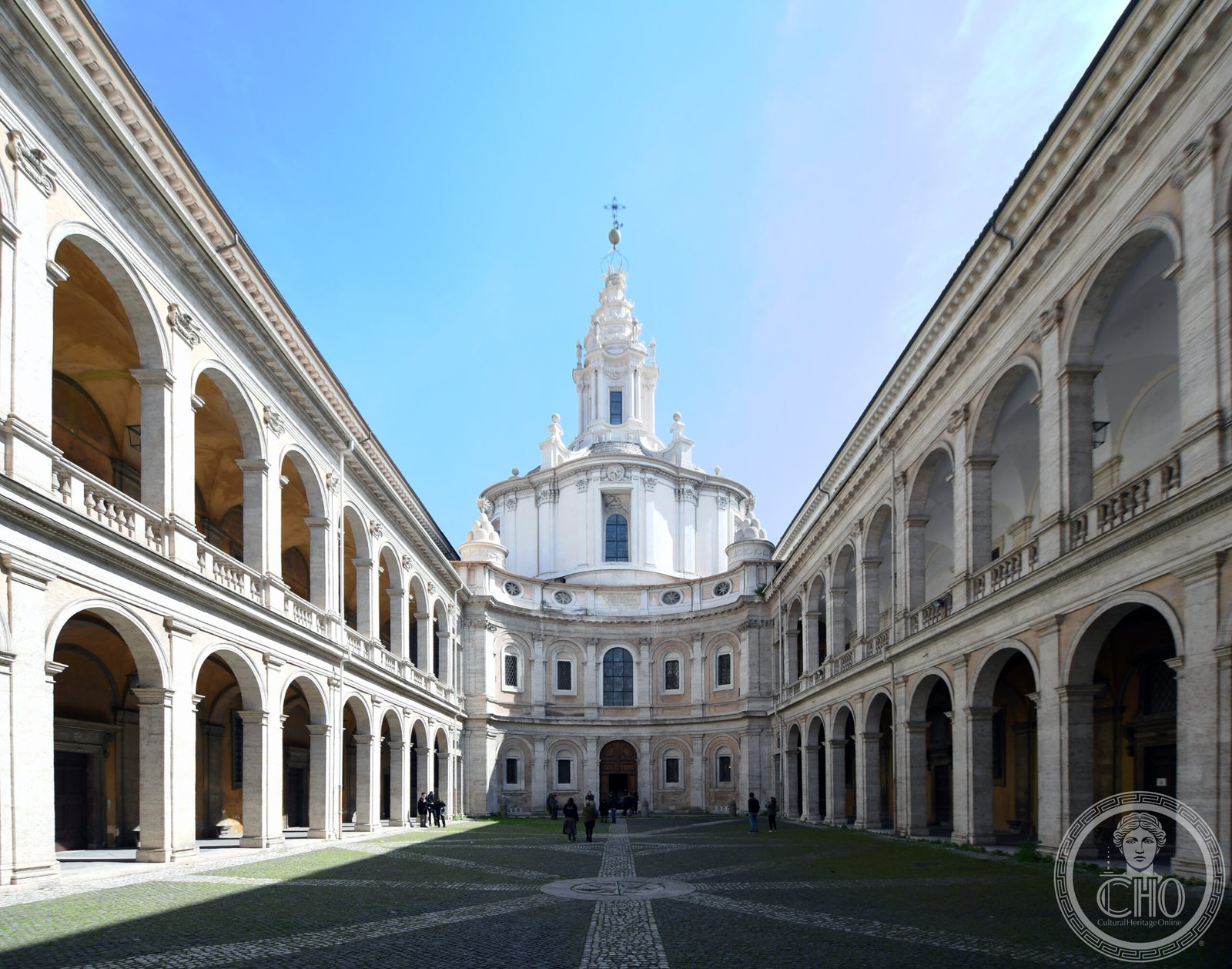
Church of Sant’Ivo alla Sapienza
Sant’Ivo alla Sapienza is one of the great masterpieces of European Baroque architecture, designed entirely by Francesco Borromini and built between 1642 and 1660 within the courtyard of the Palazzo della Sapienza, the seat of Rome’s oldest university. Its plan — based on an interlocking system of triangles and curves — and its extraordinary spiralling lantern make it the most geometrically inventive church in Rome, a building that has influenced architects from the 17th century to the present day.
At a glance
- Type
- Chapel of the Archivio di Stato di Roma; former university chapel
- Period
- 1642–1660
- Style
- Roman Baroque
- Architect
- Francesco Borromini
- Location
- Corso del Rinascimento 40, Rome, Italy
- Coordinates
- 41.8981° N, 12.4748° E
Overview
Sant’Ivo alla Sapienza stands at the closed end of Giacomo della Porta’s Renaissance courtyard of the Palazzo della Sapienza, where its concave facade forms a dialogue with the two-storey porticoes that frame the space. The church was designed as the chapel of the Sapienza, Rome’s university founded in 1303, and dedicated to Saint Yves of Brittany, patron of lawyers and scholars. Today the building is maintained by the Archivio di Stato di Roma (State Archive of Rome), which occupies the palazzo, and is widely regarded a masterpiece of Roman Baroque architecture.
History
Construction began under Pope Urban VIII (Barberini) in 1642 and was completed under Pope Innocent X and Pope Alexander VII (Chigi) in 1660, explaining the presence of all three families’ heraldic symbols within the church’s decoration. Borromini received the commission around 1632 but design work developed over the following decade. The building was unprecedented in its complex plan and its technical audacity, and Borromini’s contemporaries — including those who admired his rival Bernini — recognised it as a work of singular invention. The Sapienza university moved to its current location near the Termini station in 1935, leaving the palazzo and church to their archival function.
What you see
The floor plan is generated from two overlapping equilateral triangles forming a six-pointed star, with the points alternately rounded into apses and sharpened into convex bays — a geometry Borromini derived from the six-pointed star of the Barberini bee emblem and from symbolic associations with wisdom and the Holy Spirit. The single unified interior space rises without a break from the polychrome marble floor to the lantern high above, its white stucco walls animated by pilasters and ribs that converge at the drum. The exterior lantern — a helix of stone spiralling upward to a flame and a cross — is visible from much of the surrounding neighbourhood and is Borromini’s most iconic skyline element.
Cultural significance
Sant’Ivo alla Sapienza is universally cited among the defining works of 17th-century European architecture and is the subject of an extensive scholarly literature. Its geometric and symbolic programme has been the focus of iconological debate for decades, with proposed readings involving Solomonic wisdom, the Holy Spirit, and humanist Neo-Platonism. The church is protected as a monument of exceptional national interest under Italian cultural heritage law.
Practical information
- Address
- Corso del Rinascimento 40, 00186 Roma RM, Italy
- Hours
- Typically open Sunday mornings and on specific days; hours are limited — check the Archivio di Stato di Roma or current tourism sources before visiting
- Admission
- Free when open
Getting there
The church is located near Piazza Navona and the Pantheon, in one of Rome’s densest historic districts. Bus lines serving Corso del Rinascimento or Piazza Navona stop within a 2-minute walk. From the Pantheon, the entrance on Corso del Rinascimento is approximately a 4-minute walk east. There is no Metro stop nearby; the nearest is Spagna or Barberini (Line A), both about 20 minutes on foot, making bus or taxi the preferred option.
Sources & resources
Find it on the map
See this place and what’s around it →Historical events at this place (2)
📷 Diventa un fotografo di Cultural Heritage Online
Condividi le tue foto dei luoghi: restano pubblicate con la tua firma come autore. Più vengono viste, più ti fai conoscere — e presto un concorso premierà le foto più apprezzate.
Accedi o registrati gratis per aggiungere una foto