
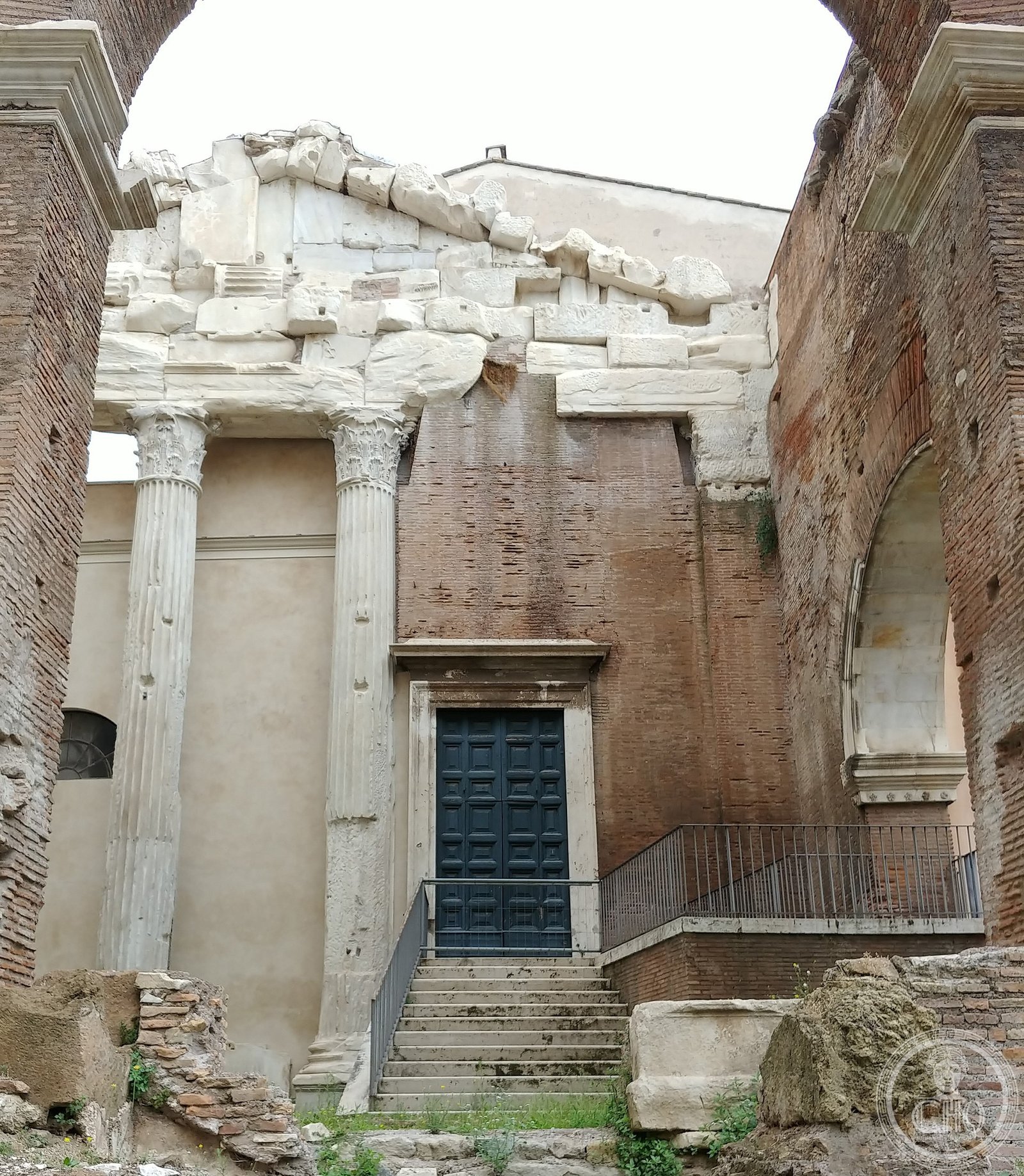
Church of Sant’Angelo in Pescheria
Sant’Angelo in Pescheria is an 8th-century church embedded in the ruins of the ancient Porticus Octaviae in Rome’s historic Jewish Ghetto district. Its name — “in Pescheria” — derives from the fish market that operated for centuries beneath the surviving colonnades of the Augustan portico, making this one of the most dramatically layered sites in Rome: a Christian church built directly upon a Roman imperial monument, flanked by the remains of the very market that gave it its popular name.
At a glance
- Type
- Conventual church (General Curia of the Clerics Regular Minor)
- Period
- Founded 8th century; rebuilt and modified through the medieval and early modern period
- Style
- Early medieval Christian; integrated within Roman Porticus Octaviae ruins
- Location
- Via del Portico d’Ottavia, Rome, Lazio, Italy
- Coordinates
- 41.8926° N, 12.4787° E
Overview
The church occupies one of the most historically dense corners of central Rome, where the monumental Porticus Octaviae — built by Augustus around 27–23 BC and dedicated to his sister Octavia Minor — provided ready-made stone walls and colonnades that medieval builders incorporated directly into Christian architecture. The site sits near the Tiber bend in the Rione Sant’Angelo, at the edge of what became Rome’s Jewish Ghetto, established in 1555. Today the church serves as the global headquarters of the Clerics Regular Minor (Adorno Fathers), a 16th-century religious order.
History
A church dedicated to the Archangel Michael was documented here as early as the 8th century, making it one of Rome’s older surviving Christian foundations. The pescheria (fish market) that gave the church its distinctive suffix operated under the portico’s colonnades from the medieval period until the 19th century, when sanitation reforms ended the practice. Cole di Rienzo, the 14th-century tribune who briefly led a popular revolution in Rome, is said to have proclaimed his programme to the people on the steps of this church in 1347. Significant restorations occurred during the 19th and 20th centuries.
What you see
The church facade incorporates columns and entablature from the Porticus Octaviae — Roman stonework still visibly bearing classical proportions that predate the church by nearly a millennium. The interior preserves medieval frescoes and early Christian decorative elements alongside later baroque furnishings. Immediately outside the church entrance, the re-erected propylon (gateway) of the Porticus Octaviae stands as one of the most evocative ancient Roman structures in the city centre, providing a dramatic visual context for the church’s layered history.
Cultural significance
Sant’Angelo in Pescheria is a key monument for understanding how medieval Rome was built physically and symbolically upon ancient foundations. Its location at the edge of the former Jewish Ghetto gives it additional layers of historical meaning as a site where Rome’s Jewish, Christian, and pagan histories literally converge in the same architectural fabric. It is also a rare intact seat of a minor religious order with global reach.
Practical information
- Address
- Via del Portico d’Ottavia, 00186 Roma RM, Italy
- Hours
- Check official website or contact the Clerics Regular Minor for visiting arrangements
- Admission
- Typically free for church visits; check for any guided-tour arrangements
Getting there
The church is a short walk from the Largo Argentina bus hub (served by multiple city bus lines). The nearest metro station is Circo Massimo (Line B), approximately 15 minutes on foot via Via del Teatro di Marcello. The area is in the historic centre and is best explored on foot from Piazza Venezia or Campo de’ Fiori.
Sources & resources
Find it on the map
See this place and what’s around it →📷 Diventa un fotografo di Cultural Heritage Online
Condividi le tue foto dei luoghi: restano pubblicate con la tua firma come autore. Più vengono viste, più ti fai conoscere — e presto un concorso premierà le foto più apprezzate.
Accedi o registrati gratis per aggiungere una foto