
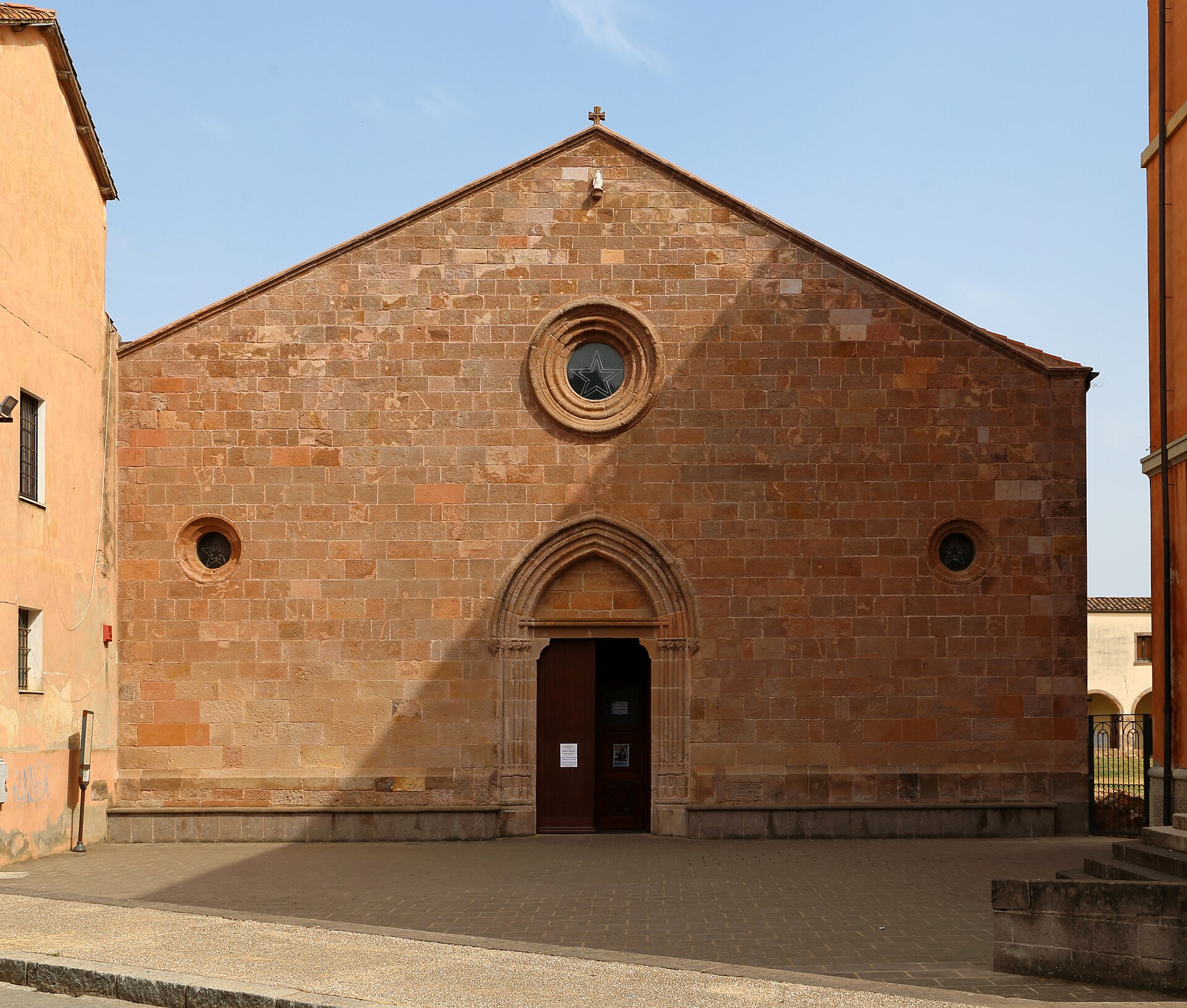
A Franciscan church of red trachyte in the old town of Iglesias, one of the most intact Catalan Gothic buildings in Sardinia, beside the surviving fragments of its cloister.
At a glance
San Francesco stands in the medieval centre of Iglesias, in south-western Sardinia. The church and the remains of its convent are among the most valuable traces left on the island by the Friars Minor Conventual. The restored cloister is now the seat of the town’s Pro Loco.
History
The Franciscans reached Iglesias in the early fourteenth century, by concession of Pope John XXII and with the backing of King James II of Aragon. The present church is a sixteenth-century rebuilding of the earlier one. A capital and the holy-water stoup carry the year 1558.
After the Savoy state suppressed the religious orders, a royal decree closed the church in 1899 and handed it to the town. It served as a barracks and a bakery and came close to demolition in 1914. Worship resumed in 1928, and the friars returned in 1935.
What you see
The facade is a plain wall of red trachyte, broken only by a rose window above the portal and two small round windows. Inside, pointed diaphragm arches divide the single nave into bays under an exposed timber roof. Seven raised chapels open on each side. The square presbytery, raised above the nave, closes under a star vault with a hanging boss. Its main treasure is a polyptych of about 1560, attributed to the Cagliari painter Antioco Mainas.
Of the cloister, only the perimeter walls and part of a portico beside a tower remain. It was used as an air-raid shelter in the 1940s.
Key facts
- Order: Friars Minor Conventual, in Iglesias since the early 14th century
- Church: 16th-century rebuilding in Catalan Gothic style; dated inscription 1558
- Plan: single nave with pointed diaphragm arches, seven chapels on each side, star-vaulted presbytery
- Artwork: polyptych of about 1560 attributed to Antioco Mainas
- Cloister: 14th-century fragments with round arches in pink trachyte, restored
- Address: Piazza San Francesco 1, 09016 Iglesias (SU), Italy; the cloister is on Via Crispi
- GPS: 39.312219, 8.532118 · Open in Google Maps
Practical information
San Francesco is a working church. The cloister can be visited with the Iglesias Old Town Tour ticket, or with a combined ticket that includes the Civic Museums. During Monumenti Aperti 2025 the church was opened with guided tours by the Associazione Amici di San Francesco. Hours change: check with the Iglesias tourist office before visiting.
Getting there
The church lies in the south-western part of the historic centre, near Piazza Municipio. On foot it is reached from Via Satta and Via Don Minzoni.
Sources
- Sardegna Cultura, Iglesias, Chiesa di San Francesco
- Sardegna Turismo, San Francesco, Iglesias
- Iglesias Turismo, Church of San Francesco and Cloister of San Francesco
- Pro Loco Iglesias, Chiostro di San Francesco
- FAI, I Luoghi del Cuore, Convento di San Francesco
- Monumenti Aperti 2025, Chiesa di San Francesco
- Wikipedia (it), Chiesa di San Francesco (Iglesias)
Find it on the map
See this place and what’s around it →📷 Become a Cultural Heritage Online photographer
Share your photos of places: they stay published under your name as the author. The more they're seen, the more you get noticed — and soon a contest will reward the most appreciated photos.
Log in or sign up free to add a photoIs this page about you?
This page is read by travellers and heritage enthusiasts who find it on Google. Tell us how you are connected to this place and we will take it from there.