
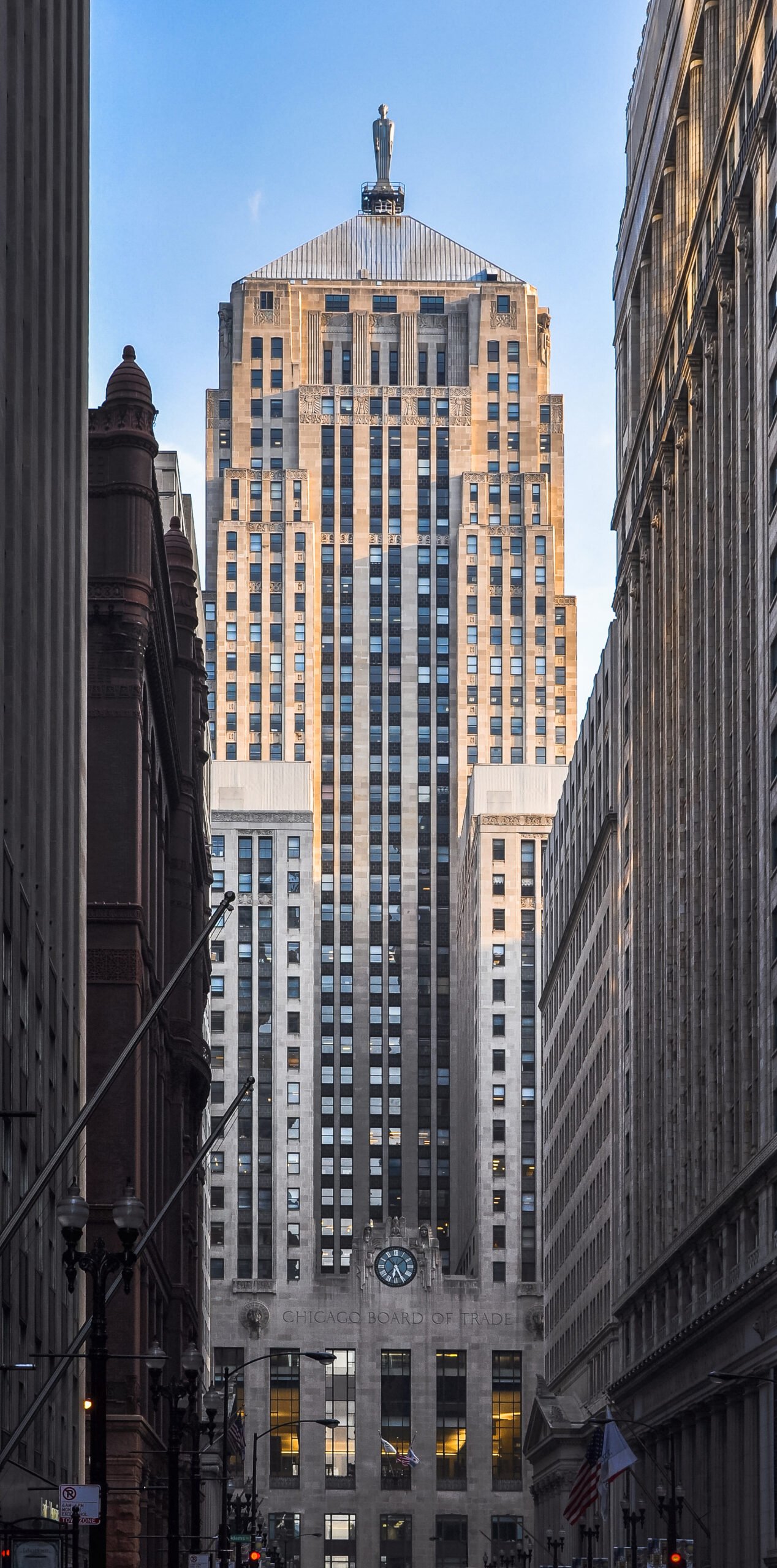
A 44-storey Art Deco tower closing the LaSalle Street canyon, crowned by a faceless aluminium goddess of grain who has watched over Chicago’s markets since 1930.
At a glance
The Chicago Board of Trade Building rises 44 storeys, about 605 feet, at the foot of the LaSalle Street “canyon” in the Loop. Built in 1930 to designs by Holabird & Root, it was the tallest building in Chicago until 1965 and remains one of the city’s defining Art Deco skyscrapers. It was raised for the Chicago Board of Trade, the grain and commodities exchange that has occupied the site since 1885, and it still functions as a trading and office building. At its summit stands a 31-foot aluminium statue of Ceres, the Roman goddess of agriculture.
Key facts
- Built: 1930
- Architects: Holabird & Root
- Style: Art Deco
- Height: 44 storeys, about 605 ft (184 m) — tallest in Chicago until 1965
- Address: 141 West Jackson Boulevard, Chicago, Illinois 60604, USA
- GPS: 41.878125, -87.632250 — Open in Google Maps
- Rooftop: 31-ft aluminium statue of Ceres by John Storrs
History
The Board of Trade has stood at the foot of LaSalle Street since 1885, when a building by William W. Boyington occupied the site; for a decade it was the tallest in Chicago. By the 1920s that structure was failing, and it was demolished in 1929. Holabird & Root designed its replacement, completed in 1930 at the depth of the Depression — a confident Art Deco statement at a moment of economic collapse.
The new tower closed the vista down LaSalle Street, the spine of Chicago’s financial district, and became the city’s tallest building for thirty-five years. It was designated a Chicago Landmark in 1977 and listed on the National Register of Historic Places. The trading floors inside, long the loudest rooms in the city, were the heart of American commodities markets through the twentieth century.
What you see
The building steps back as it rises, in the setback profile Deco skyscrapers took from 1920s zoning, narrowing to a pyramidal cap. The limestone front is carved with stylised figures, and a great clock flanked by hooded statues — a Native American holding corn and a figure holding wheat — sits above the entrance. The whole composition aims straight up the LaSalle canyon.
At the very top stands John Storrs’s aluminium Ceres, goddess of grain, raised in 1930. The story long told is that she was left featureless because the sculptor assumed no taller building would ever overlook her — and for thirty-five years none did. Inside, the lobby is a three-storey Deco room of marble, nickel and glass.
Practical information
- Access: A working office and trading building; the lobby may be viewed during business hours, subject to security
- Best view: Looking south down LaSalle Street, where the tower closes the canyon
- Best light: Late afternoon, when the western sun catches the cap and statue
- Time needed: 15–20 minutes from the street
Getting there
The building is at 141 West Jackson Boulevard, in the Loop. The CTA “L” stops at LaSalle/Van Buren and Quincy are a short walk away, and the LaSalle Street commuter station is adjacent. From most of the Loop, walk south along LaSalle Street and the tower stands directly at its end.
Nearby
- The Rookery and the LaSalle Street financial district
- Carbide & Carbon Building — Chicago’s other great Art Deco tower, on Michigan Avenue
- The Chicago Loop “L” and the Art Institute, to the east
Sources
- City of Chicago — Chicago Landmark designation (1977)
- National Register of Historic Places — building nomination
- Art Institute of Chicago — documentation on Holabird & Root and John Storrs
Find it on the map
See this place and what’s around it →Record researched and written by Luigi De Marchi for Cultural Heritage Online, 2026.
📷 Become a Cultural Heritage Online photographer
Share your photos of places: they stay published under your name as the author. The more they're seen, the more you get noticed — and soon a contest will reward the most appreciated photos.
Log in or sign up free to add a photoIs this page about you?
This page is read by travellers and heritage enthusiasts who find it on Google. Tell us how you are connected to this place and we will take it from there.