
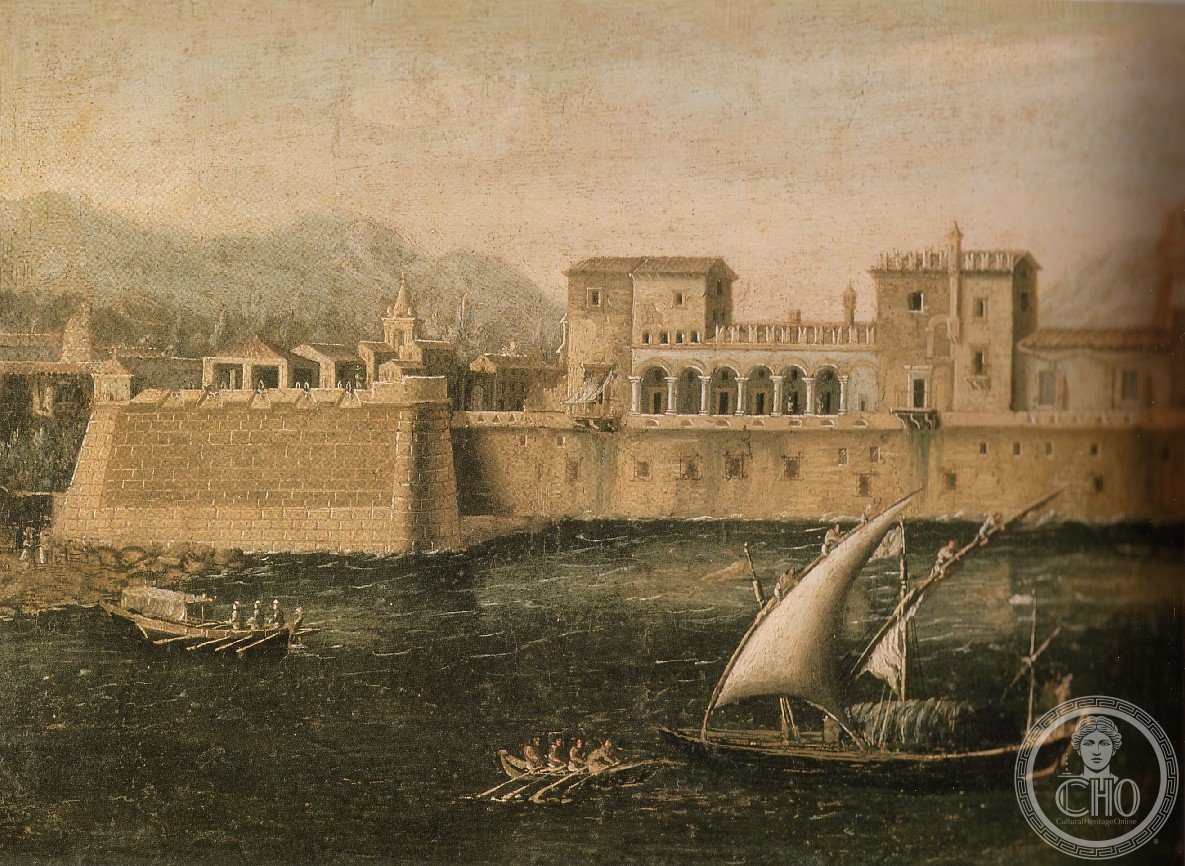
Castle at the Sea (Castellammare di Palermo)
The Castellammare — the Castle at the Sea — is a ruined Norman-era fortress that once guarded the northern harbour entrance of Palermo, the capital of Sicily. Built in the 11th century under Roger I and expanded under subsequent Swabian and Aragonese rulers, the castle served for six centuries as the primary military control point of Palermo’s port. Largely demolished in the late 19th century during urban expansion works, only fragmentary walls and a surviving tower remain, preserving the memory of one of Sicily’s most strategically important medieval strongholds.
At a glance
- Type
- Ruined Norman sea castle (partial remains)
- Period
- 11th century (Norman construction); demolished 1860s–1880s
- Style
- Norman military architecture with Swabian and Aragonese modifications
- Location
- Piazza Castellammare, Palermo, Sicily
- Coordinates
- 38.1221° N, 13.3671° E
Overview
Palermo’s Castellammare occupied the northwestern corner of the ancient city’s waterfront, guarding the natural harbour known in antiquity as the Cala. Its name — Castle of the Sea — reflects its original function as a maritime fortification. Together with the city walls, it completed a defensive perimeter that made Palermo one of the best-protected ports in the medieval Mediterranean. The castle gave its name to the surrounding district, Castellammare, as well as to the town of Castellammare del Golfo further west along the Sicilian coast.
History
The earliest fortification on the site is attributed to the Arab period (9th–10th century), when Palermo served as the Emirate of Sicily’s capital. After the Norman conquest of 1072, Roger I rebuilt and significantly expanded the coastal fortifications, integrating the castle into a comprehensive harbour defence system. The castle was further modified under Frederick II (13th century) and the Aragonese rulers of Sicily (14th–15th century), acquiring additional towers and a permanent garrison. Following Italian unification, the port of Palermo was modernised and the castle — considered an obsolete impediment to harbour traffic — was progressively demolished between the 1860s and 1880s.
What you see
Only a single surviving tower of the original complex remains standing at the Piazza Castellammare, incorporated into later urban fabric. Historical engravings and photographs from the 18th and 19th centuries document the full extent of the fortress before demolition: a substantial complex of towers, curtain walls and gate structures extending along the waterfront. The Piazza Castellammare itself preserves the urban memory of the castle through its name and layout, and periodic archaeological excavations have uncovered medieval and Norman-era masonry beneath the square.
Cultural significance
The Castellammare of Palermo represents a lost chapter of Sicily’s Norman heritage — a dynasty whose architecture (the Palatine Chapel, Monreale, Cefalù Cathedral) is celebrated as among the finest of the medieval Mediterranean. The castle’s near-total demolition in the 19th century has made it a reference point in Italian debates about heritage loss during the Risorgimento era. The surviving tower and buried foundations are protected under Italian cultural heritage legislation.
Practical information
- Address
- Piazza Castellammare, 90133 Palermo PA, Sicily
- Opening hours
- Public square accessible at all times; surviving tower exterior viewable from the street
- Admission
- No admission fee for exterior viewing
Getting there
Piazza Castellammare is in the historic centre of Palermo, near the Cala harbour and the Kalsa district. By public transport: AMAT buses serving the historic centre stop nearby. By car: a ZTL (restricted traffic zone) applies to much of the historic centre; park outside the zone and walk. Palermo Centrale railway station is approximately 1.5 km south; Falcone–Borsellino Airport is 35 km west via the A29 motorway.
Sources & resources
Find it on the map
See this place and what’s around it →📷 Diventa un fotografo di Cultural Heritage Online
Condividi le tue foto dei luoghi: restano pubblicate con la tua firma come autore. Più vengono viste, più ti fai conoscere — e presto un concorso premierà le foto più apprezzate.
Accedi o registrati gratis per aggiungere una foto