
Castelseprio-Torba
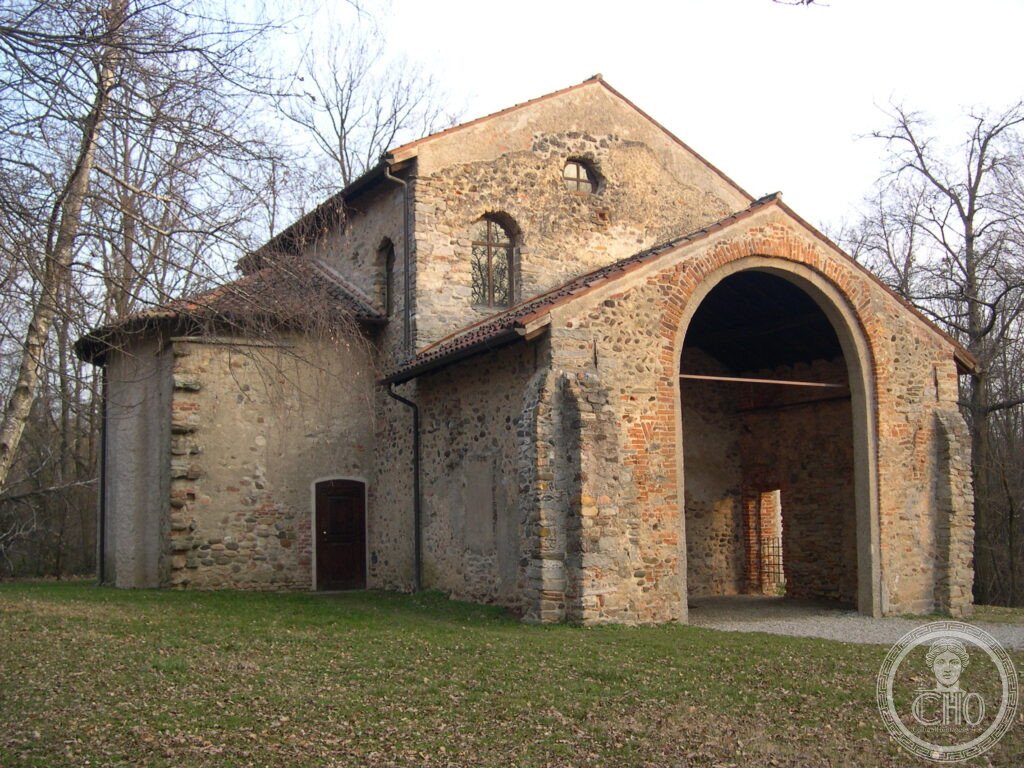
Castelseprio (UNESCO 2011, rif. 1312) è il sito longobardo più misterioso d’Italia — una piccola chiesa in rovina nella boscaglia lombarda contenente affreschi del VII–IX sec. CE di qualità abbastanza alta da aver fatto dubitare gli storici dell’arte per 70 anni sulla loro origine: Costantinopoli? Antiochia? Un’enigmatica bottega locale di straordinaria raffinatezza?
At a glance
Castelseprio Varese Lombardia (the most precisely Castelseprio zone Castelseprio Varese Lombardia Italy 45.7036 N 8.8711 E UNESCO WHS 2011 reference 1312 Longobards in Italy, Places of the Power: the Castelseprio-Torba component (the 2-part site: (1) Castelseprio (the archaeological park: the ruins of the Lombard castrum of Sibrium (the Roman-era name), rebuilt by the Lombards in the 6th century CE as a military castrum (the “castrum Sibriae”): destroyed by the Archbishop of Milan Giovanni Visconti in 1287 CE as punishment for the town’s alliance with the Torriani faction: the ruins cover 25 ha of woodland; the key monument: the church of Santa Maria foris portas (the “Santa Maria outside the gates”: a pre-existing church that was outside the walls of the castrum in a clearing in the wood)); (2) Torba (the Monastery of Torba (Monastero di Torba): 2 km south of Castelseprio: the earliest complex (4th–5th century CE: the Roman defensive tower and the Roman barracks were converted into a Benedictine monastery in the 8th century CE): the tower (the 4-story tower: the oldest element of the complex, built in the 4th century CE as a Roman military watchtower over the Via Settimia (the Roman road from Milan to the Alpine passes): the tower was converted into a church + nuns’ residence (the inscriptions on the tower walls: the names + drawings of the Benedictine nuns of the 8th–9th century CE = the only surviving signature graffiti of medieval monastic women in Italy))); the church (Santa Maria foris portas: the structure: a small church (11 m × 8 m) in Lombard style (the 3-apsed plan: the central apse + 2 side apses; the barrel-vaulted nave; the entrance porch): the frescoes (discovered in 1944 CE by Gian Pietro Bognetti, while the church was being used as a stable by local farmers during WWII: the plaster had been whitewashed over by the 16th century CE; the whitewash protected the frescoes until their re-discovery)).
Key facts
- Gli affreschi di Santa Maria foris portas e il “problema Castelseprio”: la controversia artistica più antica della storia dell’arte medievale italiana: the frescoes of Santa Maria foris portas (the cycle of frescoes in the main apse and the triumphal arch of Santa Maria foris portas: the content: the infancy of Christ (the Annunciation + the Nativity + the Presentation in the Temple + the Baptism of Christ + the angel appears to Joseph + the Magi before Herod); the style (the stylistic characteristics that set the Castelseprio frescoes apart from all other early medieval painting in Italy: (1) the volumetric modeling of the figures: the figures are modeled in chiaroscuro (light and shadow) in a way that anticipates the style of Giotto (c.1267–1337 CE) by 300–600 years; (2) the classical pose of the figures: the Annunciation Virgin (the Virgin is painted in a classical contrapposto (the counter-balancing of the body weight): a pose not seen in Italian art between the collapse of the Roman Empire and Giotto; (3) the landscape elements: the rocks and trees behind the figures are painted in a spatial (3-dimensional) way that is unique in early medieval Italian painting; the date controversy (the “Castelseprio problem”: since Bognetti’s 1944 CE discovery, scholars have proposed dates ranging from the 5th century CE (early Byzantine: Ernst Kitzinger 1966) to the 10th century CE (post-Carolingian: Kurt Weitzmann 1971) to the 7th century CE (Lombard period: Bognetti 1948); the current consensus (the majority of scholars currently date the frescoes to the 7th–8th century CE (the Lombard period) and attribute them to a Syro-Palestinian workshop (the “Near Eastern hypothesis”): the specific technique of the volumetric modeling is best paralleled by contemporary Syrian manuscript illumination))
- GPS (Santa Maria foris portas, Castelseprio): 45.7036° N, 8.8711° E; Monastero di Torba: 45.6944° N, 8.8717° E
History
Da castrum romano al UNESCO 2011 (the most precisely Castelseprio zone history: the Roman origin (the castrum Sibriae: the Roman military outpost on the road from Milan (Mediolanum) to the Alpine passes: the archaeological evidence: the Roman road (the Via Settimia: the road from Mediolanum to Verbania via the Simplon pass) passed through the site; the Lombard takeover (the Lombard conquest of 569 CE: the Lombards took the Roman military complex at Castelseprio and rebuilt the walls and watchtowers; the conversion of the Roman barracks at Torba into a Benedictine monastery: the transition from military use to monastic use happened between the 6th and 8th century CE (the Lombard kings favored the Benedictine order: the Lombard queen Theodolinda (c.570–628 CE) was the great patron of Benedictine monasticism in Lombardia)); the destruction (1287 CE: Archbishop Giovanni Visconti of Milan ordered the complete destruction of the castrum of Castelseprio as punishment for the town’s support of the Torriani faction in the Milan civil war: the destruction was so complete that the site was never rebuilt; the church of Santa Maria foris portas survived only because it was outside the walls; by the 14th century CE it was abandoned and used as a stable by local farmers: the whitewashing of the frescoes by the 16th century CE preserved them until 1944 CE); the UNESCO inscription (2011 CE: reference 1312).
What you see
Santa Maria foris portas (3 absidi, affreschi VII-IX sec. CE, riservata a visita guidata), Monastero di Torba (torre IV sec. CE + graffiti monache VIII-IX sec. CE, FAI), rovine castrum Lombardo (25 ha bosco) (the most precisely Castelseprio zone visit (3h): the combined visit: Castelseprio archaeological park + Torba monastery; the logistics: the church of Santa Maria foris portas is only accessible by guided tour (the key is held by the Soprintendenza ai Beni Culturali di Varese: the tour must be booked in advance: phone +39 0332 706226 or email to sbap-va.castelseprio@beniculturali.it; tours are available Saturday and Sunday 10:00–13:00 (spring-summer) and by appointment; the price: €5); if the church is closed: the archaeological park is always open (free entry; the ruins of the Lombard castrum: the walls + the church of San Giovanni Evangelista (the Lombard church: only the apse survives); the Monastero di Torba (Via Torba 4, Gornate-Olona: 2 km south of Castelseprio; managed by the FAI (Fondo Ambiente Italiano): the property was donated to the FAI by Contessa Anastasia Stampa di Soncino in 1977 CE: the first FAI property; €8; 10:00–18:00 Tue-Sun Mar-Oct); the visit (the Roman tower (4 floors: the bottom floor with the Roman masonry visible; the 2nd floor with the frescoes of the Lombard period (8th century CE); the 3rd floor with the Benedictine nuns’ inscriptions (the graffiti: names + drawings scratched into the plaster: “Teutperga ora” = “Teutperga pray for us”)); the cloistered garden).
Practical information
- Come raggiungere Castelseprio da Milano e Varese, e come prenotare la visita guidata agli affreschi di Santa Maria foris portas: il trasporto (Milano Cadorna → Varese: Trenord (45 min; €4.10; ogni 30 min; dalla stazione di Varese: bus CTPI per Castelseprio (30 min; €1.70; 3 corse/giorno) oppure taxi (€15)); Milano Malpensa aeroporto T1 → Castelseprio: taxi (€25; 20 min: il sito è 5 km dall’aeroporto)); la prenotazione (la visita agli affreschi DEVE essere prenotata per telefono (+39 0332 706226) o email (sbap-va.castelseprio@beniculturali.it); orari disponibili: sabato-domenica 10:00–13:00 (marzo–ottobre); l’alternativa: contattare il FAI del Monastero di Torba che può facilitare l’accesso con prenotazione; il costo: €5 (affresco) + €8 (Monastero Torba)); il programma mezza giornata: 10:00 visita guidata Santa Maria foris portas (45 min: l’abside + il programma iconografico + la spiegazione del “problema stilistico”) → 11:00 passeggiata al castrum (25 ha bosco: le mura longobarde + la chiesa di San Giovanni Evangelista (solo l’abside): 1h) → 13:00 pranzo (i ristoranti nel borgo di Castelseprio: la cucina delle Prealpi lombarde: la polenta taragna (la polenta di grano saraceno + formaggio sciur + burro) + il salame di Varzi (DOP))
Getting there
Trenord da Milano Cadorna a Varese (45 min, €4.10) poi bus CTPI (30 min, €1.70). GPS Santa Maria foris portas: 45.7036/8.8711. Prenotazione obbligatoria: +39 0332 706226. €5. Monastero Torba (FAI): €8 (10:00–18:00 mar-dom, mar-ott).
Nearby
- Sacro Monte di Varese (UNESCO 2003 rif. 1068 — 14 cappelle 1604–1703 CE; Via Sacra 2 km) — 10 km (bus da Varese; il Sacro Monte di Varese: le 14 cappelle di dedica mariana (la Vita della Madonna); il panorama dalla sommità (Santa Maria del Monte 879 m): le Alpi e il Lago di Varese)
- Abbazia di San Gemolo (IX sec. CE, Ganna, Varese — cripta longobarda) — 15 km (l’abbazia di Ganna (829 CE: fondata da Liutaldo; ricostruzione romanica XI sec. CE); la cripta (IX sec. CE: le colonne con capitelli longobardi; l’iscrizione dedicatoria del 1095 CE))
Gallery
Sources
- Wikipedia, Santa Maria foris portas; Torba monastery; Castelseprio, accessed June 2026
- UNESCO, Longobards in Italy, Places of the Power, WHS reference 1312, inscribed 2011
- Bognetti, Gian Piero; Chierici, Gino; De Capitani d’Arzago, Alberto. Santa Maria di Castelseprio. Milan: Fondazione Treccani degli Alfieri, 1948
Find it on the map
See this place and what’s around it →📷 Diventa un fotografo di Cultural Heritage Online
Condividi le tue foto dei luoghi: restano pubblicate con la tua firma come autore. Più vengono viste, più ti fai conoscere — e presto un concorso premierà le foto più apprezzate.
Accedi o registrati gratis per aggiungere una foto