
Carbonia
A twentieth-century mining city transformed into a cultural hub, where industrial heritage meets Phoenician archaeology and Sardinian prehistory across millennia.
At a glance
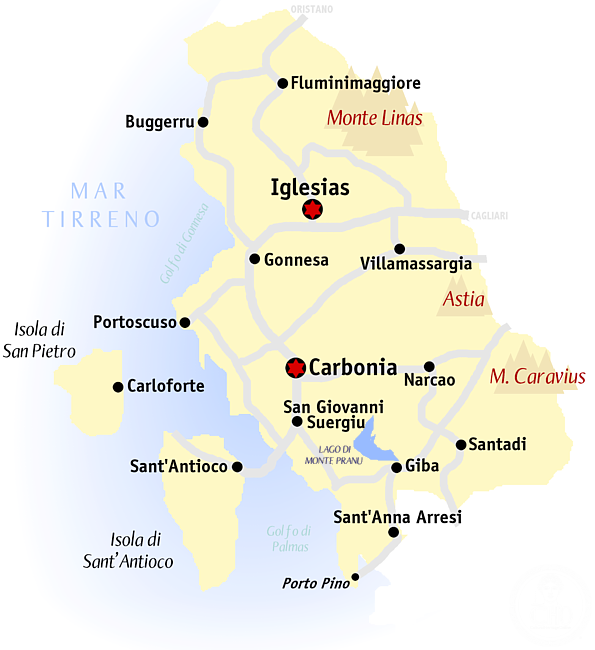
Carbonia is the ninth-largest city in Sardinia and the main center of the Sulcis region. Born in 1938 as a planned settlement for coalfield workers, it now houses approximately 30,000 residents. Wide tree-lined streets frame the city, anchored by the 45-meter bell tower of the Church of San Ponziano, its granite and trachyte façade dominating the urban landscape.
History
Founded in 1938 and constructed within two years, Carbonia was purpose-built to accommodate workers extracting coal from the Sirai-Serbariu mines, then vital to Italy’s energy supply. The basin operated from 1937 to 1964 with nine wells and 100 kilometers of tunnels. Carbonia became a center of labor struggle: between 1940 and 1943, miners led the first strike in Sardinia during the Fascist period. A two-month “white strike” in late 1948 against management’s repressive measures sparked a national solidarity movement, ultimately securing workers’ gains. The city replaced a nineteenth-century village, incorporated as a district, and grew to 48,000 residents by 1949—the historical peak.
What you see
The urban plan reflects its industrial origins: regularized streets and civic spaces designed for a working community. The Church of San Ponziano anchors the townscape with its imposing bell tower. The disused Serbariu mine now houses the Coal Museum, a faithful recreation of the mining world. The ethnographic museum documents agro-pastoral traditions. Archaeological sites frame the modern city: Mount Sirai, in a northwestern park, preserves houses, squares, a temple, and necropolises from the first Phoenician and later Carthaginian colony. The Villa Sulcis museum exhibits finds from the tophet (children’s cemetery) alongside Mesolithic artifacts from the rock shelter at Carropu, dating to 9000 BC.
Cultural significance
Carbonia embodies modern industrial heritage and working-class memory rarely preserved in European cities. Its labor history represents a pivotal moment in twentieth-century Italian labor organizing. The surrounding archaeological landscape spans from Mesolithic occupation through Roman settlement, making the region a palimpsest of Sardinian human occupation. The city hosts Mare e Miniere, an annual festival celebrating local culture through cinema, music, literature, and food traditions.
Key facts
- Address: Via Mazzini 39, 09013 Carbonia-Iglesias
- Coordinates: 39.163286, 8.5252013
- Population: approximately 30,000
- Rank: ninth-largest city in Sardinia
- Website: http://www.comune.carbonia.ci.it/urbiportal/home.html
- Phone: 0781 6726
Practical information
The Coal Museum at Serbariu and Villa Sulcis museum offer access to industrial and archaeological heritage. The ethnographic museum documents regional traditions. Opening hours and admission fees are not listed; check the official website or contact the municipality.
Getting there
Carbonia is located in south-western Sardinia within the Carbonia-Iglesias province. For transport options and detailed directions, consult the official municipal website or contact the municipality at the number provided.
Sources & resources
Find it on the map
See this place and what’s around it →📷 Diventa un fotografo di Cultural Heritage Online
Condividi le tue foto dei luoghi: restano pubblicate con la tua firma come autore. Più vengono viste, più ti fai conoscere — e presto un concorso premierà le foto più apprezzate.
Accedi o registrati gratis per aggiungere una foto