
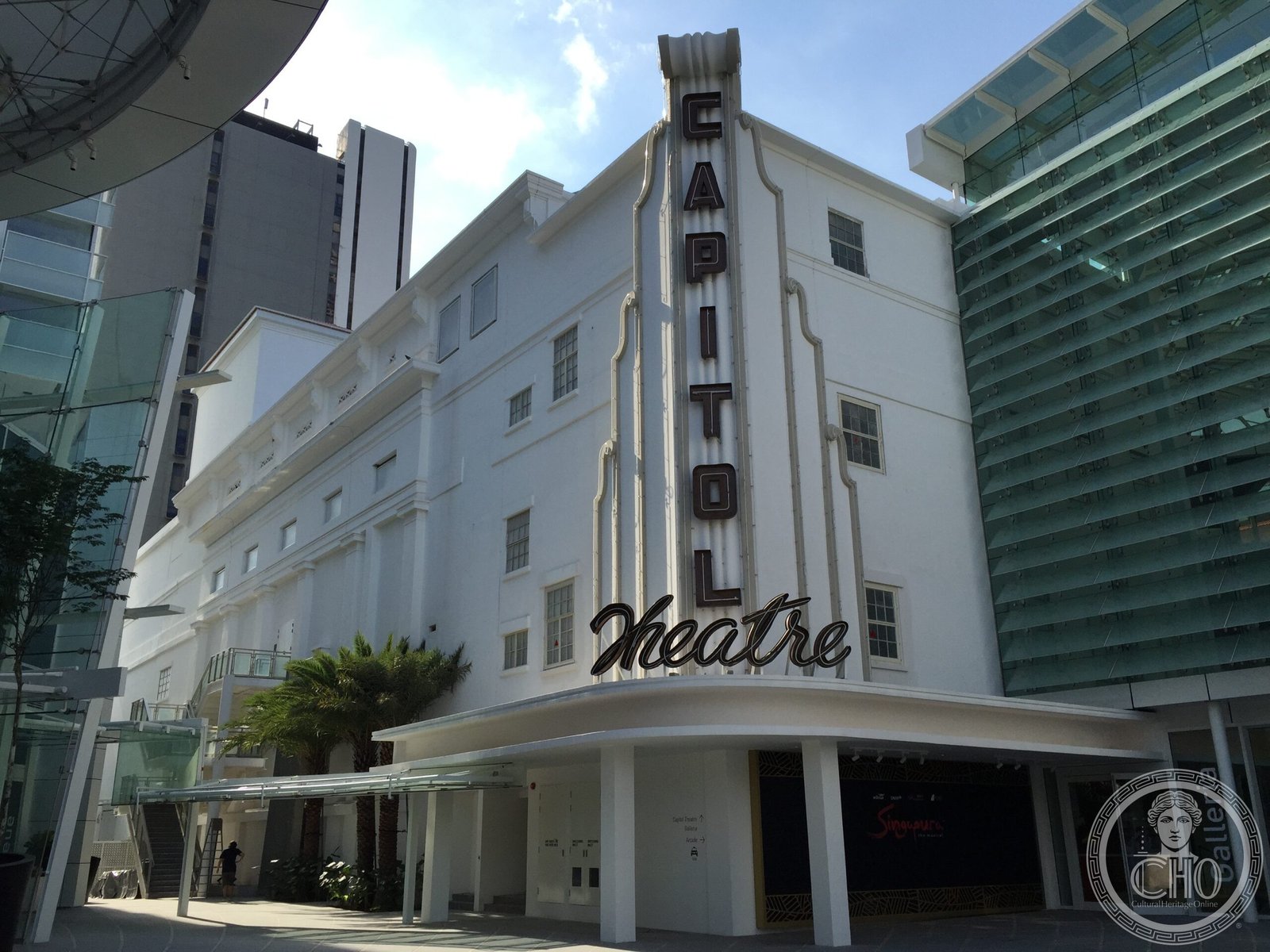
The Capitol Theatre on North Bridge Road is Singapore’s most glamorous surviving Art Deco entertainment venue, a gazetted national monument that has witnessed nearly a century of the city-state’s cultural and social history. Completed in 1930 to designs by the British firm Keys & Dowdeswell — led by P.H. Keys — it opened as a combined cinema, hotel, and retail complex at a prime intersection in Singapore’s Civic District, steps from St Andrew’s Cathedral and the colonial government buildings of the Padang. The building’s dramatic facade, with its soaring central tower crowned by a vertical fin of stepped decorative cornices, drew direct inspiration from the great American movie palaces of the 1920s — the Capitol Theatre of New York, the Paramount in Los Angeles, the Chicago Theatre. Inside, an auditorium originally seating 1,600, with elaborate plasterwork ceiling, crystal chandeliers, and one of Singapore’s first mechanical air-conditioning systems, offered a sensory experience of luxury that drew the city’s English-educated upper and middle classes and, from the late 1930s, audiences for Malay-language films shot in the studios of Shaw Brothers and Cathay-Keris. Gazetted as a national monument in 1992, the building underwent a full restoration (2014–2015) that integrated a new mixed-use development — Capitol Piazza — behind the preserved historic shell, allowing the theater to reopen as a fully equipped 600-seat performing arts venue.
At a glance
- Type
- Cinema / performing arts theater
- Period
- 1930
- Style
- Art Deco
- Location
- 17–19 Stamford Road, Civic District, Singapore
- Coordinates
- 1.2938° N, 103.8517° E
- Architect(s)
- P.H. Keys (Keys & Dowdeswell)
Overview
Capitol Theatre sits at the junction of North Bridge Road and Stamford Road, at the heart of Singapore’s colonial Civic District. Its white rendered facade, articulated by strong vertical piers and a dominant central tower with stepped Art Deco crown, forms a powerful urban marker visible from St Andrew’s Cathedral and the esplanade. The 2015 restoration by RSP Architects retained all significant heritage fabric while inserting a contemporary mixed-use podium behind it — a hybrid model that has since become a precedent for Singapore’s approach to adaptive reuse of gazetted monuments. The restored auditorium, reduced from 1,600 to 600 seats to meet modern acoustic and fire safety standards, serves as a venue for theatrical performances, screenings, and corporate events.
History
Capitol Theatre was built by the Namazie family, prosperous Singaporean merchants, on the site of the earlier Hotel de l’Europe. It opened in May 1930 as the most technically advanced cinema in Southeast Asia, with air conditioning, a Wurlitzer theatre organ, and a capacity of 1,600. Through the 1930s it was the premier venue for English-language Hollywood films and, from 1938, Malay-language productions from Bombay Talkies and the nascent Singapore film industry. During the Japanese occupation (1942–45) it continued operating as a cinema under Japanese administration. Post-war, it resumed as a commercial cinema and remained profitable through the 1970s before competition from suburban multiplexes eroded audiences. It was gazetted a national monument in 1992, halting demolition proposals, and subsequently purchased by Capitol Investment Holdings for restoration. A first restoration attempt stalled before the 2014–15 project by RSP Architects successfully integrated the heritage shell into a new development while restoring the original facade, foyer, and auditorium.
Architecture & Design
Keys & Dowdeswell’s design follows the American movie-palace model: a symmetrical street facade dominated by a central vertical tower, its surface articulated with horizontal banding, geometric ornament, and deep-set window reveals characteristic of late-1920s Art Deco. The tower crown — a stepped ziggurat profile with decorative fins — was the most distinctive feature of the Singapore skyline in its era. The original interior featured a fan-shaped auditorium with a shallow barrel-vaulted plaster ceiling richly ornamented with geometric and floral motifs, a proscenium arch framed by pilasters and a decorative grille, and a balcony supported by slender cast-iron columns. The 2015 restoration reconstructed missing ornamental elements using historic photographs and surviving plaster samples, and installed contemporary stage machinery and acoustics within the original spatial envelope.
Cultural significance
Capitol Theatre is inseparable from Singapore’s cultural coming-of-age as a colonial city. For a generation of Singaporeans born between the wars, attending a film at the Capitol — dressed formally, in a fully air-conditioned hall, beneath elaborate plasterwork — was an aspirational social ritual. The theater was the first public space in Singapore where Malay, Chinese, Indian, and European audiences regularly shared the same room, united by cinema. Its gazetting in 1992 was a landmark moment in Singapore’s heritage conservation movement, signalling that Art Deco entertainment buildings deserved protection alongside colonial administrative structures.
Visiting today
The restored Capitol Theatre is integrated into the Capitol Piazza mixed-use development and hosts live performances, private screenings, and events. The historic facade and lobby can be visited freely; performances require ticketing through venue booking systems. The surrounding Civic District offers St Andrew’s Cathedral, the National Museum of Singapore, the Asian Civilisations Museum, and the Padang within easy walking distance — one of Singapore’s finest heritage walking routes.
Getting there
Capitol Theatre is located on Stamford Road in the Civic District. The nearest MRT stations are City Hall (EW/NS Lines, 5 minutes on foot) and Bras Basah (CC Line, 3 minutes on foot). Numerous bus services run along North Bridge Road and Bras Basah Road. The building is a short walk from Raffles Hotel, CHIJMES, and the National Museum of Singapore.
Sources & resources
Find it on the map
See this place and what’s around it →Record researched and written by Luigi De Marchi for Cultural Heritage Online, 2026.
📷 Become a Cultural Heritage Online photographer
Share your photos of places: they stay published under your name as the author. The more they're seen, the more you get noticed — and soon a contest will reward the most appreciated photos.
Log in or sign up free to add a photoIs this page about you?
This page is read by travellers and heritage enthusiasts who find it on Google. Tell us how you are connected to this place and we will take it from there.