

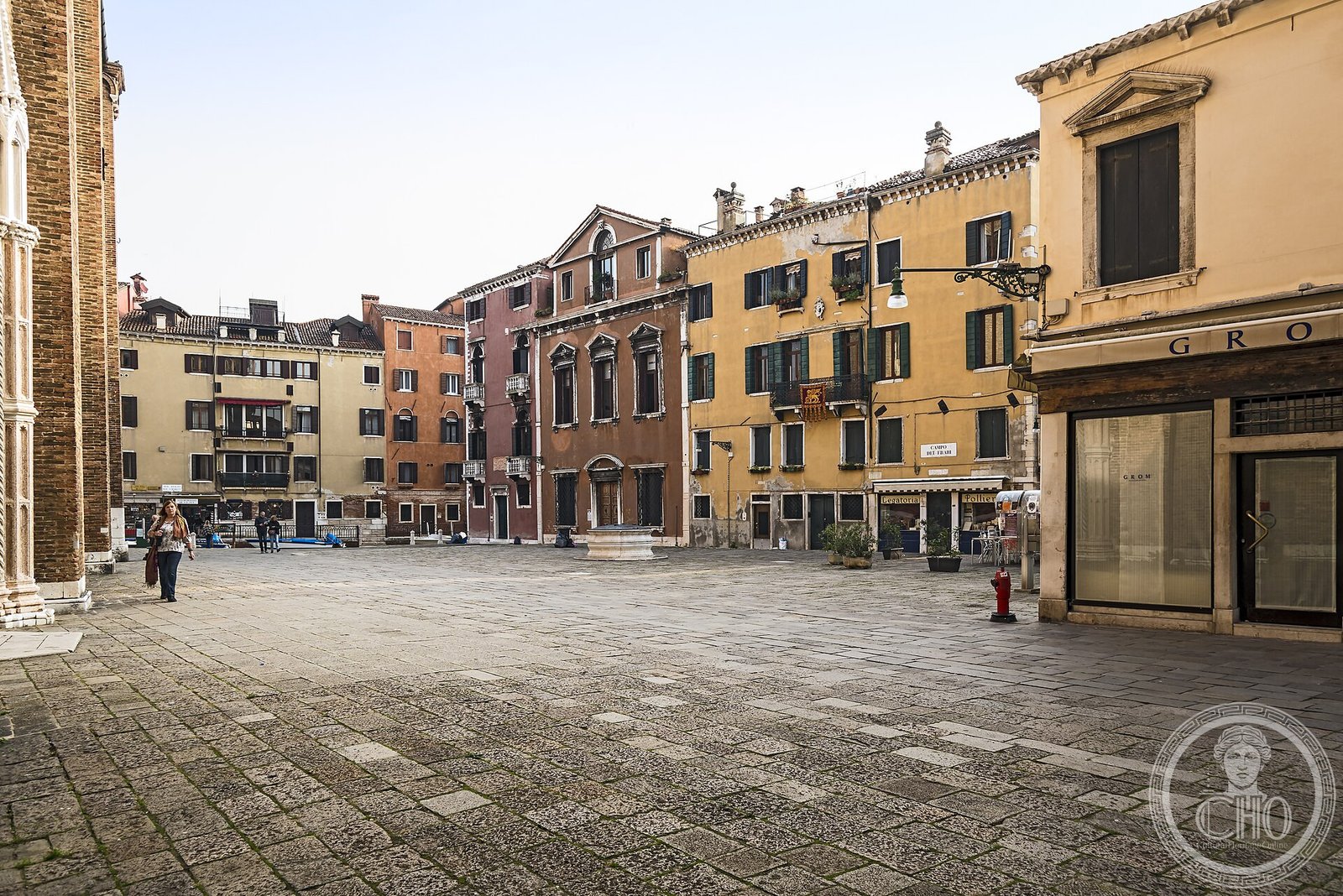
Campo dei Frari is the broad square at the heart of the San Polo district of Venice, dominated by one of the largest and most important Gothic churches in Italy: the Basilica di Santa Maria Gloriosa dei Frari. Founded by the Franciscan friars in the 13th century and rebuilt in its current monumental form between 1330 and 1443, the Frari basilica contains masterworks by Titian, Giovanni Bellini, and Donatello, making the campo one of the most art-rich squares in the world.
At a glance
- Type
- Public square (campo) and basilica precinct
- Period
- Church founded 13th century; current building 1330–1443
- Style
- Venetian Gothic
- Location
- San Polo sestiere, Venice
- Coordinates
- 45.4372° N, 12.3271° E
Overview
The Basilica di Santa Maria Gloriosa dei Frari, commonly known as the Frari, is a church located in the Campo dei Frari at the heart of the San Polo district of Venice. It is one of the largest churches in the city and holds the status of a minor basilica. The church is dedicated to the Assumption of Mary. Together with the adjacent Scuola Grande di San Rocco, this area forms the single greatest concentration of monumental art in Venice outside the Piazza San Marco.
History
The Franciscans arrived in Venice in the 13th century and built a first church on this site in 1250. The current structure was begun in 1330 and completed in 1443, representing nearly a century of Gothic construction. The building’s soaring brick nave, at 90 metres long and 28 metres wide, made it the dominant landmark of the San Polo district. Over the following centuries, noble Venetian families and doges endowed the interior with chapels, tombs, and altarpieces, turning it into a vast repository of Venetian art history.
What you see
The campo itself is an irregular open space paved in traditional Venetian stone, with the basilica’s long southern flank running along its edge. The church’s facade, completed in 1440, presents a restrained Gothic profile with three portals and a brick campanile — the second tallest in Venice. Inside, the most celebrated work is Titian’s Assumption of the Virgin (1516–18), displayed on the high altar, widely considered one of the greatest paintings in Italian art. The church also contains Titian’s own tomb, the tomb of Canova’s heart in a pyramid monument, and Giovanni Bellini’s Madonna and Child with Saints in the sacristy.
Cultural significance
The Frari is a UNESCO World Heritage Site as part of Venice and its lagoon. It represents one of the supreme achievements of Venetian Gothic architecture and is unequalled as a collection of Venetian Renaissance painting in its original church context. Titian’s Assumption is considered the work that established his international reputation.
Practical information
The basilica is open Monday to Saturday 9:00–18:00 and Sunday 13:00–18:00 (check official website for seasonal variations). Admission is charged; it is included in the Chorus Pass covering multiple Venetian churches. The campo is freely accessible at all times.
Getting there
Take vaporetto line 1 to San Tomà, the closest stop to the Frari. From the landing, follow signs north-west for approximately three minutes. The square is clearly signposted from the Rialto and Accademia areas and is a natural waypoint on any cross-Venice walk.
Sources & resources
Find it on the map
See this place and what’s around it →📷 Become a Cultural Heritage Online photographer
Share your photos of places: they stay published under your name as the author. The more they're seen, the more you get noticed — and soon a contest will reward the most appreciated photos.
Log in or sign up free to add a photoIs this page about you?
This page is read by travellers and heritage enthusiasts who find it on Google. Tell us how you are connected to this place and we will take it from there.