
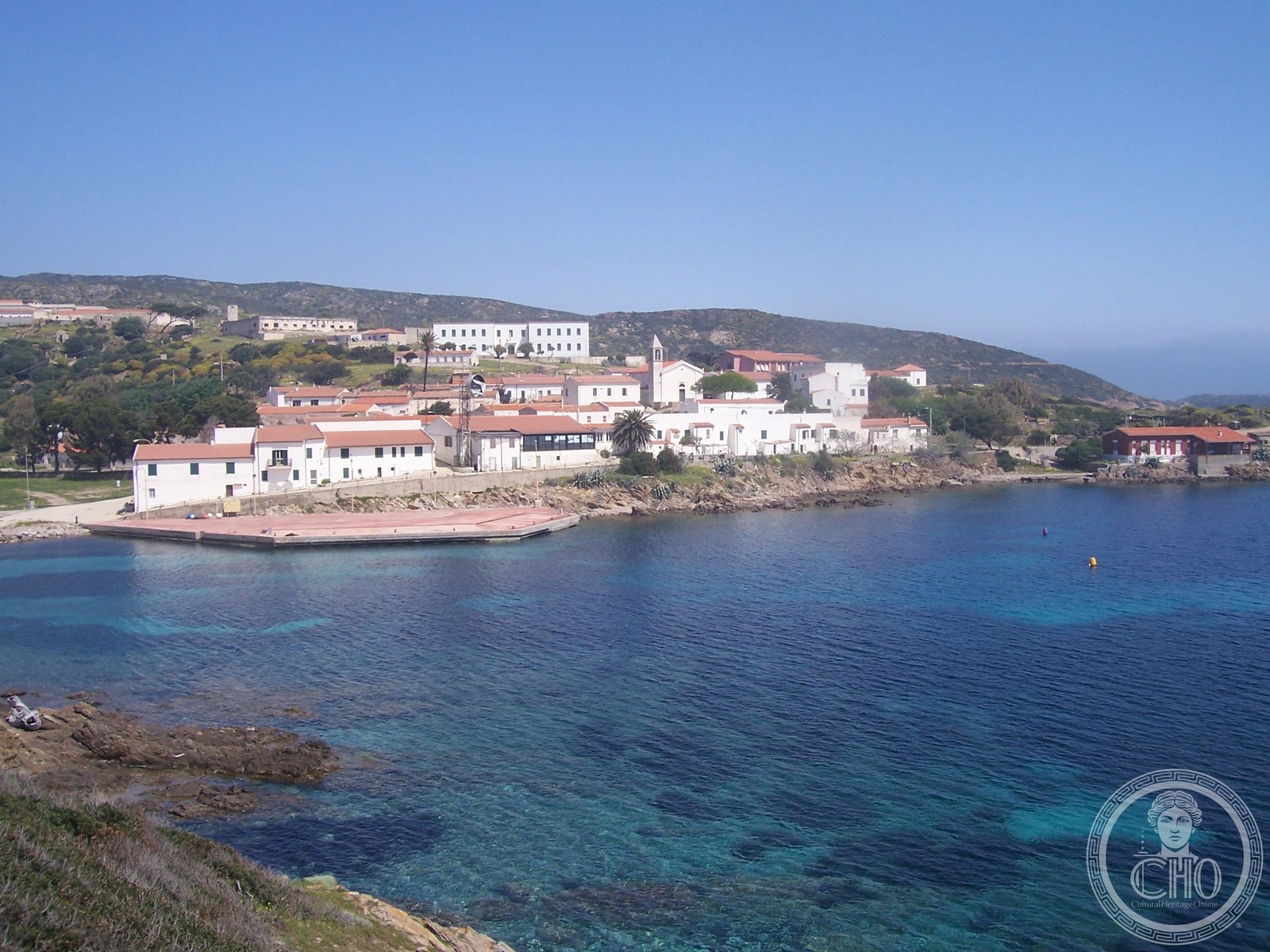
Cala d’Oliva
Cala d’Oliva is the only permanently inhabited locality on Asinara, a protected island of 52 km² off the north-western tip of Sardinia. Set around a sheltered inlet of exceptional clarity, the hamlet preserves the traces of successive institutional lives — a 19th-century quarantine station, a World War I prisoner-of-war camp, and one of Italy’s most secure prisons until 1998 — all now absorbed into the quiet landscape of a national park where wild albino donkeys roam the scrubland and the only traffic is foot and bicycle. A medieval coastal tower overlooks the bay from the headland above the settlement.
At a glance
- Type
- Coastal hamlet and natural inlet within a national park
- Period
- Inhabited since at least the early modern period; current structures mainly 19th–20th century
- Style
- Vernacular institutional architecture; quarantine and prison buildings in whitewashed stone
- Location
- Cala d’Oliva, Asinara island, Sassari, Sardinia, Italy
- Coordinates
- 41.0844° N, 8.3342° E
Overview
Asinara is the second-largest island in Sardinia, situated off Porto Torres and separated from the mainland by a narrow strait. Virtually uninhabited — the 2001 census recorded a single resident — the island became a national park in 1998 after the closure of its high-security prison and is now managed as a wildlife and marine reserve. Cala d’Oliva, located on the island’s sheltered eastern flank, functions as the park’s operational base, home to ranger facilities, a visitor centre, and the small cluster of buildings that once housed prison administration.
History
From the 19th century, Asinara was used as a lazaretto (quarantine station), isolating travellers suspected of carrying cholera and other epidemic diseases. During World War I the island received thousands of Serbian soldiers and Austro-Hungarian prisoners of war, many of whom died there and are buried on the island. From the 1970s through 1997, Cala d’Oliva was the administrative heart of Italy’s Asinara Penitentiary, which housed organised crime bosses and political prisoners under the special 41-bis regime. The prison’s closure and the simultaneous creation of the national park in 1998 transformed Cala d’Oliva from a place of confinement into a centre for ecological tourism.
What you see
The hamlet today presents a small cluster of whitewashed buildings set back from the beach, a jetty for authorised boats, and the silhouette of the Cala d’Oliva coastal tower on the rise above the inlet. The water of the bay is among the clearest in the Mediterranean — protected from development and without motorised traffic, the marine environment has recovered fully. The albino donkeys descended from the island’s original working animals are a constant presence, and the surrounding maquis is dense with juniper, mastic, and wild olive.
Cultural significance
Cala d’Oliva condenses three centuries of Italian penal and public health history into a single landscape. Its layered institutional architecture — quarantine, internment, maximum-security prison — makes it a rare site where the history of the state’s use of isolation as a tool of governance remains physically legible. The transition to national park status has given this history a new frame, drawing visitors who come as much for the stories embedded in the buildings as for the exceptional natural environment.
Practical information
- Access
- Asinara is accessible only by authorised boat; private vehicles are prohibited on the island. Guided tours and licensed boat services depart from Porto Torres and Stintino.
- Opening hours
- Check the official Parco Nazionale dell’Asinara website for current visiting permits and seasonal timetables.
- Admission
- Entry to the island requires a national park permit; fees vary by season and tour type.
Getting there
Boat services to Asinara operate seasonally from Porto Torres (approx. 30 minutes) and Stintino (approx. 20 minutes), both on the north-western coast of Sardinia. Porto Torres is linked to Sassari by rail and to the SS131 state road. The closest airport is Alghero-Fertilia (AHO), approximately 55 km to the south, with connections to major Italian and European cities.
Sources & resources
- Wikipedia: Asinara
- Wikipedia: Asinara National Park
- Official park site: parcoasinara.org
- Cultural Heritage Online
Find it on the map
See this place and what’s around it →📷 Diventa un fotografo di Cultural Heritage Online
Condividi le tue foto dei luoghi: restano pubblicate con la tua firma come autore. Più vengono viste, più ti fai conoscere — e presto un concorso premierà le foto più apprezzate.
Accedi o registrati gratis per aggiungere una foto