
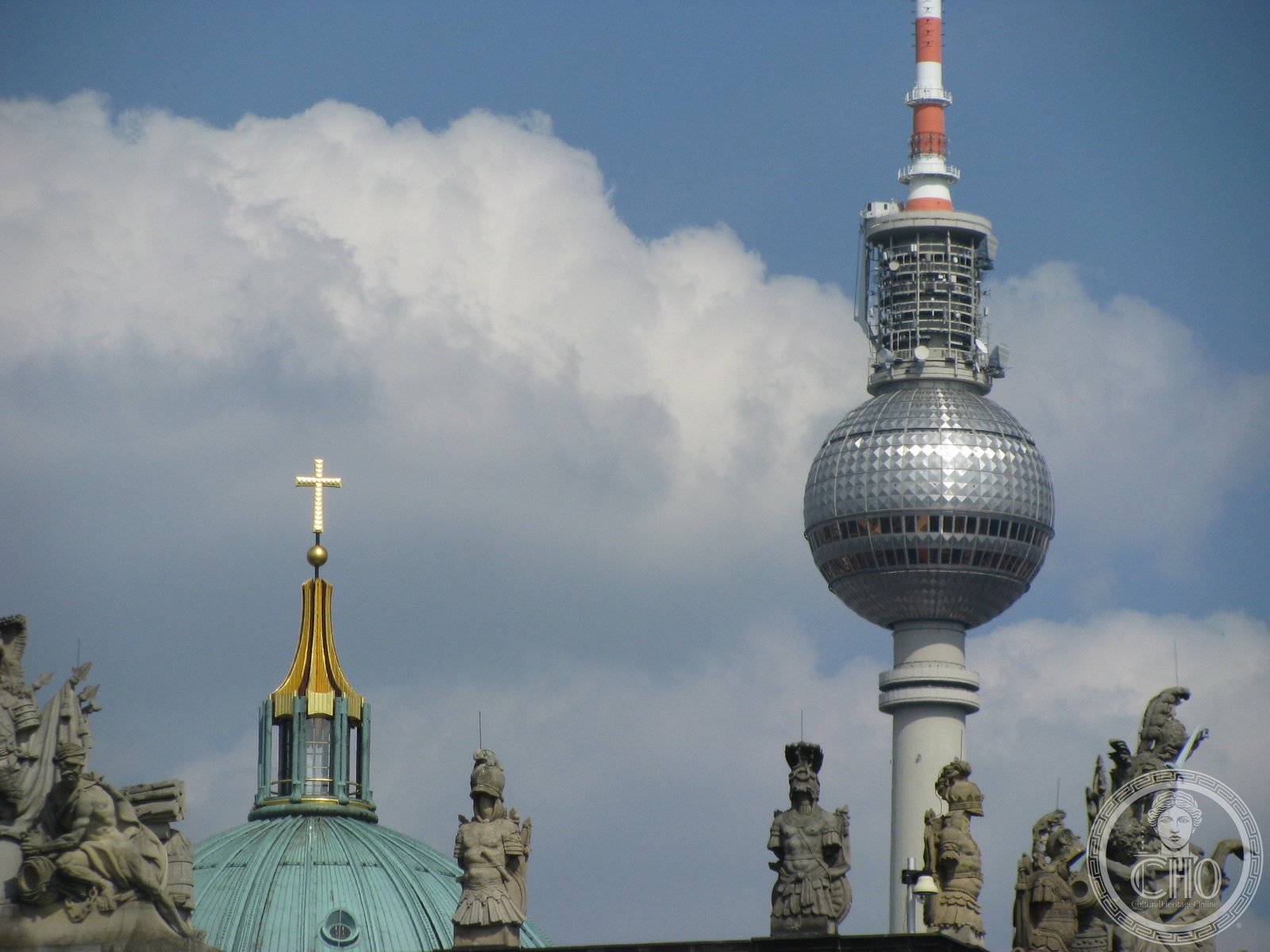
Berlin TV Tower (Berliner Fernsehturm)
The Berliner Fernsehturm is a 368-metre television tower in the heart of Berlin, constructed between 1965 and 1969 by the government of the German Democratic Republic as both a functional broadcasting facility and a highly visible symbol of socialist achievement. It remains the tallest structure in Germany and one of the most recognisable landmarks in Europe.
At a glance
- Type
- Television and telecommunications tower
- Period
- Constructed 1965–1969; opened 3 October 1969
- Style
- Socialist Modernism; mid-century GDR architecture
- Location
- Alexanderplatz, Mitte, Berlin, Germany
- Height
- 368 metres (1,207 ft)
- Coordinates
- 52.5207° N, 13.4095° E
Overview
The Berlin TV Tower stands at Alexanderplatz in the Mitte district, visible from virtually every part of the city and from distances of up to 80 kilometres on clear days. It was conceived by the East German state as a demonstration of technological prowess during the Cold War, intended to project modernity and confidence onto the divided city’s skyline. Today it is the most-visited landmark in Germany, attracting over one million visitors annually to its observation deck and rotating restaurant.
History
Construction began in 1965 under the supervision of the East German Ministry of Posts and Telecommunications, with a team led by engineers Hermann Henselmann, Jörg Streitparth, and Günter Franke. The site at Alexanderplatz was chosen deliberately to ensure the tower would be visible across West Berlin. When it opened on 3 October 1969, it immediately became the tallest structure in Germany. A curious phenomenon, known informally as the “Pope’s Revenge,” was observed soon after completion: sunlight reflecting off the sphere produces a cross-shaped shimmer — an irony not lost on a state that suppressed religious expression.
What you see
The tower consists of a slender concrete shaft rising to a steel sphere at 203 metres, which houses the observation deck at 204 metres and the Telecafé revolving restaurant at 207 metres. The sphere, clad in stainless steel panels, completes one full revolution every 30 minutes. Above the sphere a further 160 metres of antenna mast carries broadcasting equipment for television and radio. The structure’s silhouette — a needle puncturing a ball — became an instantly recognisable icon of Berlin.
Cultural significance
Few structures encapsulate Cold War history as directly as the Fernsehturm: built to proclaim socialist superiority, it now serves as a shared symbol for reunified Berlin. It has been listed as a technical monument and features prominently in discussions of postwar European architecture and urban planning. Its image appears on countless artworks, films, and design objects associated with Berlin’s identity.
Practical information
- Address
- Panoramastraße 1A, 10178 Berlin, Germany
- Opening hours
- Open daily; check official website for seasonal hours
- Admission
- Paid entry to observation deck and restaurant; check official website for current prices
- Website
- tv-turm.de
Getting there
The tower is located directly at Alexanderplatz, one of Berlin’s major transport hubs. S-Bahn lines S3, S5, S7, S75, and S9 stop at Alexanderplatz, as do U-Bahn lines U2, U5, and U8. Numerous tram and bus lines also serve the square. The tower is a short walk from the eastern end of the plaza.
Sources & resources
Find it on the map
See this place and what’s around it →📷 Diventa un fotografo di Cultural Heritage Online
Condividi le tue foto dei luoghi: restano pubblicate con la tua firma come autore. Più vengono viste, più ti fai conoscere — e presto un concorso premierà le foto più apprezzate.
Accedi o registrati gratis per aggiungere una foto