
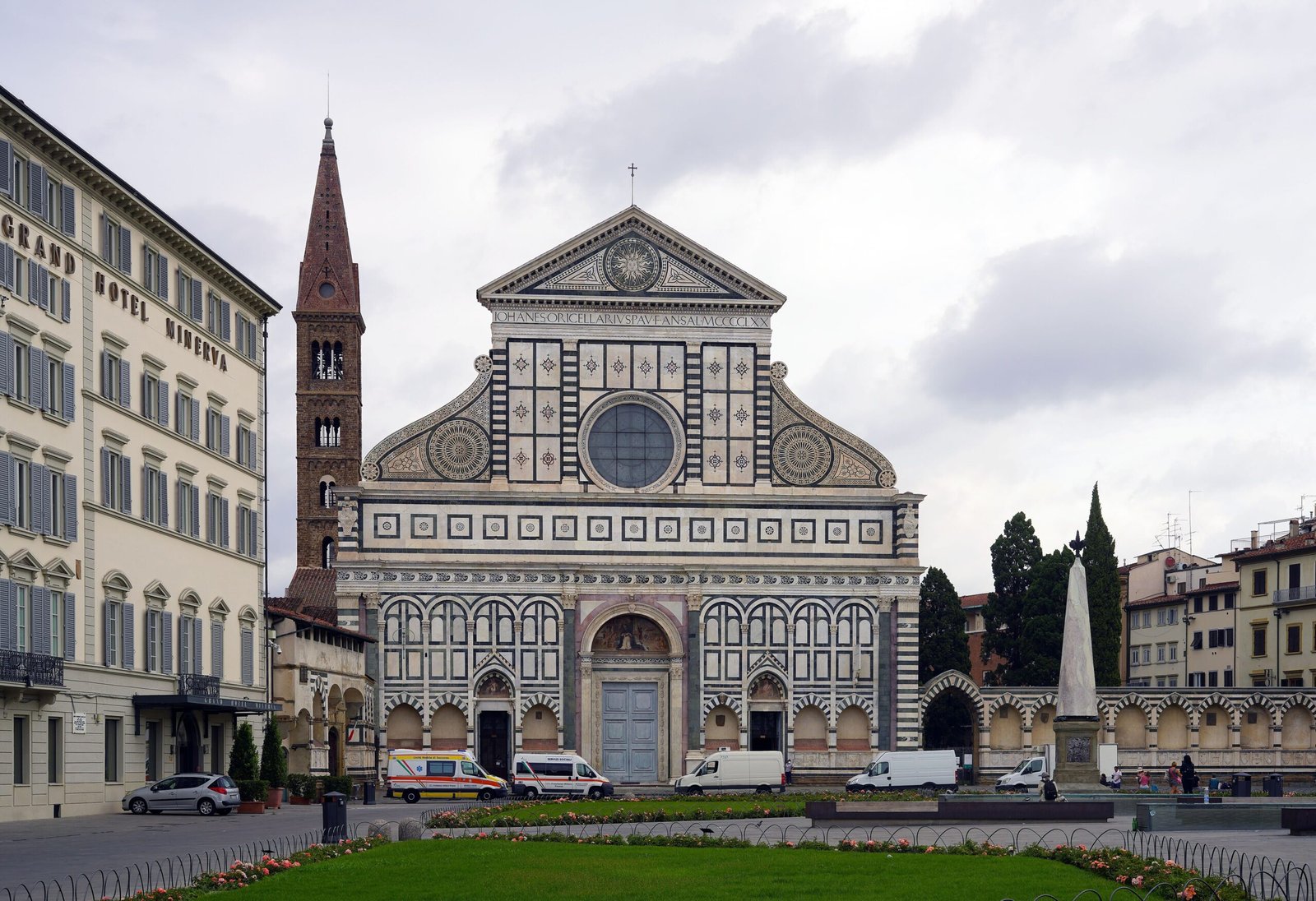
Basilica of Santa Maria Novella
One of Florence’s greatest churches and the spiritual heart of Dominican life in the city, Santa Maria Novella anchors its Renaissance square with a façade that bridges medieval and modern sensibilities.
At a glance
Santa Maria Novella served as Florence’s principal center for Dominican monastic culture, just as Santa Croce anchored Franciscan thought and Santo Spirito housed the Augustinians. Built over more than a century, the basilica’s construction began in earnest in 1242 and reached completion by the mid-14th century, following an earlier church dedicated to Santa Maria delle Vigne that stood on the site.
History
In 1219, twelve Dominicans arrived in Florence from Bologna under the leadership of Fra Giovanni da Salerno. By 1221, they had secured ownership of the small church of Santa Maria delle Vigne, named for the vineyards that once surrounded it on land then beyond the city walls. That earlier church, originally built by the cathedral canons, was consecrated in 1094 according to the most reliable documentation in the chapter archives, though fragmentary Romanesque remains survive beneath the present sacristy.
The Dominican community initiated construction of a much larger basilica in 1242, securing papal indulgences by 1246 to encourage financial contributions. The formal Laying of the First Stone occurred on 18 October 1279 during the feast of San Luca, blessed by Cardinal Malabranca Orsini, though building work had already commenced. The project extended through the 14th century, culminating in the completed structure that dominates the piazza today.
What you see
The basilica presents a façade facing south toward the piazza, synthesizing Gothic and early Renaissance design principles. Buried archaeological evidence—bases of Romanesque pillars recovered under the sacristy—testifies to the earlier church’s footprint and construction methods. The basilica’s interior volume reflects the scale and ambition appropriate to a major mendicant community’s headquarters.
Cultural significance
Santa Maria Novella became Florence’s definitive Dominican establishment, serving not merely as a place of worship but as an intellectual and spiritual nexus for the order’s presence in Tuscany. Its prominence within the city’s religious geography underscores how mendicant orders—Dominicans, Franciscans, and Augustinians—shaped medieval and Renaissance Florence through architecture, theology, and civic identity.
Key facts
- Address: Piazza di Santa Maria Novella, 18, 50123 Florence
- Coordinates: 43.7746343, 11.2493885
- Website: https://www.smn.it/it/
- Phone: +39 055 219257
Practical information
The basilica is located on the homonymous piazza in central Florence. Hours of operation and admission fees are available on the official website. Visitors should verify current access details before planning a visit.
Getting there
Santa Maria Novella sits on Piazza di Santa Maria Novella in Florence’s city center, easily accessible from major transportation hubs and nearby monuments. Public transit connections and walking routes from adjacent landmarks can be found through standard city navigation resources.
Sources & resources
Find it on the map
See this place and what’s around it →📷 Diventa un fotografo di Cultural Heritage Online
Condividi le tue foto dei luoghi: restano pubblicate con la tua firma come autore. Più vengono viste, più ti fai conoscere — e presto un concorso premierà le foto più apprezzate.
Accedi o registrati gratis per aggiungere una foto