
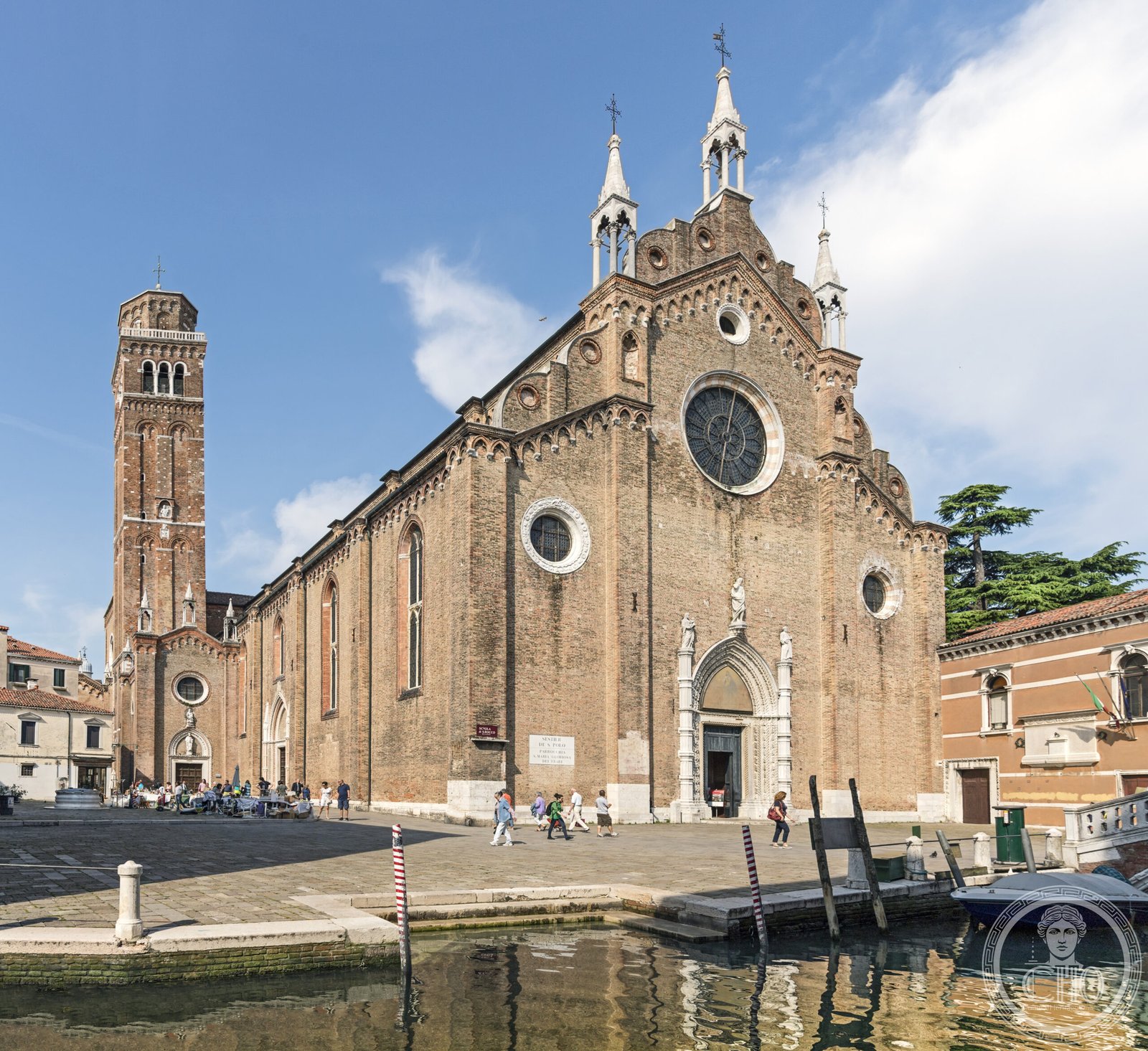
Basilica of Santa Maria Gloriosa dei Frari
Santa Maria Gloriosa dei Frari — known to Venetians simply as the Frari — is a Gothic brick basilica in the sestiere of San Polo, Venice, built by the Franciscan friars between 1340 and 1443. One of the largest churches in Venice, it houses an exceptional concentration of Renaissance and Baroque masterworks, including Titian’s monumental Assumption of the Virgin (1518) above the high altar and his Pesaro Madonna (1519–26), as well as Giovanni Bellini’s sacristy triptych and the sculpted tomb of Doge Giovanni Pesaro by Baldassare Longhena.
- Address
- Campo dei Frari, San Polo 3072, 30125 Venezia VE
- Period
- Construction began c. 1340; consecrated 1492
- Style
- Venetian Gothic
- Architects
- Attributed to Scipione Bon (campanile); design by the Franciscan building tradition
- Patron
- Order of Friars Minor (Franciscans)
- Function
- Active parish and conventual church
- Coordinates
- 45.4367° N, 12.3262° E
- Notes
- Contains tombs of Titian and composer Claudio Monteverdi; campanile is the second tallest in Venice; Scuola Grande di San Rocco is adjacent
At a glance
- Type
- Gothic brick basilica and Franciscan friary
- Period
- 1340–1443 (main structure); campanile 1396
- Style
- Venetian Gothic
- Location
- San Polo, Venice, Veneto, Italy
- Notable works
- Titian, Assumption of the Virgin (1518); Bellini, sacristy triptych (1488)
Overview
The Basilica of Santa Maria Gloriosa dei Frari is considered one of the supreme treasures of Venetian Gothic architecture. Its vast, triple-aisled interior stretches 83 metres in length and shelters works by the greatest Venetian artists of the Renaissance, making it an unrivalled open museum of painting and sculpture. The Franciscan complex also includes the adjoining Archivio di Stato, one of the most important state archives in Italy, housed in the former monastic buildings.
History
The Franciscans arrived in Venice in 1222 and received the land at San Polo shortly thereafter. A first church was built in the 1250s, but the present basilica was begun around 1340 in the Venetian Gothic style and completed over the following century. The campanile, the second tallest bell tower in Venice after St Mark’s, was added in 1396. The church was formally consecrated in 1492, by which time it had already accumulated the patronage and burial rights of Venice’s leading noble families.
Throughout the 15th and 16th centuries, major Venetian painters received commissions here. Titian’s Assumption of the Virgin, installed in 1518, transformed the high altar and is widely regarded as one of the greatest paintings in Italy. After the suppression of religious orders under Napoleon in 1806, the complex passed to civic authorities; the monastery became the State Archives, while the church remained in use.
What you see
The facade of rose-tinted Istrian brick is articulated by blind arcading and three doorways enriched with marble carvings. Inside, the vast nave is divided by a carved Gothic wooden choir screen (jubé) — one of the few surviving in Venice — which separates the friars’ choir from the lay nave. The apse glows with Titian’s radiant Assumption, while fourteen lateral chapels, each endowed by a noble family, contain altarpieces and funerary monuments of outstanding quality.
Among the permanent highlights: Bellini’s luminous triptych Madonna and Child with Saints (1488) in the sacristy; Donatello’s polychrome wooden statue of St John the Baptist (1438) in the Florentine chapel; and the imposing tomb of Doge Giovanni Pesaro (d. 1659) by Baldassare Longhena. The wall monuments to Titian (d. 1576) and to Claudio Monteverdi (d. 1643) are also located within the basilica.
Cultural significance
The Frari is protected under Italian national heritage law and forms part of the historic centre of Venice, inscribed as a UNESCO World Heritage Site in 1987. It ranks among the most visited cultural monuments in the Veneto and is a mandatory reference for any study of Venetian Renaissance painting and Gothic civic architecture. Cultural Heritage Online has documented this complex as part of its Venetian heritage portfolio.
Practical information
Address: Campo dei Frari, San Polo 3072, Venice.
Opening hours: Monday–Saturday 09:00–18:00; Sunday 13:00–18:00 (check official website for current hours and admission fees).
Admission: Entry fee applies; combined tickets available with the Chorus network of Venetian churches.
Accessibility: Main nave accessible; contact the church for specific requirements.
Getting there
From central Venice, take the ACTV vaporetto Line 1 or Line 2 to the San Tomà stop on the Grand Canal; the basilica is a 3-minute walk from the landing stage. On foot from the Rialto, cross the bridge and follow signs through the San Polo district westward (approximately 10 minutes). From Santa Lucia railway station, vaporetto Line 1 reaches San Tomà in about 15 minutes.
Sources & resources
Find it on the map
See this place and what’s around it →📷 Diventa un fotografo di Cultural Heritage Online
Condividi le tue foto dei luoghi: restano pubblicate con la tua firma come autore. Più vengono viste, più ti fai conoscere — e presto un concorso premierà le foto più apprezzate.
Accedi o registrati gratis per aggiungere una foto