
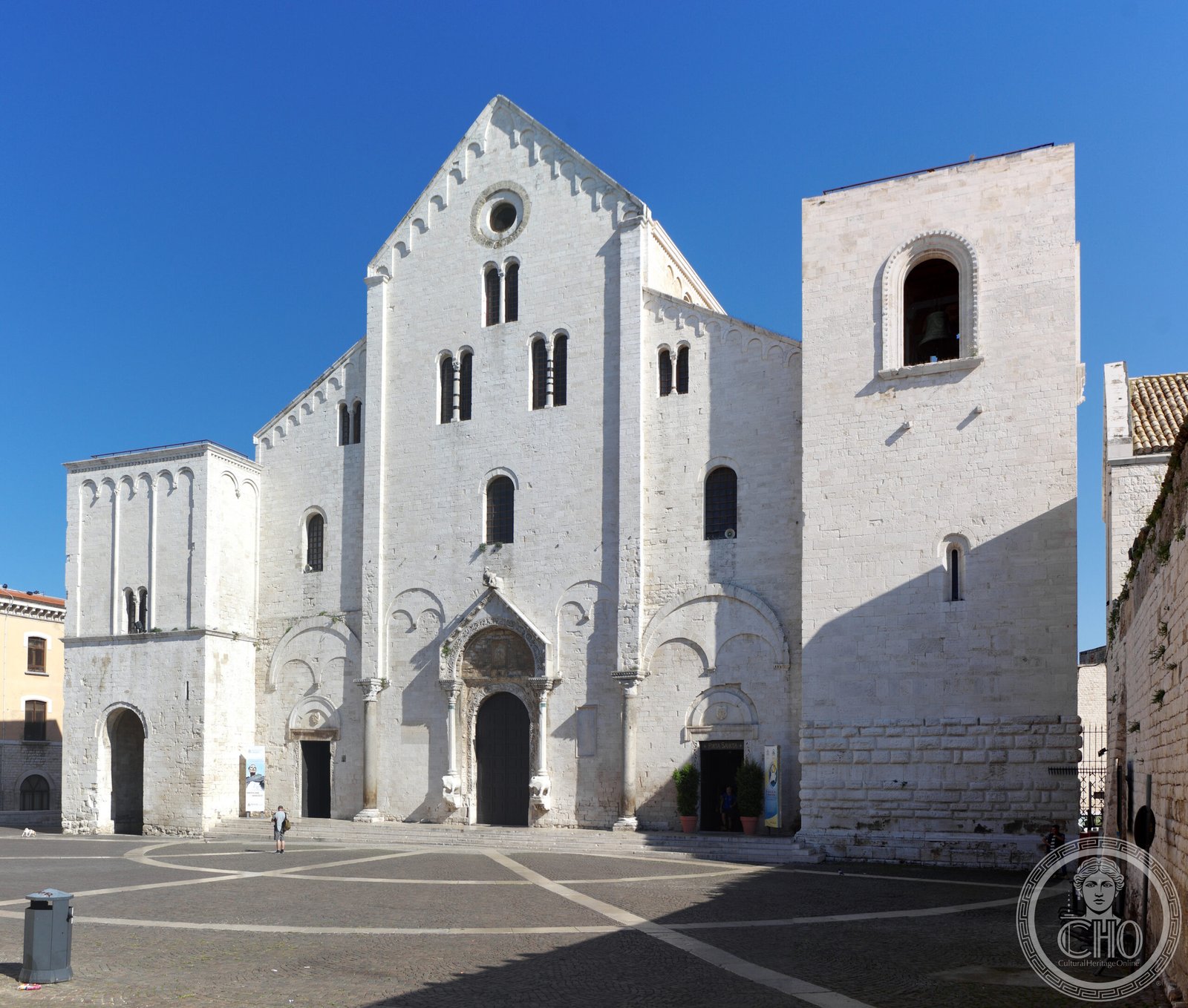
Basilica of Saint Nicholas — Citadel and Byzantine Governors’ Praetorium
The Basilica of Saint Nicholas in Bari is one of the most important pilgrimage churches in Italy and a landmark of Norman Romanesque architecture in southern Italy, built from 1087 to enshrine the relics of Saint Nicholas of Myra, transported from Lycia by Barese merchants. The basilica stands in the oldest part of Bari, known as the Citadel, on the site once occupied by the residence of the Byzantine governors of the city — the praetorium — giving the location exceptional historical depth as a seat of power from late antiquity through the Norman period and beyond.
At a glance
- Type
- Pilgrimage basilica · Norman Romanesque · Byzantine heritage site
- Period
- Construction begun 1087; built on the site of the Byzantine praetorium (pre-1071)
- Style
- Apulian Romanesque; Norman synthesis with Byzantine and Islamic influences
- Location
- Città Vecchia (Old Bari), Bari, Puglia, Italy · 41.1303° N, 16.8700° E
Overview
The Basilica of Saint Nicholas stands at the heart of Bari Vecchia, the old city on the promontory between the two harbours of the Adriatic port. It is among the most venerated pilgrimage destinations in the Christian world — revered by Catholic, Orthodox, and Protestant traditions alike as the resting place of Saint Nicholas, bishop of Myra and prototype of the modern Santa Claus figure. The basilica’s architectural form, completed in the 12th century, established a model that influenced Romanesque church building throughout Puglia and the wider southern Italian region for generations.
History
Bari was a Byzantine administrative centre for centuries before the Norman conquest in 1071; the praetorium — the residence and offices of the Byzantine catepan, or governor — occupied the elevated Citadel site where the basilica now stands. When Barese merchants brought the bones of Saint Nicholas from Myra (in present-day Turkey) in 1087, construction of a new church began almost immediately on this prestigious site, with the relics placed in the crypt in 1089 in the presence of Pope Urban II. The upper basilica was completed progressively through the 12th century under Norman patronage, and the complex was entrusted to the Dominicans in the 13th century. The church served for centuries as a symbol of Bari’s mercantile ambitions and civic identity in the Mediterranean.
What you see
The basilica presents a severe and powerful Apulian Romanesque facade flanked by two square towers, with a triple-naved interior of great spatial dignity. The crypt beneath the main altar houses the tomb of Saint Nicholas and the Myrrh — a liquid substance said to emanate from the saint’s bones that has been collected and venerated by pilgrims for centuries. Notable works of art include the episcopal throne of Archbishop Elia (c. 1098), a remarkable Romanesque sculpture supported by three carved figures, and the carved portal decorations that show Byzantine, Islamic, and Western Romanesque motifs intertwined. The Citadel context — the old city lanes and medieval fabric surrounding the basilica — adds greatly to the experience of visiting.
Cultural significance
The Basilica of Saint Nicholas is a site of worldwide religious importance and one of the foundational monuments of Apulian art and architecture. Its construction marked the political ambitions of the Norman rulers of southern Italy and the economic vigour of the Barese merchant class in the medieval Mediterranean. As the resting place of the relics that gave rise to the figure of Santa Claus through Dutch Sinterklaas tradition, the basilica has an unexpected global cultural resonance that extends far beyond its Italian pilgrimage context. It was included in the UNESCO Tentative List for World Heritage designation as part of the Norman monuments of southern Italy.
Practical information
- Address
- Piazza San Nicola, 70122 Bari BA, Italy
- Hours
- Basilica: typically open daily in the morning and afternoon; crypt has separate hours. Check the official website for current schedule.
- Admission
- Free entry to the basilica; donations welcome
- Website
- basilicasannicola.it
Getting there
The basilica is in Bari Vecchia, the old city quarter, a 10–15 minute walk from Bari Centrale railway station. By car, follow signs for Bari Centro/Porto; paid parking is available near the old city perimeter. Bari Karol Wojtyła Airport is approximately 8 km from the city centre, connected by direct rail service to Bari Centrale. From the station, the old city and the basilica are easily reached on foot along the seafront.
Sources & resources
Find it on the map
See this place and what’s around it →📷 Diventa un fotografo di Cultural Heritage Online
Condividi le tue foto dei luoghi: restano pubblicate con la tua firma come autore. Più vengono viste, più ti fai conoscere — e presto un concorso premierà le foto più apprezzate.
Accedi o registrati gratis per aggiungere una foto