
Archdiocese of Spoleto-Norcia
The Archdiocese of Spoleto-Norcia is a Latin Church ecclesiastical territory of the Catholic Church in Umbria, central Italy, uniting the ancient sees of Spoleto and Norcia. Originally a diocese tracing its roots to early Christianity, it was elevated to an archdiocese in 1821 and today operates as a non-metropolitan see immediately exempt to the Holy See. The archdiocese encompasses the historic city of Spoleto, seat of the Duchy of Spoleto in the early medieval period, and the mountain town of Norcia, birthplace of Saint Benedict of Nursia.
At a glance
- Type
- Catholic archdiocese (Latin Church)
- Period
- Early Christian origins; elevated to archdiocese 1821; current name reflecting union of Spoleto and Norcia sees
- Style
- Ecclesiastical territory; cathedral in Romanesque-Gothic style
- Location
- Spoleto and Norcia, Province of Perugia, Umbria, Italy
- Coordinates
- 42.7346° N, 12.7381° E
Overview
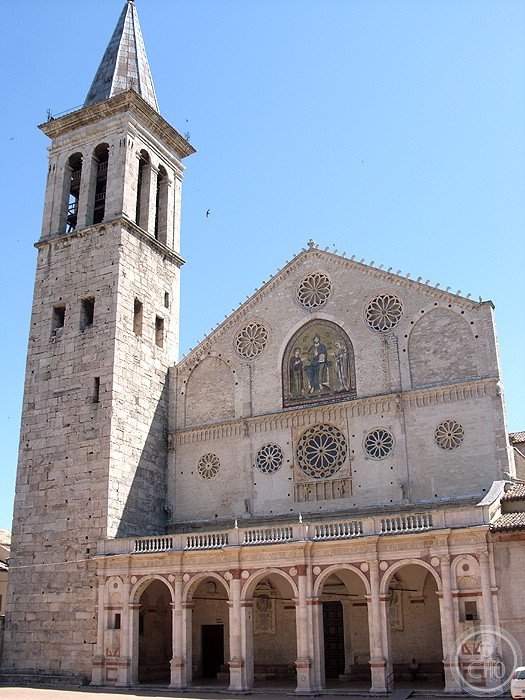
The Archdiocese of Spoleto-Norcia is a Latin Church ecclesiastical jurisdiction in Umbria, central Italy, covering the territories of two historically significant towns. It is a non-metropolitan see, meaning it is not the head of an ecclesiastical province but rather reports directly and immediately to the Holy See in Rome. The archdiocese is home to the Cathedral of Santa Maria Assunta in Spoleto, a landmark of Umbrian Romanesque-Gothic architecture with its celebrated apse frescoes by Filippo Lippi.
History
Spoleto’s episcopal history reaches back to the early centuries of Christianity, with the diocese formally documented from the 4th century. The city served as the capital of the Lombard Duchy of Spoleto from the 6th to the 11th century, a period that greatly shaped its religious and civic identity. In 1821 the see was elevated to an archdiocese. The diocese of Norcia, birthplace of Saint Benedict (480–547 AD), the founder of Western monasticism, was later united with Spoleto to form the current combined archdiocese.
What you see
The cathedral of Spoleto, dedicated to the Assumption of Mary, dominates the upper city with a Romanesque facade decorated with rose windows and a 12th-century mosaic of Christ in Majesty. Inside, the apse contains celebrated frescoes depicting the Life of the Virgin painted by Filippo Lippi between 1467 and 1469, including his own tomb designed by his son Filippino. The archdiocese also encompasses the Romanesque Basilica of San Salvatore, a UNESCO World Heritage Site, and the venerable churches of Norcia where Benedict’s birthplace is commemorated.
Cultural significance
Spoleto is considered one of the great ecclesiastical centres of medieval Umbria, and its cathedral stands as one of the finest examples of Romanesque art in Italy. The union with the diocese of Norcia links the archdiocese directly to the origins of Western monasticism, making it a site of profound importance for Catholic heritage worldwide.
Practical information
- Address
- Piazza del Duomo, 06049 Spoleto PG, Italy
- Opening hours
- Check official website for current visiting hours
- Admission
- Cathedral free; some chapels may require a fee
Getting there
Spoleto is served by the Spoleto railway station on the Rome–Ancona line, with frequent connections from Rome (approximately 1 hour 20 minutes) and Perugia. From the station, the historic centre and cathedral are accessible on foot (about 15 minutes) or by local shuttle bus. By car, take the A1 motorway and exit at Orte, then follow the SS3 Flaminia towards Spoleto.
Sources & resources
Find it on the map
See this place and what’s around it →📷 Diventa un fotografo di Cultural Heritage Online
Condividi le tue foto dei luoghi: restano pubblicate con la tua firma come autore. Più vengono viste, più ti fai conoscere — e presto un concorso premierà le foto più apprezzate.
Accedi o registrati gratis per aggiungere una foto