
Archaeological Park of Sibari
The Archaeological Park of Sibari preserves the remains of three superimposed ancient cities on the Calabrian plain near the Gulf of Taranto: Greek Sybaris (founded c. 720 BC and destroyed in 510 BC), the later Thurii (founded 444 BC by a Panhellenic colony including colonists guided by Hippodamus of Miletus and Herodotus), and the Roman Copia (established 193 BC). Sybaris was one of the wealthiest and most populous cities of the ancient Greek world, proverbially synonymous with luxury and refined living — the origin of the word sybarite — before its total destruction by the rival city of Kroton. The park includes an on-site museum, the Museo Nazionale Archeologico della Sibaritide, housing finds spanning the entire occupation sequence.
At a glance
- Type
- Archaeological park — three superimposed ancient cities
- Period
- c. 720 BC (Sybaris) · 444 BC (Thurii) · 193 BC (Copia) · continuing to 3rd century AD
- Style
- Archaic Greek, Classical Greek (Hippodamian grid), Roman Republican and Imperial
- Location
- Cassano allo Ionio, Province of Cosenza, Calabria, Italy
- Coordinates
- 39.7181° N, 16.4915° E
Overview
Sybaris was an important ancient Greek city situated on the coast of the Gulf of Taranto in modern Calabria, founded by Achaean colonists around 720 BC and renowned throughout the ancient world for its extraordinary wealth and population, estimated by ancient sources at 300,000 inhabitants. The city’s opulence made it a byword for luxury — sybaritic entered Greek and then modern European vocabulary as a permanent legacy. After its annihilation by Kroton in 510 BC and the deliberate flooding of its ruins, the site was recolonised twice: first by Thurii in 444 BC (a city where Herodotus reportedly died), then by Rome with the Latin colony of Copia in 193 BC. Today the archaeological park exposes structures from all three urban phases within a flat alluvial landscape.
History
Sybaris was founded c. 720 BC by Achaean Greeks from the Peloponnese, and rapidly grew into one of the largest and richest cities in the Mediterranean, controlling a vast territory extending across the Calabrian plain to both coasts of the peninsula. Its legendary prosperity ended in 510 BC when Kroton, aided by the philosopher Pythagoras and his school according to ancient tradition, destroyed Sybaris and diverted the river Crati over its ruins. Pericles’ Panhellenic colony of Thurii was planted on the same site in 444 BC, laying out a new city on a rational grid plan. After Thurii declined in the Hellenistic period, the Romans established Copia in 193 BC as a Latin colony, and this city continued into the late Empire before eventual abandonment.
What you see
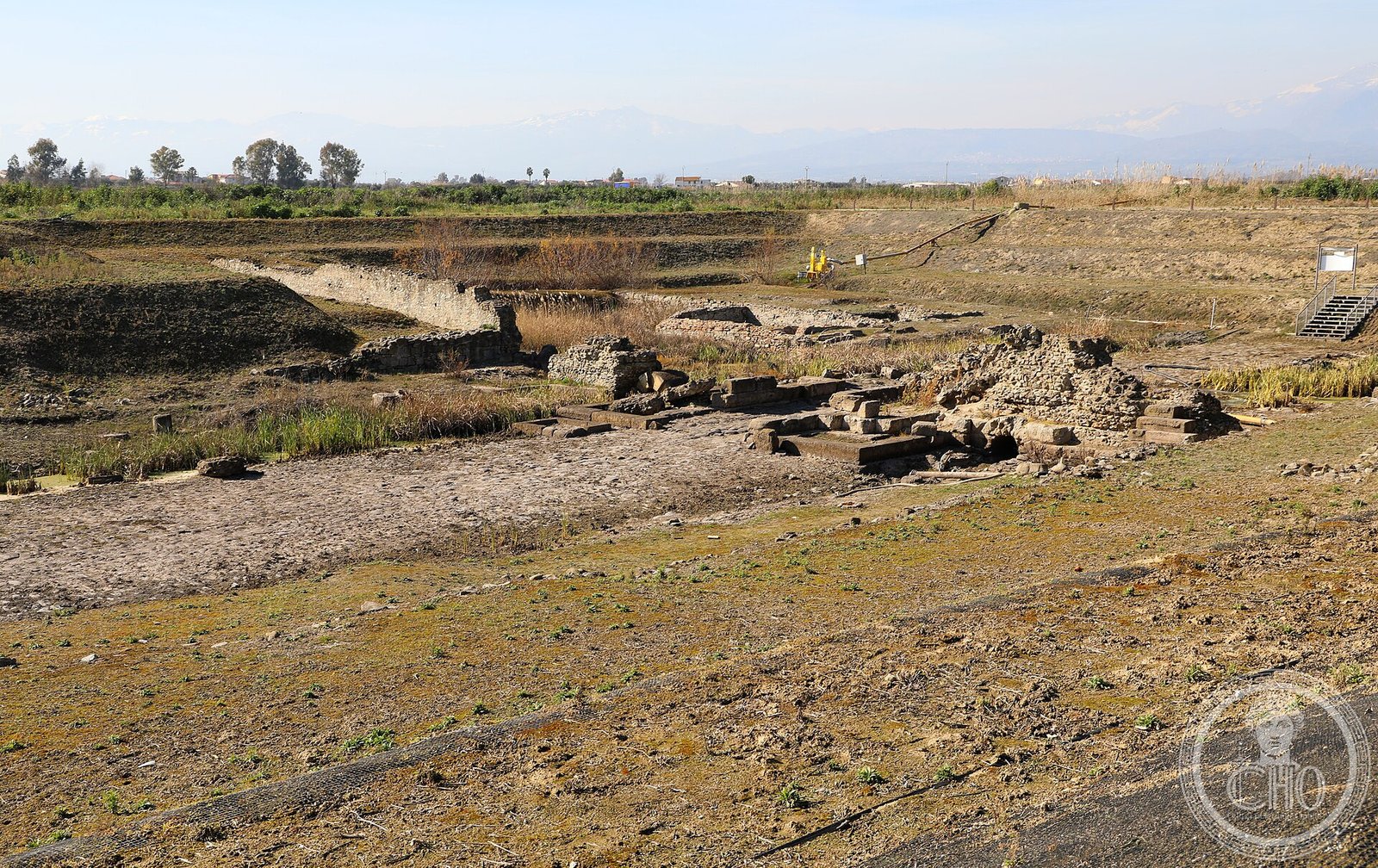
The archaeological park exposes structures across a broad flat area of the Calabrian plain, with excavated sections revealing streets, house foundations, cisterns and public buildings from the Greek and Roman periods. The layers of Sybaris itself lie deepest and are partially accessible in specific excavated zones. The Museo Nazionale Archeologico della Sibaritide, located within the park, displays a rich collection of finds including fine pottery, bronzes, architectural terracottas and inscriptions from all occupation phases, providing essential visual context for the largely buried city.
Cultural significance
Few ancient sites carry the same mythic weight as Sybaris, whose name has permanently marked the vocabulary of luxury and excess in Western culture. As an archaeological site, the park is exceptional for preserving three complete urban realities superimposed on the same spot — a stratigraphy of ambition, destruction and renewal that embodies the turbulent history of Magna Graecia. It remains one of the most important and least crowded major archaeological parks in southern Italy.
Practical information
- Address
- Museo della Sibaritide, SS106, Cassano allo Ionio, 87011 CS, Calabria
- Hours
- Check official website of the Parco Archeologico di Sibari
- Admission
- Paid entry; check current tariffs on the official site
Getting there
The park lies on the SS106 coastal highway between Taranto and Reggio Calabria, near Cassano allo Ionio. The nearest railway station is Sibari on the Taranto–Reggio Calabria line, approximately 2 km from the museum entrance. By car from Cosenza, take the A2 motorway north to the Firmo exit, then follow the SS105 and SS106 east (approximately 60 km).
Sources & resources
Find it on the map
See this place and what’s around it →📷 Diventa un fotografo di Cultural Heritage Online
Condividi le tue foto dei luoghi: restano pubblicate con la tua firma come autore. Più vengono viste, più ti fai conoscere — e presto un concorso premierà le foto più apprezzate.
Accedi o registrati gratis per aggiungere una foto