
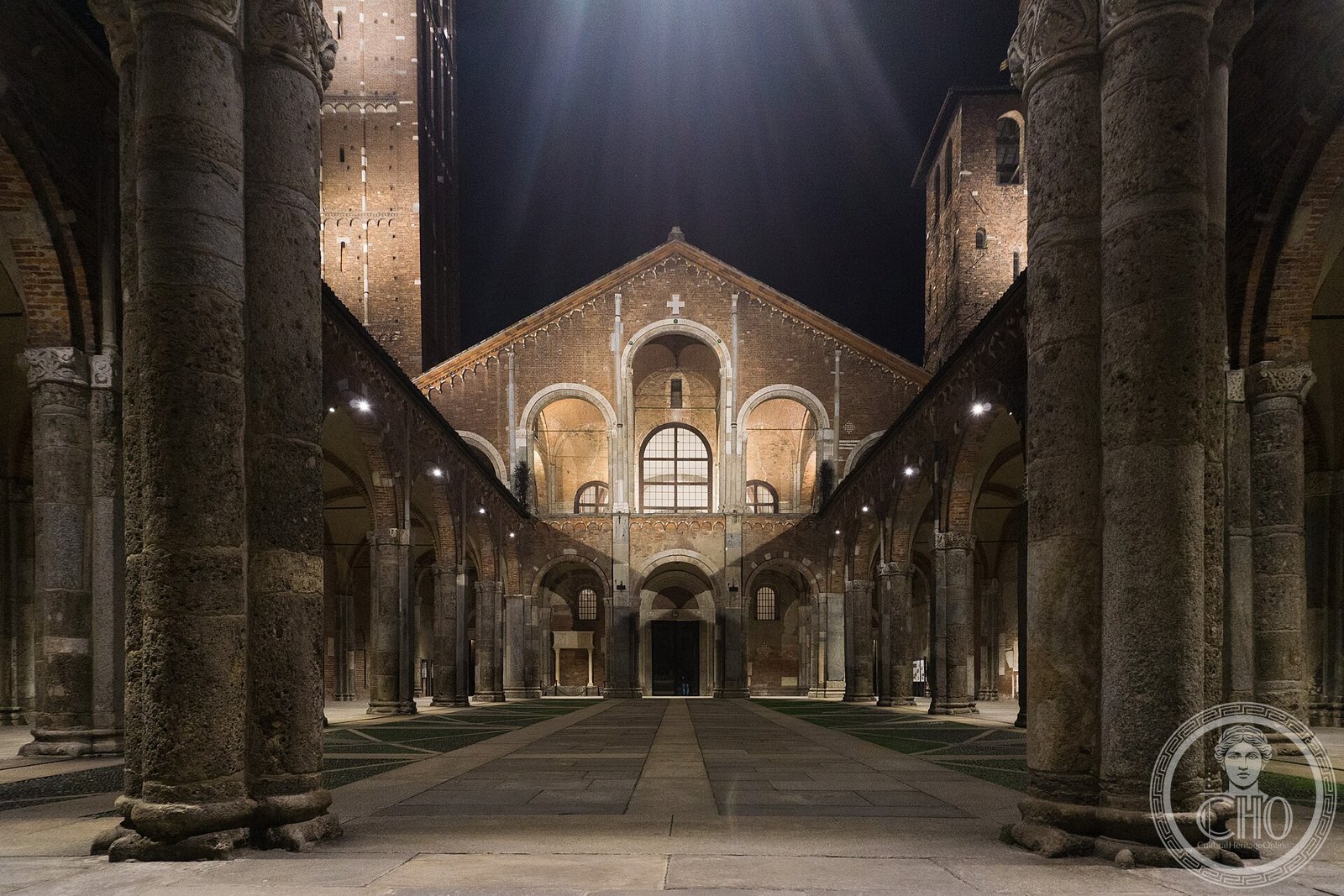
Antiquum Oratorium Passionis — Basilica of Sant’Ambrogio
The Antiquum Oratorium Passionis is a small Early Christian oratory embedded within the monastic complex of the Basilica of Sant’Ambrogio in Milan, one of the oldest and most significant Christian structures in northern Italy. Founded in the 4th century in connection with Ambrose, Bishop of Milan, the oratory preserves mosaic cycles and architectural fabric that predate the better-known basilica nave, offering a rare direct link to Milan’s Ambrosian liturgical origins. The entire Sant’Ambrogio complex is a UNESCO candidate and a cornerstone of Milanese religious and artistic identity.
At a glance
- Type
- Early Christian oratory (chapel) within a larger basilica complex
- Period
- 4th century origins; Carolingian and Romanesque phases 8th–12th century
- Style
- Early Christian, Carolingian, Romanesque
- Location
- Piazza Sant’Ambrogio, Milan, Lombardy, Italy
- Coordinates
- 45.4621° N, 9.1750° E
- Patron
- Saint Ambrose, Bishop of Milan (374–397 AD)
Overview
The Basilica of Sant’Ambrogio is among the most important Romanesque churches in Italy, founded by Ambrose himself around 379 AD as a martyrs’ basilica outside the Roman walls of Mediolanum. Within this complex, the Antiquum Oratorium Passionis (Ancient Oratory of the Passion) is one of several subsidiary chapels that preserve Early Christian and Carolingian decorative programs largely intact. The oratory is characterised by mosaic fragments, frescoed surfaces, and masonry of exceptional antiquity that complement the better-known golden altarpiece (Paliotto d’Oro) in the main basilica.
History
Ambrose began construction of what would become the Sant’Ambrogio complex in 379 AD, consecrating it in 386 and interring the relics of Saints Gervasius and Protasius beneath the altar. The oratory dedicated to the Passion was among the earliest devotional spaces attached to the basilica and underwent renovation under Carolingian patronage in the 9th century. The Romanesque rebuilding of the main basilica in the 11th and 12th centuries left the older oratory partially encased within new walls, preserving its Early Christian fabric almost by accident. The complex was heavily restored in the 19th century, with further conservation campaigns carried out throughout the 20th century.
What you see
The oratory is a compact single-apse space with low vaulting supported by ancient columns, displaying mosaic fragments on the conch and painted surfaces from multiple medieval campaigns. The masonry reveals several building phases, with Roman brick courses visible alongside Carolingian and Romanesque additions. Access is through the atrium of the main basilica, and the oratory is typically visited as part of a guided tour of the entire Sant’Ambrogio complex, which also includes the Carolingian portico, the golden altarpiece, and the crypt containing the relics of Ambrose.
Cultural significance
The Antiquum Oratorium Passionis stands as physical evidence of the Ambrosian rite’s origins and Milan’s foundational role in the formation of Western Christianity. The Sant’Ambrogio complex as a whole shaped Carolingian church architecture across northern Europe, and its oratory retains layers of devotional art that document an unbroken liturgical tradition of nearly 1,700 years.
Practical information
- Address
- Piazza Sant’Ambrogio 15, 20123 Milano MI
- Opening hours
- Check official website; guided tours typically required for oratory access
- Admission
- Basilica entry free; museum and oratory guided tours may carry a fee
- Website
- basilicasantambrogio.it
Getting there
Metro M2 (green line) to Sant’Ambrogio station, directly adjacent to the piazza. Bus lines 50 and 58 stop at Piazza Sant’Ambrogio. The basilica is approximately 15 minutes on foot from the Duomo di Milano via Via Torino.
Sources & resources
Find it on the map
See this place and what’s around it →Historical events at this place (2)
📷 Diventa un fotografo di Cultural Heritage Online
Condividi le tue foto dei luoghi: restano pubblicate con la tua firma come autore. Più vengono viste, più ti fai conoscere — e presto un concorso premierà le foto più apprezzate.
Accedi o registrati gratis per aggiungere una foto