
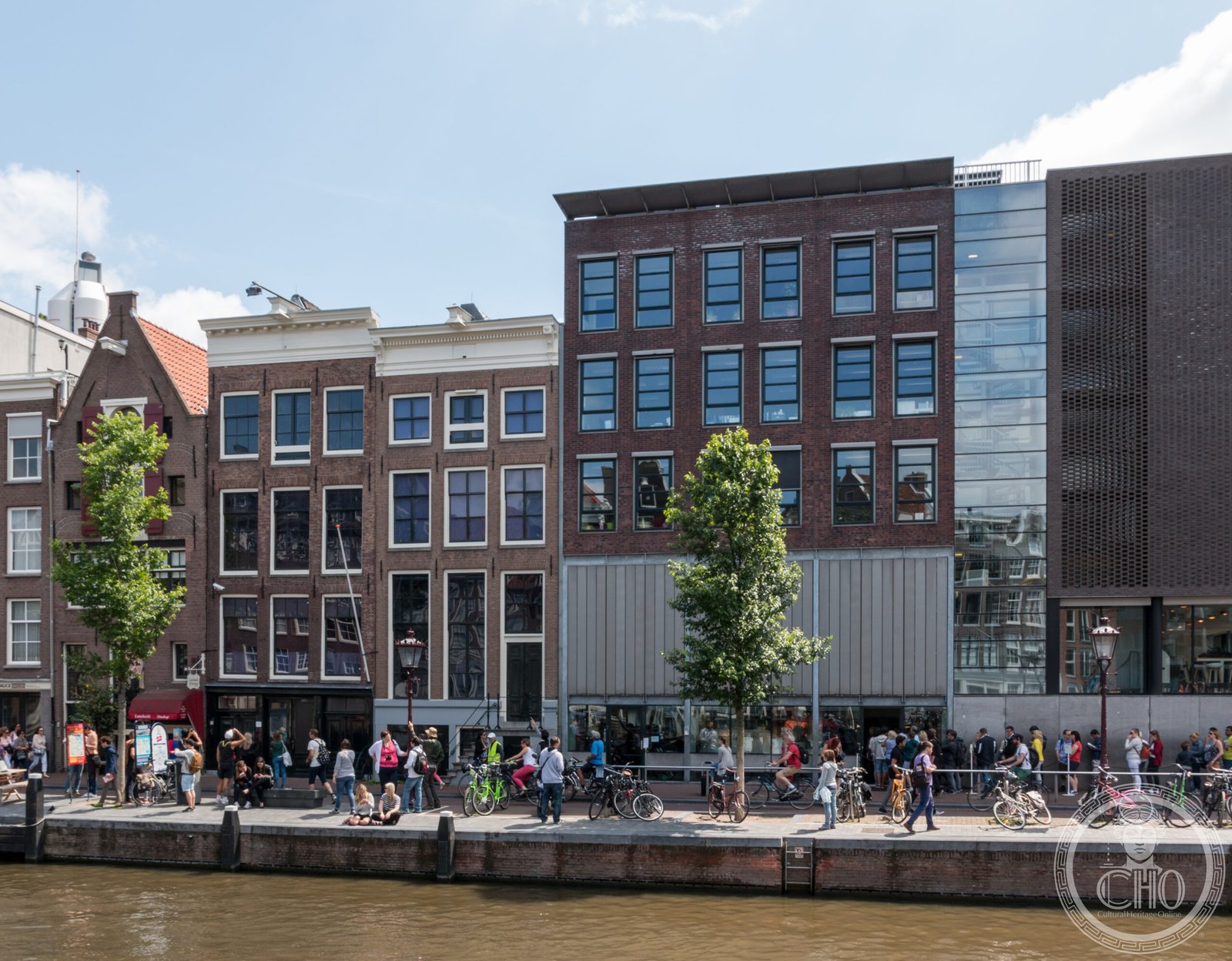
Anne Frank House
The Anne Frank House is a biographical museum and writer’s house dedicated to Anne Frank, the Jewish girl who hid here with her family for more than two years during the Nazi occupation of Amsterdam. Located on the Prinsengracht canal near the Westerkerk in the historic centre, the building preserves the Secret Annex where Anne wrote her diary between 1942 and 1944. That diary, published after the war by her father Otto Frank, became one of the most widely read personal accounts of the Holocaust and a defining document of 20th-century history.
At a glance
- Type
- Biographical museum / historic house / memorial site
- Period
- Building dates to 1635; used as hiding place 1942–1944; museum since 1960
- Style
- Dutch canal house (exterior); preserved wartime interior
- Location
- Prinsengracht 263–267, 1016 GV Amsterdam, Netherlands
- Coordinates
- 52.3752° N, 4.8818° E
Overview
The Anne Frank House occupies a narrow canal house on the Prinsengracht, close to the Westerkerk, in one of Amsterdam’s best-preserved 17th-century neighbourhoods. The museum presents the hiding place exactly as Anne described it in her diary, with the revolving bookcase that concealed the entrance to the Secret Annex still in place. It receives well over one million visitors annually and is one of the most visited sites in the Netherlands.
History
Anne Frank was born in Frankfurt in 1929 and moved to Amsterdam with her family in 1933 as Nazi persecution of Jews escalated. On 6 July 1942, the Frank family went into hiding in the concealed rear section of Otto Frank’s business premises on the Prinsengracht, joined shortly after by four others. For 25 months they lived in the Secret Annex, sustained by a small group of trusted employees, until they were betrayed and arrested by the Gestapo on 4 August 1944. Anne died in Bergen-Belsen concentration camp in February or March 1945, weeks before the camp’s liberation. After the war, Otto Frank — the sole survivor of the family — fulfilled Anne’s wish by publishing her diary. He established the Anne Frank House foundation in 1957 and the museum opened in 1960.
What you see
Visitors move through the building’s original commercial floors before entering the Secret Annex via the famous revolving bookcase. The hiding rooms are presented unfurnished, as they were emptied after the arrest; original details — pencil height marks on the wall, film-star cuttings pasted by Anne — have been carefully preserved. The museum also contains Anne’s original diary manuscripts, a permanent exhibition contextualising the Holocaust and the persecution of Dutch Jews, and a section on the reception and global impact of the diary after publication.
Cultural significance
The Anne Frank House is among the most powerful Holocaust memorial sites in the world, combining physical authenticity — the actual rooms where the diary was written — with one of the most humanising personal testimonies to survive the Nazi genocide. It is a UNESCO Memory of the World site (the diary manuscripts) and a listed national monument, visited by heads of state, schoolchildren and pilgrims from every continent as a site of witness, mourning and resolve.
Practical information
- Address
- Prinsengracht 263–267, 1016 GV Amsterdam
- Opening hours
- Open daily; advance online booking strongly recommended as tickets sell out weeks in advance
- Admission
- Check official website for current prices; timed entry tickets required
- Website
- annefrank.org
Getting there
The museum is a 20-minute walk from Amsterdam Centraal station along the Singel and Keizersgracht canals. Tram lines 13, 14 and 17 stop at Westermarkt, immediately adjacent to the entrance. Bicycle parking is available nearby; arriving early or at off-peak times is advisable given the queue.
Sources & resources
Find it on the map
See this place and what’s around it →📷 Diventa un fotografo di Cultural Heritage Online
Condividi le tue foto dei luoghi: restano pubblicate con la tua firma come autore. Più vengono viste, più ti fai conoscere — e presto un concorso premierà le foto più apprezzate.
Accedi o registrati gratis per aggiungere una foto