
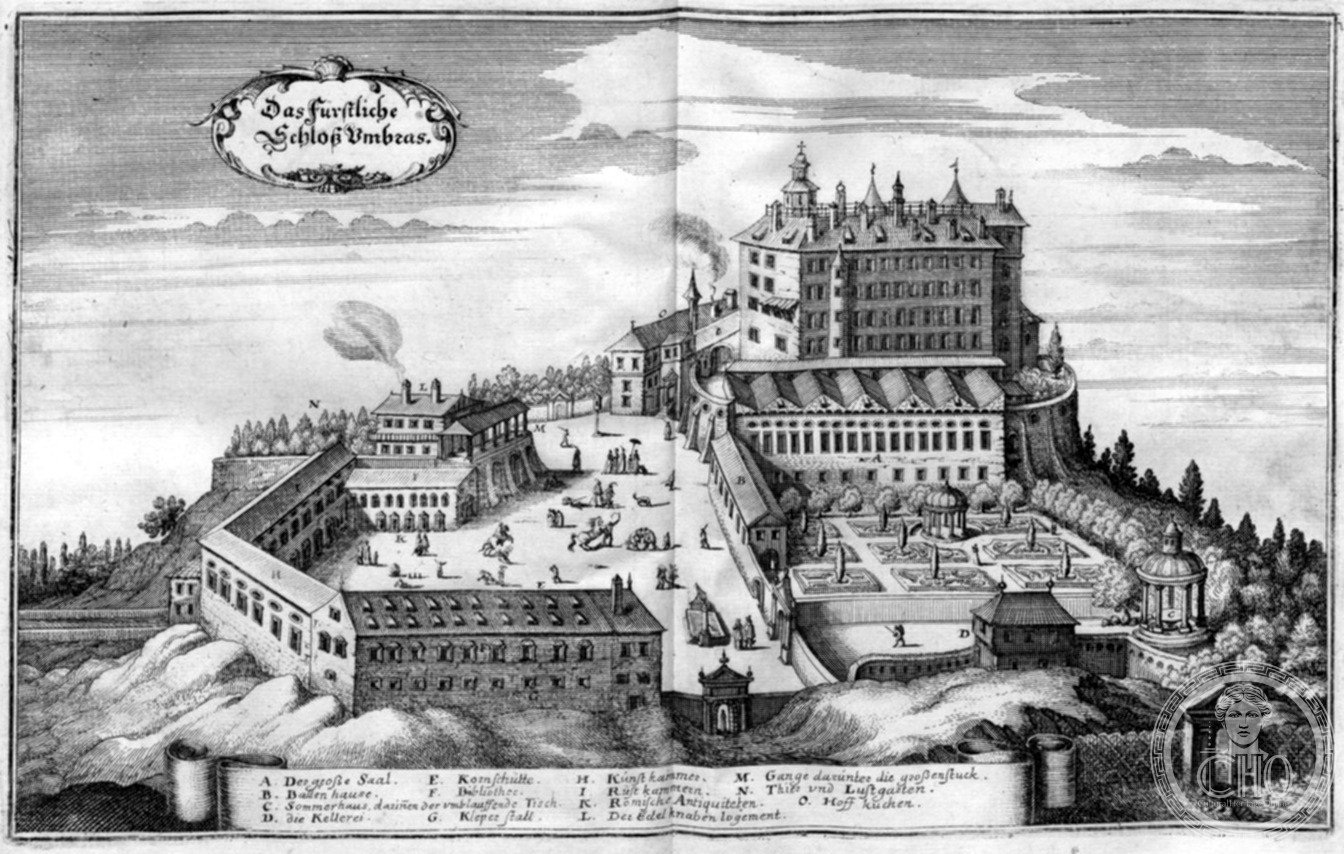
Ambras Castle
Ambras Castle is a Renaissance castle and palace set in the hills above Innsbruck, Austria, at 632 metres above sea level. Built in the 16th century on the site of a 10th-century predecessor, the castle was transformed by Archduke Ferdinand II of Habsburg into one of Europe’s earliest purpose-built museum complexes, housing his extraordinary collection of armour, art, and curiosities — a collection still on display today, making Ambras one of the oldest museums in the world.
At a glance
- Type
- Renaissance castle, palace, and museum complex
- Period
- Original 10th-century fortress; rebuilt as Renaissance castle from 1563
- Style
- Renaissance; Spanish Hall (Spanischer Saal) is a landmark of Northern Renaissance architecture
- Location
- Innsbruck, Tyrol, Austria (47.2561° N, 11.4339° E)
Overview
Ambras Castle is considered one of the most popular tourist attractions in Tyrol and a landmark of European Renaissance culture. The castle’s significance is inseparable from Archduke Ferdinand II (1529–1595), son of Emperor Ferdinand I and ruler of Tyrol, who transformed a medieval fortress into a humanist residence and public museum for his collections. Ferdinand was one of history’s most prominent collectors of art and arms, and the Lower Castle he built specifically to house his museum remains the core of the modern attraction. The castle also served as Ferdinand’s family residence from 1567 until his death in 1595, and was built in part as a gift for his wife, Philippine Welser, a Nuremberg merchant’s daughter he married in a secret morganatic union.
History
The site of Ambras was fortified as early as the 10th century, when it served as the seat of power for the Counts of Andechs. By the 16th century the medieval castle had fallen into disrepair, and Ferdinand II ordered its complete reconstruction beginning around 1563. The new design separated the complex into three distinct parts: the Upper Castle (residential), the Lower Castle (museum), and the Spanish Hall connecting them. Ferdinand’s transformation of Ambras into a Kunst- und Wunderkammer — a cabinet of art and curiosities — anticipated the modern museum concept by several centuries. After Ferdinand’s death, the castle passed through various Habsburg hands before eventually coming under the administration of the Kunsthistorisches Museum Wien, which manages it today.
What you see
The Spanish Hall (Spanischer Saal), completed in 1571, is widely regarded as one of the finest secular Renaissance interiors north of the Alps: a 43-metre barrel-vaulted gallery decorated with 27 portraits of Tyrolean rulers and an intricate inlaid wooden floor. The Lower Castle houses the collection rooms containing Ferdinand’s original armour gallery — one of the world’s most significant collections of tournament and battle armour — alongside the portrait gallery and the Kunst- und Wunderkammer with its natural curiosities, scientific instruments, and objets d’art. The Upper Castle features a series of historic apartments and the castle chapel. The surrounding park offers panoramic views over Innsbruck and the Inn valley.
Cultural significance
Ambras Castle holds a unique place in the history of museums: the Lower Castle was constructed specifically as a public display space for Ferdinand’s collections, predating the Uffizi’s public opening and making it one of the earliest purpose-built museums in Europe. The armour collection is of international scholarly importance, preserving unique examples of 15th- and 16th-century craftsmanship from the leading workshops of Augsburg, Milan, and Innsbruck itself. The castle’s role in the history of collecting, the Wunderkammer tradition, and Habsburg cultural patronage ensures its continued relevance to the history of European art and material culture.
Practical information
- Address
- Schlossstraße 20, 6020 Innsbruck, Austria
- Coordinates
- 47.2561° N, 11.4339° E
- Managed by
- Kunsthistorisches Museum Wien
- Hours
- Generally open daily; closed November. Check official website for current seasonal hours
- Admission
- Charged; combined tickets available with other Innsbruck attractions
- Official website
- schlossambras-innsbruck.at
Getting there
Innsbruck Hauptbahnhof is served by Austrian Federal Railways (ÖBB) with direct connections to Vienna, Munich, Zurich, and the Brenner corridor. From central Innsbruck, bus line 4134 connects to Schloss Ambras directly. The castle is approximately 4 km south-east of the city centre and can be reached by taxi, bicycle, or on foot via a signed path through the Ambraserwald. Innsbruck Airport (INN) serves domestic and European routes.
Sources & resources
- Cultural Heritage Online: culturalheritageonline.com
- Wikipedia — Ambras Castle: en.wikipedia.org/wiki/Ambras_Castle
- Official site: schlossambras-innsbruck.at
- Kunsthistorisches Museum Wien: khm.at
Find it on the map
See this place and what’s around it →📷 Diventa un fotografo di Cultural Heritage Online
Condividi le tue foto dei luoghi: restano pubblicate con la tua firma come autore. Più vengono viste, più ti fai conoscere — e presto un concorso premierà le foto più apprezzate.
Accedi o registrati gratis per aggiungere una foto