
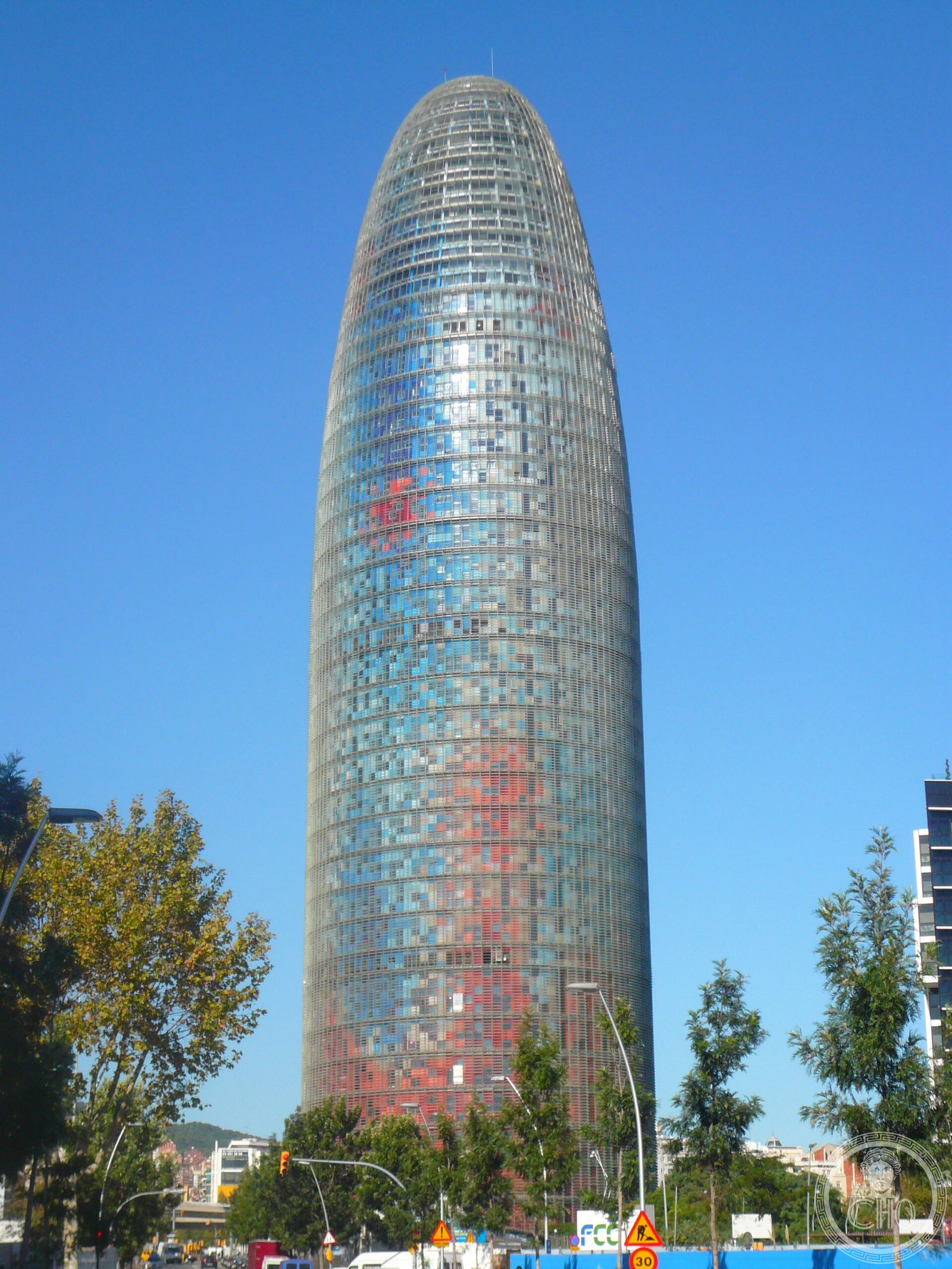
Torre Glòries (Agbar Tower)
Torre Glòries — originally named Torre Agbar after the Agbar water-utility group that commissioned it — is a 38-storey, 144-metre bullet-shaped skyscraper in the Poblenou district of Barcelona. Designed by French architect Jean Nouvel in association with Spanish firm b720 Fermín Vázquez Arquitectos and completed in 2005, the tower marks the gateway to Barcelona’s 22@ technology district and has become one of the most recognisable landmarks on the city’s skyline.
At a glance
- Type
- Commercial skyscraper
- Period
- Completed 2005
- Style
- Contemporary / Deconstructivist
- Location
- Avinguda Diagonal 211, 08018 Barcelona, Spain
- Coordinates
- 41.4034° N, 2.1874° E
Overview
Torre Glòries stands at the junction of Avinguda Diagonal and Carrer Badajoz, near the Plaça de les Glòries Catalanes, a strategic node in Barcelona’s urban masterplan. The tower was designed by Jean Nouvel, winner of the Pritzker Architecture Prize, whose design drew inspiration from a geyser or bullet shape tapering toward the sky. Its elliptical footprint and latticed aluminium-and-glass skin studded with 4,500 LED panels allow the facade to produce dynamic light displays at night, making it a landmark visible across much of the metropolitan area.
History
The tower was commissioned by the Agbar Group, a holding company that controls the Barcelona water utility Aigües de Barcelona, and designed by Jean Nouvel from the late 1990s. Construction began in 2001 and the building was inaugurated in September 2005 by King Juan Carlos I. It quickly became controversial among Barcelonans, attracting both admiration for its sculptural boldness and criticism for its departure from the city’s predominantly horizontal skyline. In 2017 the building was renamed Torre Glòries after Agbar sold its stake; it continues to house office tenants and remains a defining feature of the 22@ innovation district.
What you see
The tower rises 144 metres across 38 floors, its oval profile clad in 40,000 panels of glass and painted aluminium in shades of blue, green, and grey that shift with the light. At street level a landscaped plaza surrounds the base. The interior floors were designed as flexible open-plan office space. The rooftop dome, closed to the general public, crowns the structure with a glazed lantern. After dark the building’s LED skin can display a programmable spectrum of colours, a feature that has made it a favourite subject for urban photographers.
Cultural significance
Torre Glòries represents Barcelona’s architectural ambition in the post-Olympic era, embodying the city’s strategy of using landmark buildings to anchor urban regeneration in former industrial districts. It has become as symbolic of contemporary Barcelona as Gaudí’s Sagrada Família is of its historical heritage, and is frequently cited in discussions of parametric and high-tech architectural design in Europe.
Practical information
- Access
- Exterior and plaza freely accessible; interior office space not open to visitors
- Nearest landmark
- Plaça de les Glòries Catalanes, Avinguda Diagonal 211
- Hours
- Check official website for any public events or access
Getting there
Metro: Glòries station (Line L1) or Llacuna station (Line L4), each a short walk from the tower. Tram: Glòries stop (lines T4, T5, T6) on Avinguda Diagonal. Multiple bus lines stop at Glòries. By bicycle, the area is served by the Bicing shared-bicycle network and dedicated cycle lanes on Avinguda Diagonal.
Sources & resources
Find it on the map
See this place and what’s around it →📷 Diventa un fotografo di Cultural Heritage Online
Condividi le tue foto dei luoghi: restano pubblicate con la tua firma come autore. Più vengono viste, più ti fai conoscere — e presto un concorso premierà le foto più apprezzate.
Accedi o registrati gratis per aggiungere una foto