
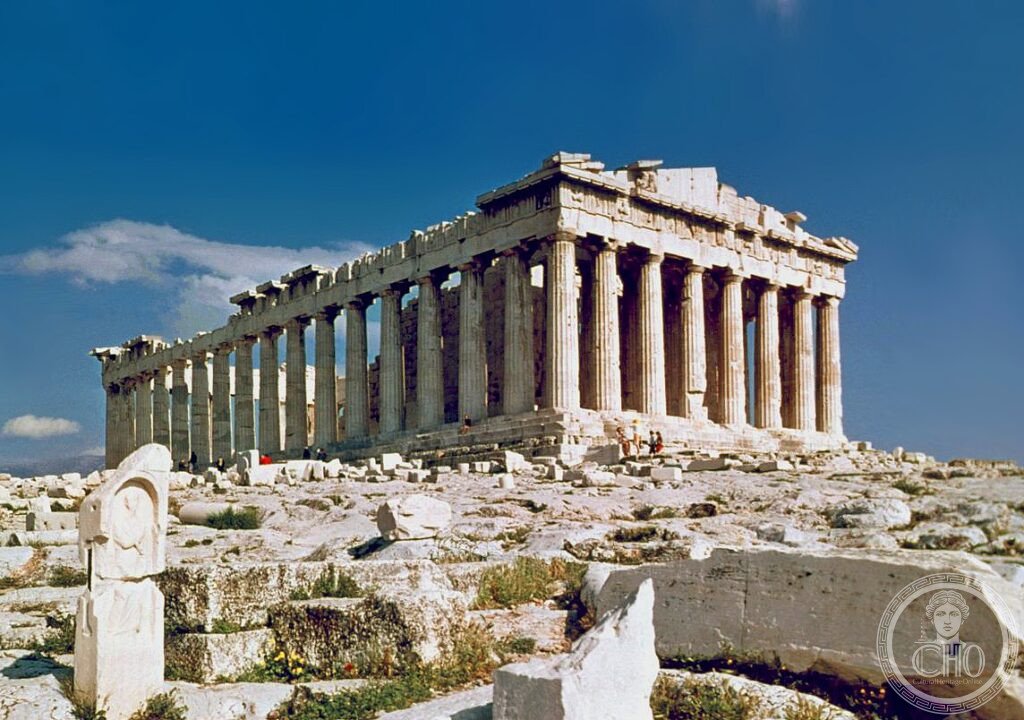
Acropolis of Athens
Ictinus and Callicrates built the Parthenon between 447 and 432 BC, its marble columns still standing — subtly curved in every dimension to correct for the optical illusions of perfect geometry — and still defining what architecture can aspire to after 2,500 years.
At a glance
The Acropolis of Athens is a flat-topped limestone rock rising 156 metres above the city, its summit enclosed by a series of monumental buildings constructed in the 5th century BC under the leadership of Pericles and the artistic direction of the sculptor Phidias. The site had been inhabited since the Neolithic period (c. 4000 BC), fortified in the Mycenaean era, and served as the religious and civic heart of Athens since archaic times. After the Persian sack of 480 BC destroyed the existing temples, Pericles undertook the most ambitious building programme in Greek history: the Parthenon (447–432 BC), the Erechtheion (421–406 BC), the Propylaea (437–432 BC), and the Temple of Athena Nike (427–424 BC). Together they constitute the finest surviving ensemble of Classical Greek architecture. The site was inscribed as a UNESCO World Heritage Site in 1987.
Key facts
- Parthenon architects: Ictinus and Callicrates; sculptural programme directed by Phidias (c. 490–430 BC); commissioned by Pericles (c. 495–429 BC)
- Construction: 447–432 BC (Parthenon); 437–432 BC (Propylaea); 421–406 BC (Erechtheion); 427–424 BC (Temple of Athena Nike)
- Parthenon dimensions: 69.5 × 30.9 metres; Doric order; 8 columns on the short ends, 17 on the long; built of Pentelic marble from Mount Pentelicus, 16 km north-east of Athens
- Optical corrections: every horizontal surface of the Parthenon is subtly convex (curvature of 6 cm on the 69.5 m stylobate), every column leans slightly inward, columns taper and swell (entasis) — all to correct optical distortions that make straight lines appear to sag
- The Acropolis Museum: opened 2009 at the foot of the hill; houses original sculptures including most of the Parthenon frieze
- Heritage: UNESCO World Heritage Site, inscribed 1987
- GPS: 37.9715° N, 23.7267° E
History
The Acropolis rock was first inhabited in the Neolithic period and fortified with a Cyclopean wall in the Mycenaean Bronze Age. In the archaic period (700–480 BC) it was already the site of temples to Athena Polias, the city’s patron goddess, including the Old Temple of Athena and an early Parthenon begun under Cleisthenes. When Xerxes’ Persian forces sacked Athens in 480 BC, they destroyed and burned the temples on the Acropolis, leaving the ruins as a memorial of Persian sacrilege. After the Greek victory at Plataea (479 BC), Athens sworn an oath not to rebuild the temples but to leave them in ruins as a permanent reminder — an oath that Pericles eventually persuaded the Athenians to abandon in the 460s BC.
The Periclean building programme, funded by the treasury of the Delian League (in effect, an Athenian imperial tribute from allied cities), represents an act of confident self-assertion by the world’s first democracy at the height of its power. The Parthenon — dedicated to Athena Parthenos (Athena the Virgin) — housed a gold-and-ivory cult statue by Phidias approximately 12 metres tall; the statue no longer exists but its dimensions are recorded in ancient sources. The building served successively as a Greek temple, a Byzantine church, a Latin Catholic church after the Fourth Crusade (1204), and finally a mosque after the Ottoman conquest (1458). In 1687, a Venetian artillery shell struck a gunpowder magazine the Ottomans had stored inside the Parthenon, causing a catastrophic explosion that destroyed the building’s central section.
The Elgin Marbles — approximately half the surviving Parthenon frieze, pediment sculptures, and metopes — were removed by the British diplomat Lord Elgin between 1801 and 1812 and are now held in the British Museum. The Greek government has sought their return since the founding of the modern Greek state; the dispute remains unresolved. The Acropolis Museum (2009), designed by Bernard Tschumi and Michalis Photiadis, was built specifically to house these sculptures should they be returned, with the Parthenon gallery situated at the same orientation and position on the building’s footprint as the original frieze.
What you see
The ascent to the Acropolis passes through the Propylaea — the ceremonial gateway designed by Mnesicles — whose central passage is flanked by Doric columns on the outer face and Ionic columns inside, a subtle shift of register that signals the transition from the civic to the sacred. To the right, the small Temple of Athena Nike stands on a bastion above the approach road, its Ionic columns perfectly preserved. Inside the precinct, the Parthenon commands the summit: 46 exterior columns of white Pentelic marble, each 10.4 metres tall, their surfaces worn to a warm honey-white by the Athenian light.
Close examination reveals the building’s famous optical corrections: none of the columns are truly vertical, none of the horizontal surfaces truly flat — every element has been subtly warped to overcome the human eye’s tendency to read sagging curves in perfectly straight lines. The Erechtheion, to the north, is the site’s other great building: its Porch of the Caryatids — six maidens serving as columns — faces the Parthenon across the ancient temenos. The originals have been replaced on-site by exact copies; the originals are in the Acropolis Museum below.
Practical information
- Address: Dionysiou Areopagitou, Athens 117 42, Greece
- Hours: daily 8 am–sunset (varies seasonally); closed on specific national holidays
- Admission: EUR 20 for the Acropolis alone; EUR 30 combined ticket including Museum, Ancient Agora, and other sites; valid for 5 days; children under 18 free in summer
- Best time: early morning (8–10 am) before the heat and the crowds; midsummer afternoons are brutal; June–September temperatures on the open rock frequently exceed 40°C
- Footwear: non-slip flat soles essential — the ancient limestone is worn glass-smooth and dangerously slippery in even a light shower
- Acropolis Museum: at the foot of the hill (separate ticket); shows original sculptures and a film on the construction; essential context before ascending
Getting there
The Acropolis is in the Monastiraki/Plaka district of central Athens. Nearest Metro: Akropoli (Red Line 2), five minutes on foot from the south entrance. Athens airport (Eleftherios Venizelos) is 35 km east; Metro to Monastiraki takes 40 minutes. The ascent from the ticket office to the summit takes 15–20 minutes. GPS: 37.9715, 23.7267.
Nearby
- Acropolis Museum — Bernard Tschumi’s 2009 museum at the foot of the hill houses the original Parthenon frieze sections, Caryatids, and pediment sculptures; the Parthenon gallery is glass-floored and aligned with the temple above
- Ancient Agora — the civic heart of classical Athens, 10 minutes north-west; the Hephaisteion temple (449–415 BC) is the best-preserved ancient Greek temple in the world
- Theatre of Dionysus — the world’s first theatre, cut into the south slope of the Acropolis rock; performances of Aeschylus, Sophocles, and Aristophanes premiered here in the 5th century BC
- Plaka — the neoclassical neighbourhood below the south slope; the best-preserved historic district in Athens
Sources
- Wikipedia, Acropolis of Athens and Parthenon, accessed June 2026
- Official Acropolis website: odysseus.culture.gr
- UNESCO, Acropolis, Athens, WHS reference 404, inscribed 1987
- Jeffrey M. Hurwit, The Acropolis in the Age of Pericles, Cambridge University Press, 2004
Find it on the map
See this place and what’s around it →📷 Diventa un fotografo di Cultural Heritage Online
Condividi le tue foto dei luoghi: restano pubblicate con la tua firma come autore. Più vengono viste, più ti fai conoscere — e presto un concorso premierà le foto più apprezzate.
Accedi o registrati gratis per aggiungere una foto