
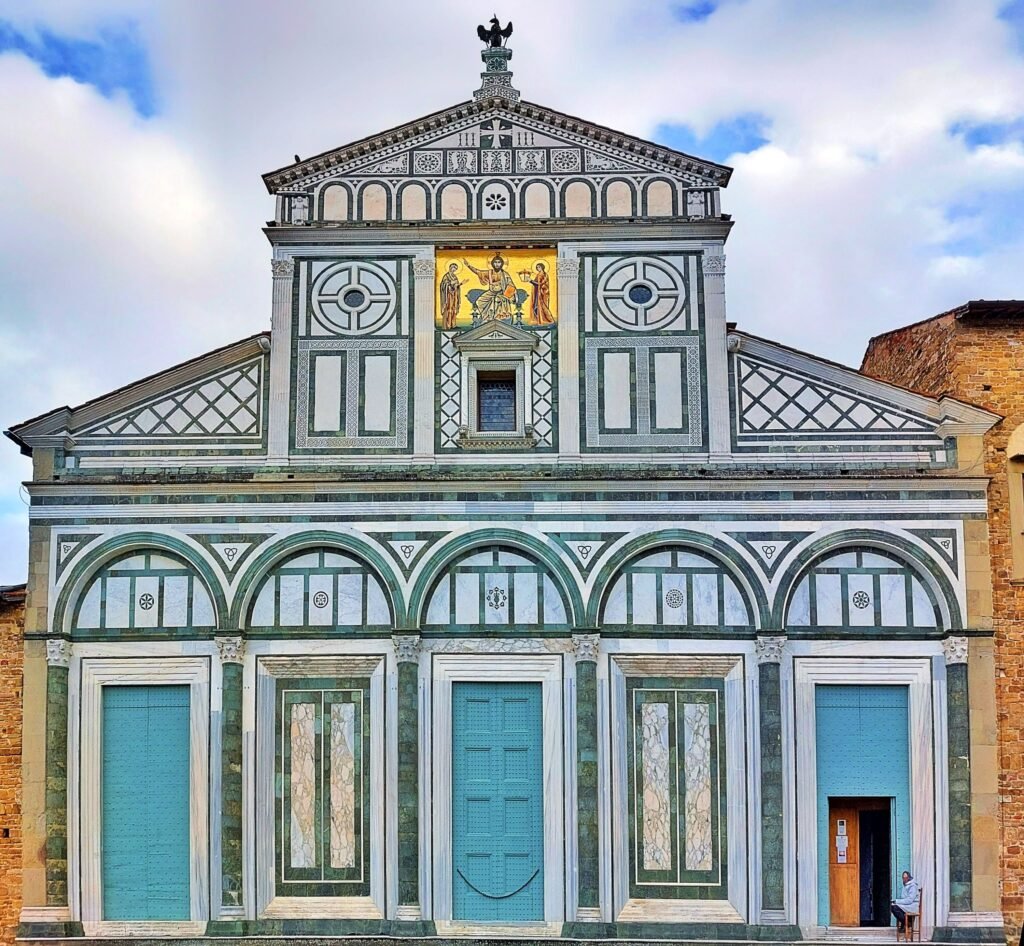
Abbazia di San Miniato al Monte (1018): il marmo bianco-verde, il mosaico absidale e la cripta romanica sopra Firenze
Si sale per una scalinata di cipressi e all’improvviso c’è Firenze tutta sotto, e davanti la facciata a tarsie di marmo bianco e verde che da mille anni detta la regola del bello fiorentino. Dentro, un mosaico d’oro nell’abside, un pavimento con i segni zodiacali del 1207 e una cripta a trentotto colonne dove riposa il martire Miniato.
At a glance
San Miniato al Monte crowns a hill on the south bank of the Arno, above Piazzale Michelangelo, with one of the most famous views in Florence. Begun around 1018 over the burial place of Minias, an early Christian martyr, it is among the finest Romanesque churches in Tuscany and one of the oldest religious buildings in the city still in use. Its geometric two-tone facade — white Carrara marble and green Prato serpentine — shaped Florentine architecture for centuries. Administered by Olivetan monks since 1373, it remains a living monastery, with daily Gregorian chant, an 11th-century crypt, a golden apse mosaic, and a zodiac marble floor.
Key facts
- Founded: c. 1018 by Bishop Hildebrand of Florence, over the oratory of the martyr Minias (San Miniato)
- Community: Benedictine, then Cluniac, and Olivetan since 1373 — the monks live there still
- Facade: Florentine Romanesque, white-and-green marble inlay, with a 13th-century golden mosaic of Christ between the Virgin and Saint Minias
- Apse mosaic: Christ in majesty with the Virgin, Saint Minias and the tetramorph, c. 1297, echoing the facade
- Marble floor: inlaid pavement dated 1207, with zodiac signs and a solar line that lights the sign of Cancer at the summer-solstice noon
- Crypt: the oldest part, 11th century, 38 columns, with vault frescoes by Taddeo Gaddi
History
According to tradition the Armenian-born martyr Minias was beheaded near Florence around 250 CE and buried on this hillside, where an oratory marked the spot. In 1018 Bishop Hildebrand founded a Benedictine monastery and began the present basilica; the nave and crypt were complete by the mid-12th century, and the interior decoration — the inlaid pavement (1207), the marble choir screen, the apse mosaic — continued through the 13th century. The community passed from the Benedictines to the Cluniac congregation and, in 1373, to the Olivetan branch, who remain.
The hill has a martial chapter too: during the Siege of Florence of 1529–1530, Michelangelo — charged with the city’s defences — fortified the campanile and, by tradition, hung it with mattresses and wool sacks to cushion enemy artillery. The bell tower itself had been rebuilt after a lightning strike in 1499.
What you see
The facade is divided into five bays by green-and-white pilasters, with blind arcading below and, above, the shimmering 13th-century mosaic of Christ enthroned. Inside, the raised presbytery is enclosed by a Romanesque marble choir screen and pulpit of 1207; the apse glows with the great mosaic of Christ between the Virgin and Saint Minias, surrounded by the symbols of the four Evangelists. The nave floor is a marble intarsia signed and dated 1207, set with the signs of the zodiac and with a fixed solar line: at local noon on the summer solstice a shaft of light falls on the sign of Cancer.
Below the presbytery, the 11th-century crypt — the oldest surviving part, its 38 slender columns carrying groin vaults — holds the relics of the martyr and fragments of 14th-century frescoes by Taddeo Gaddi. Off the church, the sacristy (c. 1387) is frescoed by Spinello Aretino with the Life of Saint Benedict, and the Chapel of the Cardinal of Portugal (1459–1467) is a jewel of early Renaissance art, uniting architecture with an altarpiece by Antonio and Piero del Pollaiolo, paintings by Alesso Baldovinetti, and a glazed-terracotta ceiling by Luca della Robbia.
Practical information
- Address: Via delle Porte Sante 34, Firenze
- Admission: free; donations welcomed; the monks sell honey and herbal products at the abbey shop
- Gregorian chant: the Olivetan community sings vespers daily — open to visitors
- Time needed: 45–60 minutes, plus the climb and the view
Getting there
From the Oltrarno, walk up from Porta San Miniato or Porta Romana (20–25 minutes), or take bus 12 or 13 to Piazzale Michelangelo and climb the final stairs (about 5 minutes). Parking near Piazzale Michelangelo is limited; the historic centre discourages cars. GPS: 43.7595° N, 11.2651° E.
Nearby
- Piazzale Michelangelo — the panoramic terrace just below the basilica, with a bronze copy of the David
- Giardino delle Rose & Giardino Bardini — terraced gardens on the slope toward the river
- Forte di Belvedere — Medici fortress with views and contemporary-art exhibitions
Sources
- Visit Tuscany (Regione Toscana) — “Basilica of San Miniato al Monte”
- Abbazia di San Miniato al Monte — official site
- Museum With No Frontiers / scholarly entries on the apse mosaic and crypt
Find it on the map
See this place and what’s around it →📷 Diventa un fotografo di Cultural Heritage Online
Condividi le tue foto dei luoghi: restano pubblicate con la tua firma come autore. Più vengono viste, più ti fai conoscere — e presto un concorso premierà le foto più apprezzate.
Accedi o registrati gratis per aggiungere una foto