
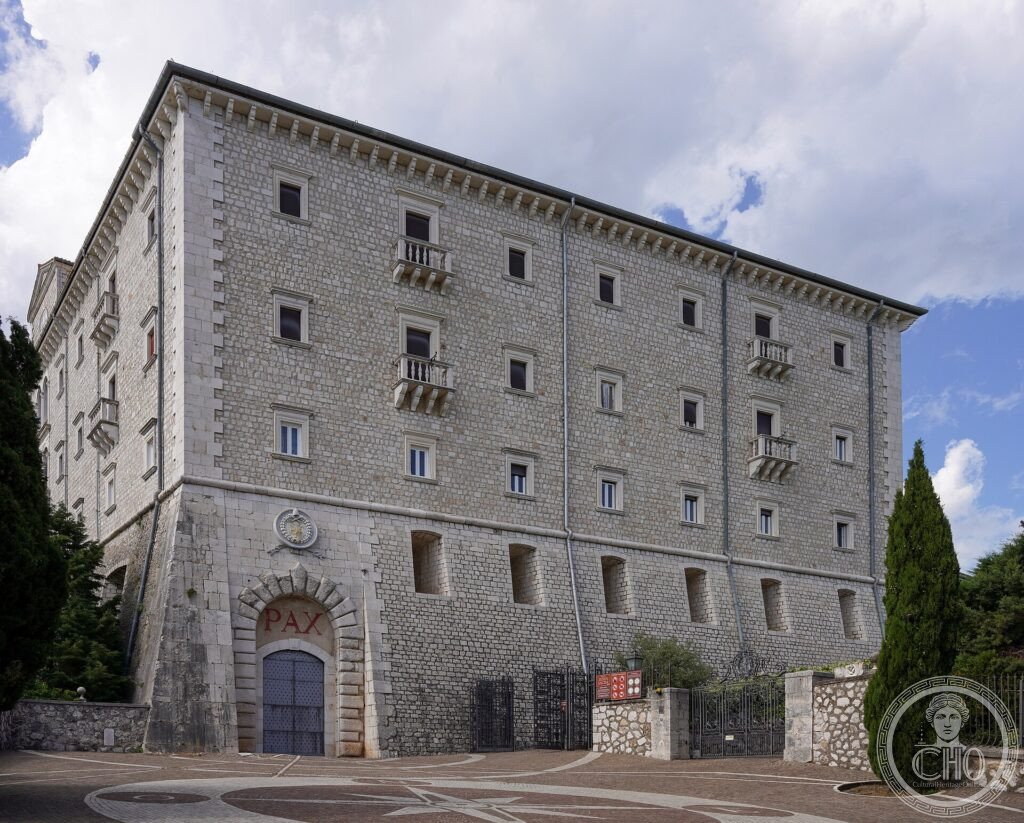
Abbazia di Montecassino (529 d.C.): San Benedetto e la Nascita del Monachesimo Occidentale
Nel 529, su questo monte tra Roma e Napoli, un giovane da Norcia distrusse un tempio pagano di Apollo e fondò una comunità religiosa che avrebbe cambiato l'Europa. San Benedetto da Norcia scrisse qui la sua Regula Monachorum — 73 brevi capitoli sull'obbedienza, la preghiera e il lavoro — e in tre secoli i suoi monaci avevano copiato i manoscritti, dissodato le foreste e insegnato a leggere a un continente uscito dal crollo dell'Impero Romano.
At a glance
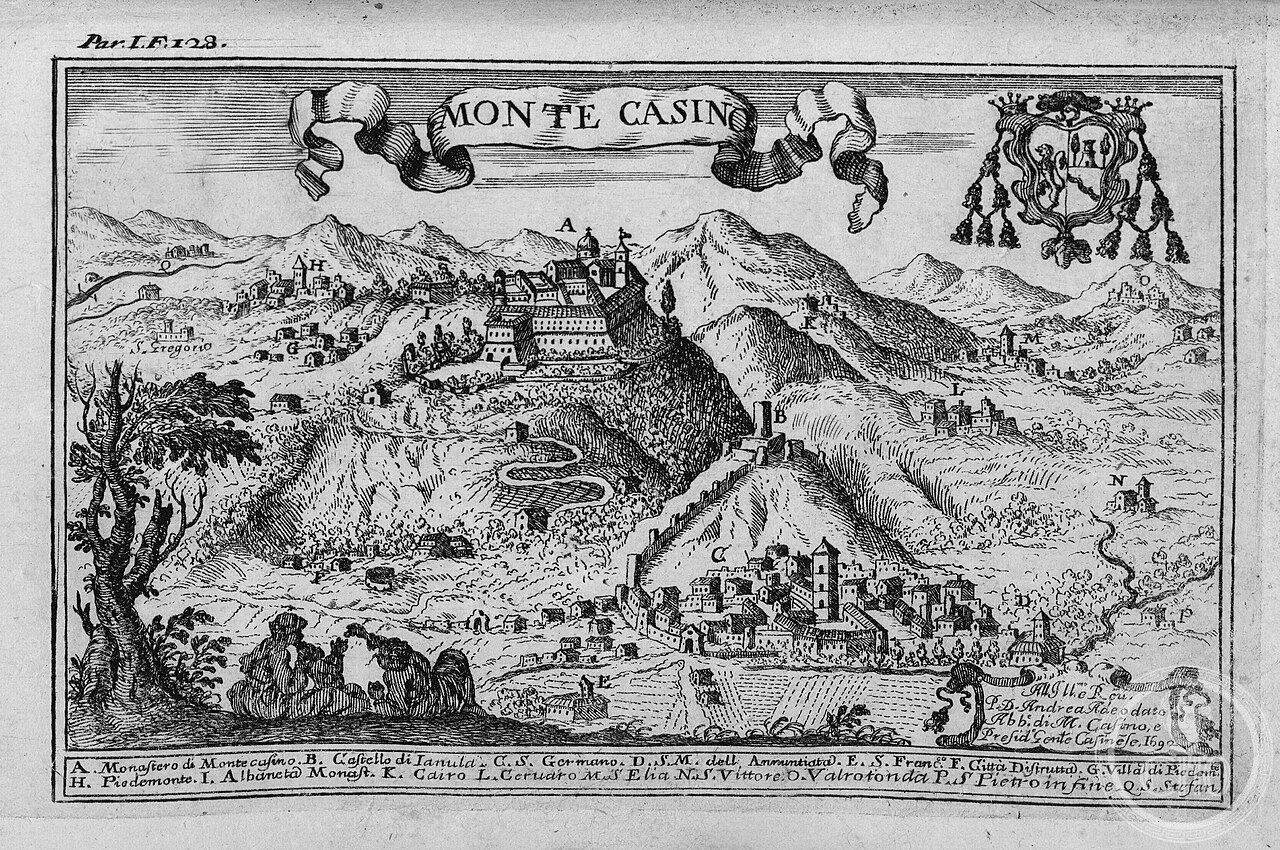
Montecassino stands at 519 m on an isolated limestone ridge above the town of Cassino (Frosinone, Lazio), 140 km south-east of Rome. The Benedictine abbey founded here in 529 by St Benedict of Nursia is the mother house of the Benedictine Order and one of the most influential religious institutions in the history of Western civilization. The Rule of Saint Benedict, written here c. 540, became the normative guide for monastic life throughout Europe and remains the basis of Benedictine, Cistercian, Trappist, and many other religious orders today. The abbey has been destroyed and rebuilt four times: by the Lombards (580), by the Saracens (884), by an earthquake (1349), and by Allied bombing during the Battle of Monte Cassino (February–May 1944). The current building is a faithful reconstruction of the 17th-century baroque abbey, completed in 1964 and consecrated by Pope Paul VI. The archive and library, which had been removed before the 1944 bombing, survive as one of the most important repositories of medieval manuscripts in Europe.
Key facts
- Founded: 529 AD by St Benedict of Nursia (480–547); patron saint of Europe; canonized by the Catholic Church; feast day 11 July
- The Rule of Saint Benedict: written at Montecassino c. 530–540; 73 chapters; prescribed daily schedule (Liturgy of the Hours: Vigils, Lauds, Prime, Terce, Sext, None, Vespers, Compline); the phrase ora et labora (prayer and work) encapsulates its spirit, though not a direct quote from the Rule
- Four destructions: 580 (Lombards), 884 (Saracens), 1349 (earthquake), 1944 (Allied bombing Feb–May, Battle of Monte Cassino: 80,000 casualties on all sides)
- Archive and library: ~40,000 volumes, 2,000 manuscripts, 200 incunabula; the 6th-century Codex Benedictus; removed before 1944 bombing and survived intact
- Today: active Benedictine community (~40 monks); open to visitors daily; UNESCO Memory of the World for the archive
- Burial: tomb of St Benedict and his sister St Scholastica in the crypt; visited by millions of pilgrims annually
History
Benedict of Nursia arrived at Monte Cassino around 529 after years as a hermit in the cave at Subiaco (see also Sacro Speco di Subiaco). He destroyed the existing temple of Apollo on the hilltop, baptized the local population, and began building a monastery. Within 15 years he had written the Rule — a document of extraordinary practical wisdom that prescribed not an impossible asceticism but a measured, sustainable life of communal prayer, manual work, and study. The Rule spread through Europe via the Lombard invasions (which paradoxically carried Benedictine monks as refugees to England, France, and Germany), and by the 8th century it had become the standard for monastic life from Ireland to Poland.
The first destruction came in 580, just 33 years after Benedict's death, when the Lombards sacked the abbey. The monks fled to Rome, taking the manuscript of the Rule and Benedict's own texts. Rebuilding began in the 8th century under Abbot Petronax, and the abbey rose to its medieval peak under Desiderius (abbot 1058–1087, later Pope Victor III), when it employed Byzantine craftsmen to create mosaics and became a centre of manuscript production and Benedictine reform. The Saracen raid of 884 caused the second destruction; the earthquake of 1349 the third. Each time the abbey was rebuilt, retaining and sometimes exceeding its earlier grandeur. The 17th-century building that was destroyed in 1944 had been one of the finest Baroque complexes in southern Italy.
The Battle of Monte Cassino (January–May 1944) was among the bloodiest of the Italian campaign: the German defensive line (the Gustav Line) used the mountain as an anchor, and four Allied offensives were needed to break through. The abbey itself was bombed on 15 February 1944 under the mistaken belief it was being used as a German observation post (subsequent inquiry found it had not been). The ruins were used by German paratroopers after the bombing. Reconstruction began in 1944 and was completed in 1964.
What you see
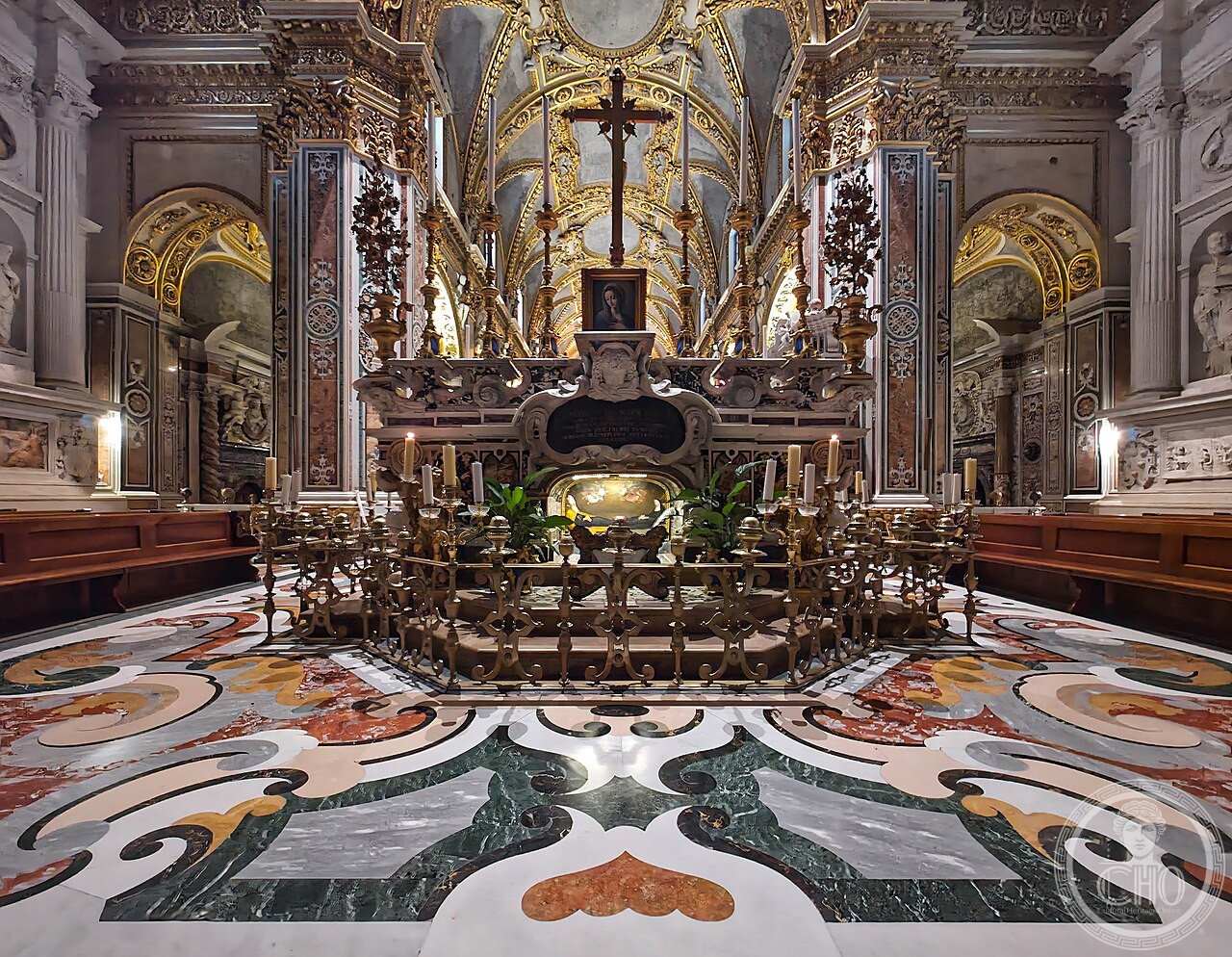
The approach to Montecassino from Cassino town is by car or bus up a steep winding road (8 km). The abbey complex is entered through a series of courtyards of increasing grandeur: the first (Cortile della Rocca) leads to the Loggiato del Paradiso (with its famous view south toward Naples); the second (Chiostro dei Benefattori) is lined with white marble statues of benefactors; the third (Chiostro di Bramante, named retrospectively) leads to the church. The basilica, rebuilt in 1727–1766 to designs by Luigi Vanvitelli and again post-1944, has a single nave with side chapels and a rich inlaid marble floor (Cosmatesque in inspiration, 20th-century execution). The crypt contains the tomb of Benedict and Scholastica. The abbey museum has medieval manuscripts, Byzantine artefacts, and documentation of the 1944 destruction and reconstruction. The War Cemetery with 1,072 Commonwealth graves is below the abbey.
Practical information
- Opening hours: daily 08:30–12:30 and 14:30–17:00 (winter) / 18:00 (summer); closed during religious services
- Admission: free; museum: small fee
- Dress code: shoulders and knees covered; shawls available at entrance
- Time needed: 1.5–2.5 hours (abbey + museum + war cemetery)
Getting there
By train to Cassino (Rome Termini, 1h20), then taxi or local bus up to the abbey (8 km). By car from Rome (140 km south-east): A1 Autostrada del Sole, exit Cassino; signs to Abbazia from town. GPS: 41.4931° N, 13.8139° E.
Nearby
- Commonwealth War Cemetery — below the abbey; 1,072 graves; one of three Allied war cemeteries in the Cassino area (also Polish Military Cemetery, German War Cemetery at Caira)
- Museo Historiale di Cassino — in Cassino town; documentation of the four battles of Monte Cassino (1943–44)
- Sacro Speco di Subiaco — 100 km north-west; the cave hermitage where Benedict lived before founding Montecassino; remarkable 13th-century frescoes
Sources
- Wikipedia — “Monte Cassino” (en.wikipedia.org/wiki/Monte_Cassino)
- Gregory the Great, Dialogues Book II (6th century) — primary source on Benedict's life at Montecassino
- Bloch, H., Monte Cassino in the Middle Ages, 3 vols., Rome 1986
- BBC — Battle of Monte Cassino: documentary archive
Find it on the map
See this place and what’s around it →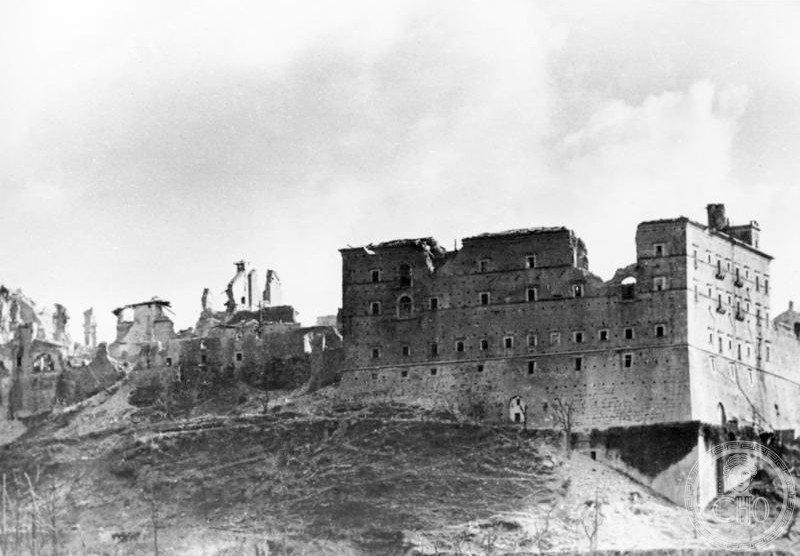
📷 Diventa un fotografo di Cultural Heritage Online
Condividi le tue foto dei luoghi: restano pubblicate con la tua firma come autore. Più vengono viste, più ti fai conoscere — e presto un concorso premierà le foto più apprezzate.
Accedi o registrati gratis per aggiungere una foto