The Tomioka Silk Mill and Related Industrial Heritage, inscribed by UNESCO in 2014, documents Japan’s transformation from the world’s largest raw-silk exporter into an industrial nation in the Meiji period (1868–1912). The Tomioka Silk Mill was established in 1872 by the Meiji government as a model factory: French silk-reeling machinery, French engineers led by Paul Brunat, and a purpose-built brick complex on the Gunma plain that transferred mechanical silk production technology to Japanese workers within a single generation. The complex operated continuously from 1872 to 1987 — 115 years — and survived intact because its owners (including Mitsui and Katakura) recognized its industrial heritage value and chose preservation over demolition.
The Kanto plain and the silk geography Nikko · Kamakura · Tokyo — 80 to 140 km
Eighty kilometres northeast of Tomioka via JR Takasaki Line north and Nikko Line (approximately 2 hours), the Shrines and Temples of Nikko in Tochigi Prefecture document the Tokugawa political tradition within whose economic framework the Gunma sericulture industry developed. The Gunma basin’s mulberry cultivation — the key precondition for silkworm raising that made Tomioka viable — was concentrated in exactly the area administered by the Edo-period Takasaki and Maebashi domains, both of which were Tokugawa vassal territories whose revenue included silk taxes. The silk thread produced in Gunma reached the Edo market through the Nakasendo highway, one of the five Edo-period post roads that converged at Nihonbashi in Edo; Nikko stands at the northern terminus of the Nikko Kaido that branched from the Nakasendo. The Yomeimon Gate of the Toshogu Shrine at Nikko, with its 508 carved figures applied to a single 7-metre gate arch, represents the Tokugawa court’s expenditure of precisely the surplus wealth that the Gunma sericulture economy and its successors generated. From Tomioka, Nikko is reached by JR Takasaki Line to Takasaki and Shinkansen to Utsunomiya, then Tobu Nikko Line (approximately 2 hours).
One hundred kilometres south by JR to Takasaki and Shonan-Shinjuku Line to Kamakura (approximately 2 hours), the early medieval Buddhist and Shinto heritage of Kamakura — though not itself a UNESCO World Heritage Site — anchors the southern extension of the Kanto heritage circuit from Tomioka. The Kotoku-in Great Buddha, cast in 1252 CE and measuring 13.35 metres, is one of the most documented monuments of the Kamakura period in which the Minamotoclan established the political pattern that the Tokugawa shogunate ultimately perfected. Kamakura is included in Japan’s Tentative List for UNESCO inscription; the absence of formal inscription makes Tomioka one of the few fully inscribed UNESCO sites serving as a practical hub for Kanto heritage itineraries that include Kamakura. From Tomioka, the journey to Kamakura by JR connections takes approximately 2.5 hours, making it feasible as a two-site day from a Tokyo or Shinjuku base.
One hundred forty kilometres southeast of Tomioka by JR Takasaki Line to Ueno (approximately 90 minutes), Tokyo holds the National Museum of Western Art, inscribed as part of the Architectural Work of Le Corbusier in 2016. The museum building was completed in 1959 as a direct result of a diplomatic agreement through which the French government returned Japanese art held in France since before World War II — a negotiation conducted in the same postwar diplomatic framework that defined Japan’s international position after the Meiji modernization that the Tomioka mill represented. Le Corbusier designed the museum’s “Musée à croissance illimitée” (Unlimited Growth Museum) as a spiral building expanding outward from a central courtyard — the only example of this building type in the world executed by Le Corbusier himself. The museum stands in Ueno Park alongside the Tokyo National Museum, the National Museum of Nature and Science, and the Tokyo University of the Arts — making the Ueno park complex the densest museum concentration in Japan and the natural endpoint of a Tomioka-to-Tokyo rail day.
One hundred forty kilometres south-southeast via Shinkansen to Omiya and JR Keihin-Tohoku Line (approximately 90 minutes), Yokohama City holds no UNESCO inscription but was the primary export port through which Tomioka’s silk reached European and American markets. Yokohama was opened as a treaty port in 1859, 13 years before the Tomioka mill’s establishment; the silk warehouses and broker offices of Yokohama’s Benten-dori commercial district handled the raw silk thread that Gunma’s sericulture produced and that Tomioka’s machine reeling processed. The physical connection between the Tomioka mill and the Yokohama port — linked by dedicated silk-carrying roads and the Takasaki Railway (opened 1884) — is one of the clearest product-to-market chains in Meiji industrial history. From Tomioka, Yokohama’s Silk Museum and Kanagawa Prefectural History Museum are reached in approximately 2 hours by JR.
North to the Joetsu mountains and beyond Sado Island · Hiraizumi — 280 to 500 km
Two hundred eighty kilometres northwest of Tomioka by Hokuriku Shinkansen from Takasaki to Niigata (approximately 80 minutes) and Sado Kisen jet ferry (60 minutes), Sado Island holds the Sado Island Gold Mine (inscribed 2024), Japan’s most recent UNESCO addition. The mine produced gold for the Tokugawa mint from the 17th century through 1989 CE, supplying the same monetary system that financed the samurai domain economy within which Gunma’s sericulture was embedded. The gold oban and koban coins of the Edo period circulated as the shogunate’s premium currency while silk thread from Gunma served as a quasi-currency in provincial trade — the two commodities occupied parallel positions in the Tokugawa economic system. From Tomioka, the Sado circuit is a full-day trip (JR to Takasaki, Shinkansen to Niigata, ferry to Sado, ferry back, Shinkansen to Tokyo, JR to Tomioka — approximately 10 hours of travel); most visitors base themselves in Niigata and make the ferry and Tomioka as separate days.
Five hundred kilometres north of Tomioka by Tohoku Shinkansen from Tokyo to Ichinoseki (approximately 2.5 hours) and JR Tohoku Main Line to Hiraizumi (5 minutes), the Temples, Gardens and Archaeological Sites of Hiraizumi in Iwate Prefecture form the northern terminus of a Japan UNESCO axis running from the Kii Mountains through the Kanto sites to the Tohoku. The Konjikido (Golden Hall) at Chusonji temple, with its gold-leaf interior and mummified Fujiwara lords beneath the altar, represents a 12th-century expression of Buddhist authority over the same northern Japan that the Meiji state’s industrial programme — exemplified by Tomioka — incorporated into a national economy seven centuries later. The sericulture geography of Gunma and the Buddhist capital geography of Hiraizumi represent consecutive phases of northern Honshu’s integration into Japanese political economy: first as a Buddhist frontier state, then as an industrial supplier. From Tomioka, Hiraizumi requires a Tokyo Shinkansen connection and is most practical as part of a multi-day Tohoku itinerary.
Practical information
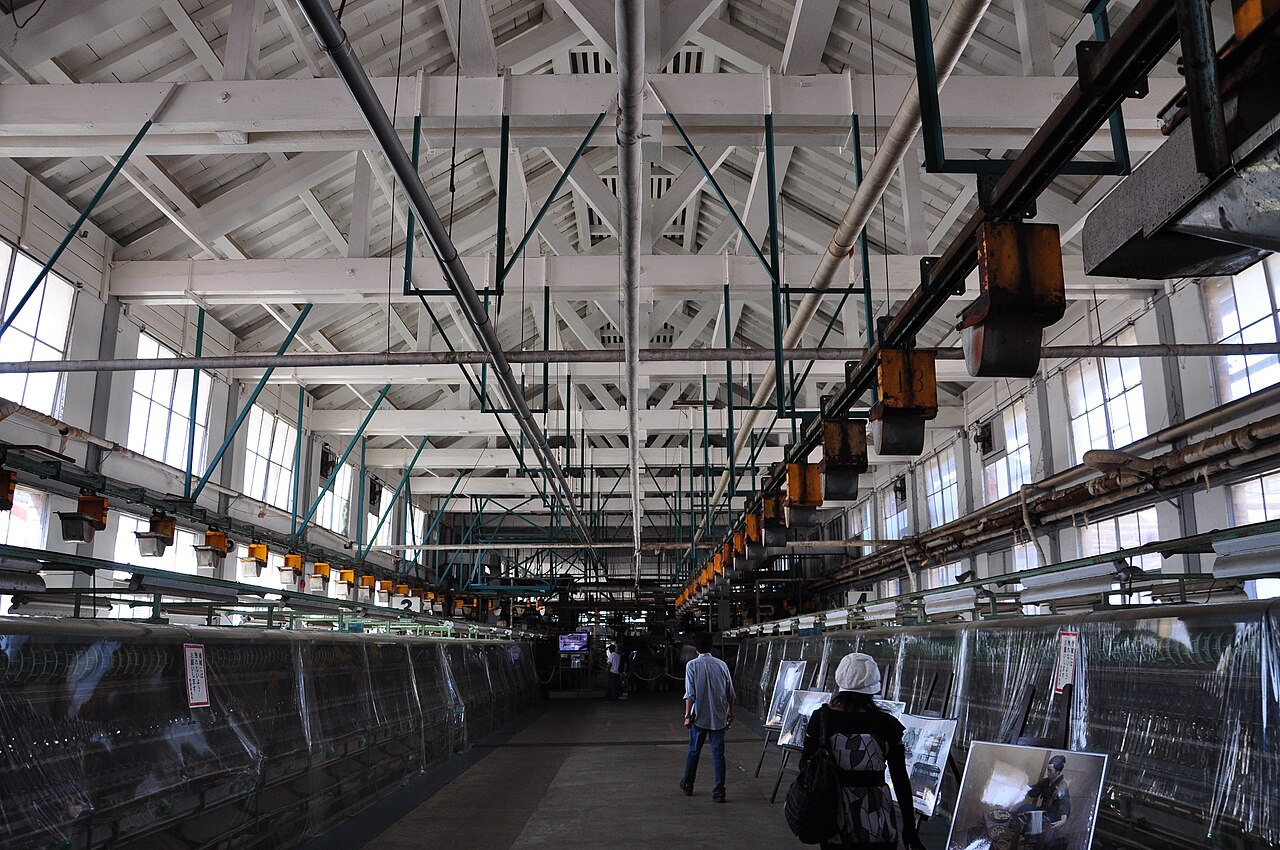
The Tomioka Silk Mill is in Tomioka City, Gunma Prefecture, approximately 50 kilometres west of Takasaki. From Tokyo (Ueno or Shinjuku), the journey by JR Takasaki Line to Takasaki (approximately 80 minutes) and Joshin Dentetsu Line to Joshu-Tomioka (30 minutes) takes approximately 110 minutes total; the mill is 15 minutes on foot from Joshu-Tomioka Station. The mill complex is open daily except Tuesdays (and the following Wednesday if Tuesday is a holiday), with last entry at 16:30. The entry fee covers the East Silk Reeling Building (the 1872 original French-designed machine hall, 140 metres long in red-brick and Douglas fir timber-frame construction), the West Silk Reeling Building, the Cocoon Warehouse, and the Brunat House — the French engineer’s residence, the only French-style brick residential structure in Japan. Guided tours in Japanese are included in the admission fee; English audio guides are available. The Tomioka Silk Mill is the primary inscribed component; the three satellite sites of the UNESCO inscription — Tajima Yahei Sericulture Farm (Maebashi), Takayama-sha Sericulture School (Fujione), and Arafune Cold Storage (Matsuida) — are spread across the Gunma plains and require a car or rural bus connections. A full circuit of all four inscription components is most conveniently done with a rental car from Takasaki (approximately half a day). Tomioka City holds a Silk Hall museum adjacent to the mill with permanent displays on the Meiji-period technology transfer and the social history of the 2,000 women who worked in the mill at peak production.
Frequently Asked Questions
Why did the Meiji government choose Tomioka as the site for Japan’s model silk mill?
The selection of Tomioka in Gunma Prefecture for the Meiji government’s model silk mill in 1871 was based on four factors specific to the location. First, Gunma was the centre of Japan’s existing sericulture and hand-reeling industry — the prefecture produced more raw silk than any other region in Japan, and the workforce had knowledge of silkworm cultivation and cocoon processing that mechanical reeling could build upon. Second, the Tomioka area had abundant clean water from the Karabori River, essential for the silk-reeling process, which requires large quantities of hot water to soften and unravel the cocoons. Third, the proximity to the Joshu-Nakasendo highway — one of the Edo-period post roads — meant that the cocoon supply from surrounding villages and the refined thread’s transport to Yokohama port could use established road infrastructure. Fourth, the site’s flat terrain and available land allowed construction of the 140-metre reeling hall without significant earthwork. The French engineer Paul Brunat, commissioned by the Meiji government’s Ministry of Finance to design and manage the mill, chose the brick construction method specifically because Gunma had clay soils suitable for making the 1.5 million bricks the buildings required; the brick was fired on-site. The choice of French machinery and French management was itself a political decision — the Meiji government was benchmarking against the Lyon silk industry, which in 1872 was the world’s technical benchmark for mechanized silk production.
What happened to the mill after the Meiji period and why did it survive so intact?
The Tomioka Silk Mill operated continuously from its 1872 opening through 1987, when Katakura Industries closed it after 115 years of silk production. The mill passed through three ownership phases: government operation from 1872 to 1893, Mitsui family ownership from 1893 to 1938, and Katakura Industries from 1938 to 1987 closure. Throughout all three phases, the original 1872 structures were maintained and the machinery updated but the building fabric preserved. When Katakura Industries closed the mill in 1987, they transferred ownership to Tomioka City in 2005 under an agreement that included a commitment to preservation and public access. The mill’s survival without significant demolition or alteration is extraordinary by international comparison: most 19th-century industrial buildings of equivalent age and scale have been demolished for redevelopment. The specific factors that preserved Tomioka are: the building’s brick and timber construction required no costly asbestos remediation (unlike many 20th-century industrial buildings), the scale of the building made it impractical to demolish incrementally, and local civic identity became strongly attached to the mill’s presence in the community before any serious demolition pressure developed. The 1872 machines are gone — replaced multiple times over 115 years of production — but the 1872 building fabric, including the original Douglas fir roof trusses imported from the United States, survives in approximately 90% of its original condition.
How did the Tomioka Silk Mill change Japanese women’s work and social position?
The Tomioka Silk Mill employed approximately 400 women in its initial 1872 workforce, drawn from samurai families across Japan through a recruitment campaign that specifically targeted daughters of the former warrior class. The Meiji government’s choice of samurai families was deliberate: the technology transfer required workers who could read the operating manuals and train other workers, and samurai daughters had higher literacy rates than the general female population. The mill’s initial female workforce came from as far as Hokkaido and Kyushu, lived in dormitories on the mill grounds, worked a 7-hour day with regulated breaks, received wages paid in cash rather than in kind, and were entitled to holidays on the 1st and 15th of each month. These conditions — unusual in Japan in 1872 — were stipulated by the French engineer Brunat and reflected French factory labour practices of the period. Former mill workers who returned to their home prefectures after training became the primary technology transfer agents for mechanized silk reeling in their home regions, establishing regional mills that replicated the Tomioka model. By 1890, the silk-reeling industry employed approximately 130,000 women in Japan, making it the country’s largest female industrial workforce. The social consequence — young women leaving rural households to earn independent wages in urban factory settings — is documented by historians as one of the primary mechanisms through which the Meiji period disrupted the Edo-period household economy and created conditions for Japan’s 20th-century industrialization.
Sources
- S1 — UNESCO World Heritage Centre — Tomioka Silk Mill and Related Sites (Ref. 1449) — https://web.archive.org/web/20230601000000/https://whc.unesco.org/en/list/1449/
- S2 — UNESCO World Heritage Centre — Statement of Outstanding Universal Value (Ref. 1449) — https://whc.unesco.org/en/list/1449/
Spotted an error? Write to editorial@culturalheritageonline.com and we correct it the same day.