
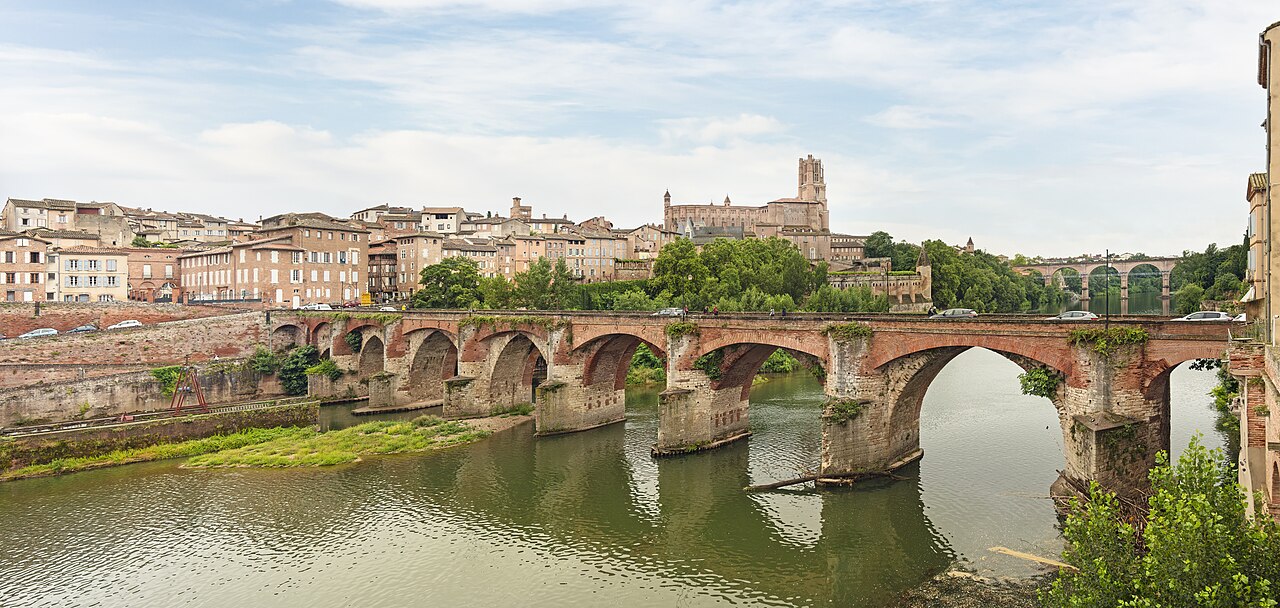
The Episcopal City of Albi, inscribed in 2010, is dominated by the fortified Sainte-Cécile Cathedral (begun 1282) — the world’s largest brick cathedral, built in a distinctive fortified Gothic style as an expression of Inquisitorial power after the Albigensian Crusade against the Cathars. The Bishop’s Palace next door is now the world’s largest collection of Toulouse-Lautrec paintings. Carcassonne and the Canal du Midi extend the southern France heritage itinerary westward.
Episcopal City of Albi: The Cathedral the Inquisition Built City centre, on the Tarn river
The Episcopal City of Albi, inscribed in 2010 under criteria (ii) and (iv), is an ecclesiastical city on the Tarn river in the Languedoc, dominated by the Cathédrale Sainte-Cécile — the largest brick structure in the world and one of the most unusual Gothic cathedrals in Europe: built not as an expression of divine transcendence but as an explicit statement of military and doctrinal power by the bishops who served as agents of the Inquisition after the Albigensian Crusade. Construction of the cathedral began in 1282 — sixty years after the Cathar Crusade began — under Bishop Bernard de Castanet, who was simultaneously the bishop of Albi and a leading Inquisitor prosecuting the remnants of Catharism in the region. The building’s mass — 113 metres long, 35 metres wide, 40 metres high at the nave, without buttresses (so that no shadow lies outside the walls of the church, and no space within which heretics could shelter) — was designed to be seen from 20 km across the Tarn plain as the undeniable visible proof of Catholic supremacy. The interior was decorated between 1494 and 1512 with a Last Judgment fresco over the western portal (the largest surviving Gothic Last Judgment in France, 200 square metres) and from 1509 with one of the most elaborate rood screens in Gothic architecture (the Jubé, in white stone carved in an Italianate flamboyant Gothic style, with more than 200 individual figures). The interior is also covered with Italian-influenced polychrome painting of 1509–1512 that transforms the naked brick into a richly coloured environment unique in French Gothic.
Musée Toulouse-Lautrec: The World’s Largest Collection Palais de la Berbie, adjacent to the Cathedral
The Palais de la Berbie (Bishop’s Palace, built from 1228), one of the earliest European examples of a palace built as a fortress rather than as a residence (its massive towers recall a military castle more than an episcopal residence), was donated by the State to the City of Albi in 1905 and now houses the Musée Toulouse-Lautrec — the largest collection in the world of works by Henri de Toulouse-Lautrec (1864–1901), the Albi-born Post-Impressionist painter whose posters and paintings of Montmartre’s nightlife (the Moulin Rouge, the café-concerts, the maisons closes) created the definitive visual image of 1890s Paris bohemian culture. The museum holds over 1,000 works: the complete series of Moulin Rouge posters (1891–1896), the Jane Avril and Yvette Guilbert portrait series, and the paintings of private scenes in the maisons closes that Toulouse-Lautrec was one of the few artists of his period to document without moral judgment. The museum’s architecture — the thirteenth-century episcopal castle rooms with their vaulted ceilings — is as significant as the collection.
Pont Vieux: France’s Oldest Bridge in Daily Use Tarn river, 5 mins walk
The Pont Vieux (Old Bridge) of Albi, built c. 1035 CE in red brick on eleven pointed arches spanning the Tarn, is the oldest bridge in France still in daily use as a pedestrian crossing — 1,000 years of continuous service as the main crossing of the Tarn at Albi. Its low profile and pointed arches (designed to reduce water resistance and allow the seasonal flooding of the Tarn to pass without destroying the piers) are characteristic of Romanesque bridge engineering in southern France; comparable bridges survive only in fragments at Avignon and Saint-Bénézet. The Pont Vieux appears in works by Henri de Toulouse-Lautrec (who grew up with this view), and its silhouette against the cathedral and bishop’s palace has been painted and photographed more than any other subject in the Albi civic heritage.
Cordes-sur-Ciel: Cathar Bastide in the Sky 🚗 ~25 mins north
Cordes-sur-Ciel (Cordes in the Sky), 25 km north of Albi, is not UNESCO-inscribed but is one of the most dramatically positioned medieval villages in France — a thirteenth-century bastide (planned new town) built on a conical isolated hilltop at 296 metres by the Count of Toulouse in 1222, immediately after the Albigensian Crusade. The village was founded as a refuge for Cathar survivors; its eight concentric rings of fortified walls (each added as the population grew into the hill’s slopes) and the streets of Gothic mansions from the 1260s–1290s represent the most intact medieval commercial architecture of thirteenth-century Languedoc. The Grand Rue (ascending the central ridge of the hill) is flanked by Gothic palaces (Maison du Grand Fauconnier, Maison du Grand Veneur) carved in a naturalistic style unusual for the thirteenth century — sculpted hunting scenes with dogs, falconers, and wild animals that reflect the prosperity of the Cathar merchants who funded them before the Inquisition effectively ended their community.
Practical information
Albi is 75 km northeast of Toulouse; trains from Toulouse (1 hr, frequent) and TGV connections from Paris (4 hrs via Toulouse) make it accessible. The Cathedral, Bishop’s Palace Museum, and Pont Vieux are all within 10 minutes’ walk; the full historic centre circuit (including the medieval Tarn riverfront and the Sainte-Cécile’s interior painted ceiling and rood screen) takes 3–4 hours. The museum is open daily except Tuesday; the cathedral is open 9 a.m. daily. Cordes-sur-Ciel is 25 km north by car; the village is steep and partially accessible only on foot. Carcassonne is 100 km southwest (1 hr by car). The best season for Albi is May–October; the Grands Crus d’Albi wine festival and the Toulouse-Lautrec Festival (August) are the main cultural events. Albi’s market (Saturday morning, Place du Vigan) is one of the best in the Tarn département.
Frequently Asked Questions
Is Albi a UNESCO World Heritage Site?
Yes. The Episcopal City of Albi was inscribed in 2010 under criteria (ii) and (iv). The inscription covers the Cathedral of Sainte-Cécile, the Palais de la Berbie (now the Musée Toulouse-Lautrec), the Pont Vieux, and the historic urban fabric of the medieval episcopal city on the Tarn — a cohesive ensemble that documents the assertion of Catholic authority in the Languedoc in the aftermath of the Cathar Crusade.
Why is the Sainte-Cécile Cathedral built like a fortress?
The Cathedral of Sainte-Cécile was designed as a fortress because it was built in the immediate aftermath of the Albigensian Crusade (1209–1229) — the papal campaign against the Cathar heresy in the Languedoc. Bishop Bernard de Castanet, who began construction in 1282, was simultaneously a leading Inquisitor prosecuting the surviving Cathar communities. The cathedral’s massive windowless lower walls, lack of buttresses, single entrance (the south porch, added 1519), and sheer brick mass were deliberate signals: that the Catholic Church would never again be driven from this region, and that the power of the Inquisition was materially embedded in the landscape. It is the most explicit piece of ecclesiastical architecture-as-political-statement in medieval Europe.
What is Toulouse-Lautrec’s connection to Albi?
Henri de Toulouse-Lautrec (1864–1901) was born in Albi into one of the oldest aristocratic families of the Languedoc. He suffered two leg fractures in childhood (1878 and 1879) that resulted in stunted growth below the waist — possibly caused by a genetic condition associated with his parents’ consanguineous marriage (they were first cousins). He moved to Paris in 1882 to study painting and documented the Montmartre nightlife with unprecedented intimacy; his colour lithograph posters (notably the Moulin Rouge-La Goulue poster of 1891, which effectively invented the modern concert poster) are among the most reproduced artworks of the nineteenth century. He died of syphilis and alcoholism at 36; his mother brought his works to Albi after his death, where they remain.


_North_views_of_the_Ste_C%C3%A9cile_Cathedral_and_the_Old_Bridge.jpg)