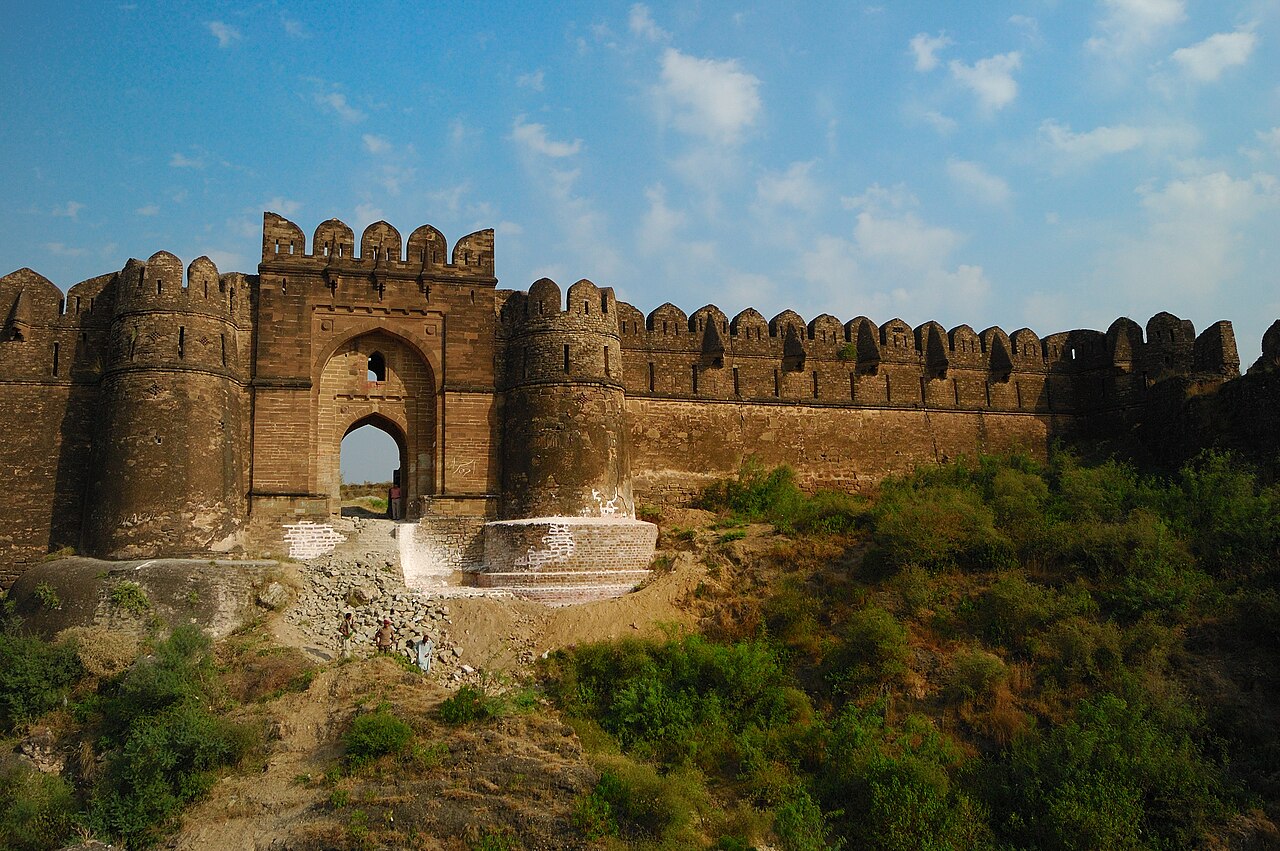
Rohtas Fort, inscribed on the UNESCO World Heritage List in 1997, was built between 1541 and 1543 by Sher Shah Suri — the Afghan ruler who temporarily expelled Mughal Emperor Humayun from the subcontinent — as a military base to control the Gakhhar tribe of the Potohar Plateau and to forestall Humayun’s anticipated return from Persia. The fort’s 4-kilometre perimeter wall, 12 individually designed gates, and 68 bastions were completed in just three years using paid local labour, without the press-ganging or enslavement common to large construction projects of the era. The fort never withstood a siege in its entire history: Humayun reclaimed Lahore in 1555 by negotiation, and Rohtas surrendered without combat.
Rohtas Fort: The Afghan Military Stronghold Built in Three Years and Never Tested in Battle Jhelum district, Punjab; 100 km southwest of Islamabad
Rohtas Fort occupies a rocky promontory above the Kahan stream in what is now Jhelum district, Punjab province of Pakistan. The site was chosen by Sher Shah Suri for its natural defensive advantage — the streams cut deep ravines on two sides of the promontory — and its strategic position on the trade and military routes connecting Punjab to the northwest frontier. The name “Rohtas” may derive from Rohtasgarh, a fort in Bihar that Sher Shah had previously captured from a Hindu Raja, though the etymology is uncertain.
Sher Shah Suri, born in the late 15th century to an Afghan noble family in the Suri confederation, rose to power as an officer in the service of the Mughal emperor Babur’s successor, Humayun. He defeated Humayun at the Battle of Chausa (1539) and again at Kannauj (1540), forcing the Mughal emperor into exile in Persia, and established the Sur Empire across North India. His reign lasted only five years (he died in a gunpowder accident at Kalinjar in 1545), but it was extraordinarily productive in administrative and infrastructural terms. Sher Shah reorganised the revenue system, established a postal relay system across the empire, rebuilt the Grand Trunk Road from Bengal to the Khyber Pass, and built Rohtas Fort — all within the same five-year period.
The fort’s construction chronology is documented in Persian chronicles as three years, which given the scale of the project is remarkable. The 4-kilometre perimeter wall reaches heights of up to 18 metres in sections and is constructed from locally quarried stone set in lime mortar, with a rubble core faced with dressed ashlar. The 68 bastions project outward from the wall at intervals, each semicircular or polygonal in plan and designed to allow flanking fire along the wall faces. The 12 gates are the architecturally most expressive elements of the fort: each has a distinct design, and together they demonstrate a synthesis of Afghan Pashtun military conventions with Indian stone-carving traditions that distinguishes Suri-period architecture from both Mughal and Rajput work.
The Kabuli Gate is the largest of the 12 gates. It faces northwest in the direction of Kabul — the gate’s name recording its orientation — and features a pointed arch approximately 15 metres high set between two round towers with an octagonal superstructure. The arch soffit is decorated with a band of Quranic inscription in carved stone. The overall composition reflects the Pashtun architectural tradition that Sher Shah brought from his Afghan background, while the quality of the stone carving in the decorative panels flanking the arch belongs to the craft traditions of Punjab. The Sohail Gate, on the southern side, is named after a star and carries more elaborate decorative carving. The Langar Khani Gate originally served the kitchen complex (langar) that provided food to labourers and later to the fort’s garrison.
The Shahi Masjid (Royal Mosque) inside the fort walls was built during the Suri period and is the principal religious structure within the fortification. It is a small five-bay mosque with brick-constructed arched openings, modest in scale by comparison with the fortification that surrounds it, but significant as evidence that Sher Shah intended Rohtas as a permanent garrison town rather than a purely military structure. A small palace foundation (Haveli Man Singh, named after the Mughal commander who used the fort under Akbar) and the ruins of residential structures indicate that the fort was intended to house a substantial permanent population. A village inside the fort walls has been continuously occupied into the present day, its residents living among and within the historic structures.
Sher Shah Suri died in May 1545 at the siege of Kalinjar fort in what is now Madhya Pradesh, killed when a rocket fired at the fort’s walls ignited a powder store near the Suri command position. He had never seen Rohtas in operational use as the fort for which he built it. Within ten years, Humayun had returned from Persia with a Safavid Persian army, recaptured Kabul and Kandahar in 1545–1546, and then systematically reclaimed northern India between 1554 and 1555. The Sur Empire’s generals did not hold Rohtas for him: the fort was surrendered without fighting, and Humayun’s commander received it intact. The elaborate gate system, the towering bastions, the provision for a large garrison — all of it was built to withstand a siege that never came.
Lahore Fort and the Mughal Imperial Legacy: 100 Kilometres Southwest 100 km southwest via Grand Trunk Road
Lahore Fort, inscribed in 1981, lies approximately 100 kilometres southwest of Rohtas via the Grand Trunk Road — the same road that Sher Shah Suri rebuilt between 1540 and 1545 as part of the administrative reorganisation of his empire. The historical connection between the two sites is direct: the Grand Trunk Road was Sher Shah’s infrastructure, and Lahore was the city that his road connected to Rohtas. When Humayun recaptured Lahore in 1555, one of the first things his son Akbar did after inheriting the empire in 1556 was to demolish or repurpose the Suri administrative structures and begin constructing the Mughal buildings that now dominate Lahore Fort.
Lahore Fort contains 21 notable monuments representing the building campaigns of every Mughal emperor from Akbar (1556–1605) to Aurangzeb (1658–1707). Shah Jahan built the Shish Mahal (Palace of Mirrors, approximately 50,000 mirror fragments set into plaster ceilings and walls) and the Naulakha Pavilion, named for the 900,000 rupees spent on its construction. Aurangzeb built the Alamgiri Gate (1674), the ceremonial entrance that faces the Badshahi Mosque — which Aurangzeb also built, completing it in 1673 as the world’s largest mosque (a distinction it held until 1986). The Shalimar Gardens, co-inscribed with the fort in 1981, were built by Shah Jahan in 1641 across three terraced levels with 410 fountains and 12 water channels. The gardens are now on UNESCO’s List of World Heritage in Danger due to road-widening construction that breached their historic perimeter wall in 2000.
The contrast between Rohtas Fort and Lahore Fort illustrates the different functions of military and imperial Mughal architecture. Rohtas was built to project force and control territory; its architecture is massive, functional, and largely unornamented except at the gate arches. Lahore Fort was built — and continuously rebuilt — to project imperial prestige and house the Mughal court. Its buildings use marble, glazed tile, pietra dura inlay, painted plasterwork, and elaborate jali (pierced screen) work in a sustained display of ornamental elaboration that was precisely calculated to communicate Mughal legitimacy and wealth. Rohtas was a tool of conquest; Lahore Fort was a monument to rule.
Taxila and the Ancient Heritage of the Potohar Plateau 80 km northwest via the Grand Trunk Road
Taxila (UNESCO 1980) lies approximately 80 kilometres northwest of Rohtas Fort — both sites occupy the Potohar Plateau, which has been one of the most historically significant zones in South Asia for over 2,500 years. The Taxila archaeological site encompasses three successive ancient cities — Bhir Mound (600–200 BCE), Sirkap (200 BCE–100 CE), and Sirsukh (from approximately 100 CE) — and the extensive monasteries and stupas associated with them, including the Dharmarajika stupa originally built by Emperor Ashoka in the 3rd century BCE.
The historical connection between Taxila and Rohtas is the Potohar Plateau itself — a strategic upland zone lying between the Punjab plains to the south and the Indus crossing points that give access to Afghanistan and Central Asia to the north. The plateau’s importance explains why it was the site of Taxila in antiquity, why Alexander the Great came through it on his way into India, why Ashoka chose it for one of his major Buddhist monuments, and why Sher Shah Suri chose to build Rohtas there to control the Gakhhar tribe and the road to Kabul. The Grand Trunk Road, as Sher Shah rebuilt it, passed through both the Taxila area and Rohtas, connecting them in a single continuous infrastructure.
Visitors to Rohtas can reach Taxila in approximately 90 minutes by road, passing through the Potohar landscape of flat-topped sandstone ridges, seasonal streams, and wheat and sugarcane agricultural land. The Taxila Museum near the Dharmarajika stupa holds the most significant collection of Gandharan Buddhist sculpture in situ — the same artistic tradition that spread from the Potohar and neighbouring Peshawar valley across all of Asia between the 1st and 5th centuries CE. The Dharmarajika stupa, the Jaulian monastery, and the Hellenistic-era city of Sirkap are the primary monuments at the site; the museum is closed on Mondays.
Hiran Minar, a Mughal structure 30 kilometres from Lahore and approximately 120 kilometres from Rohtas, though not UNESCO-listed, provides additional context for Mughal patronage in the Punjab region. Built by Emperor Jahangir in the early 17th century as a memorial to his favourite hunting deer (hiran means deer in Urdu), the 30-metre minaret stands in the centre of a large tank (reservoir) surrounded by Mughal gardens. The structure is a counterpoint to the military architecture of Rohtas: where Sher Shah built to control and defend, the Mughal emperors at their height could afford to build memorials to a pet animal in the middle of a hunting estate.
Practical information
Rohtas Fort is best visited between October and March, when temperatures in the Jhelum district range from 5°C to 22°C. Summer heat (May–August) regularly exceeds 40°C on the Potohar Plateau. The fort is approximately 7 kilometres from the town of Dina on the Grand Trunk Road (N-5), which is itself 16 kilometres from Jhelum city. From Lahore, the drive takes approximately 2 hours by motorway (M-2 to Islamabad direction, exit at Dina). From Islamabad, the drive is approximately 1.5 hours via the Grand Trunk Road toward Lahore. There is no regular public bus service directly to the fort from either city; the standard approach is to hire a private driver for the day. Local auto-rickshaws from Dina cover the 7 kilometres to the fort gate. No entrance fee is charged at the fort itself (as of 2024–2025); the Archaeology Department maintains the site but facilities are minimal. There is a small inhabited village inside the fort walls where residents can direct visitors to the main monuments. The Kabuli Gate, Shahi Masjid, and Sohail Gate are the three monuments most worth allocating time to; allow 2–3 hours for the full perimeter walk. Pakistan e-visa is available for most foreign nationalities (3–5 working days processing). Currency is the Pakistani rupee (PKR). Combined with a day visit to Lahore Fort (100 km southwest) or Taxila (80 km northwest), Rohtas makes a logical stop on a Punjab heritage circuit.
Frequently Asked Questions
Why did Sher Shah Suri build Rohtas Fort if it was never used in combat?
Sher Shah Suri built Rohtas Fort for two overlapping strategic purposes, neither of which required an actual battle to be fought for the fort to be effective. The primary stated purpose in the Persian chronicles of his reign was to suppress the Gakhhar tribe, a warrior clan that controlled the Potohar Plateau and the mountain passes leading to the Khyber. The Gakkhars had allied with Humayun and could be expected to support any Mughal attempt to reclaim India from the northwest. Building an enormous fort in Gakhhar territory, garrisoned by Suri troops, was a deterrence strategy: the fort’s presence neutralised Gakhhar power without requiring constant military campaigns against them. The secondary purpose was to provide a defensive strongpoint against Humayun’s anticipated return from Persia. Sher Shah’s intelligence network would have informed him that Humayun was at the Safavid court seeking military assistance, and a fortified base on the Potohar could slow or block a Mughal advance from the northwest. In the event, neither of these scenarios materialised as the fort’s designers imagined: Humayun returned through Afghanistan rather than being stopped at Rohtas, the Gakkhars did not mount a major coordinated offensive, and the fort changed hands without combat when the Sur commanders chose accommodation over resistance after Sher Shah’s death and the subsequent political fragmentation of the Sur Empire. The fort’s military effectiveness was thus demonstrated negatively — by deterring the attacks it was never required to repel — rather than through combat.
What is distinctive about the architecture of the 12 gates at Rohtas Fort?
The 12 gates of Rohtas Fort represent one of the most varied ensembles of fortification-gate architecture on any single site in South Asia, spanning a design range from purely functional structures to highly ornamented ceremonial entrances. Each gate has a distinct plan, elevation, and decorative programme. The Kabuli Gate (northwest-facing, toward Kabul) is the largest: a pointed arch approximately 15 metres high flanked by round towers with octagonal upper stages, decorated with a band of carved Quranic inscription along the arch soffit and geometric panels on the flanking piers. This gate served as the primary ceremonial entrance for the garrison and for official visitors arriving from the Kabul direction. The Sohail Gate (south side) has the most elaborate stone carving of the 12, with interlaced geometric patterns and floral borders that demonstrate the high standard of stone-carving craftsmanship available to Sher Shah’s construction management — a reminder that the fort was built quickly but not cheaply or carelessly. The Shishi Gate (Glass Gate) takes its name from the tile decorations that once covered its exterior surfaces, most of which have been removed over the centuries. The Langar Khani Gate (Kitchen Gate) was functionally named for the food-distribution facility (langar) associated with it, serving workers during construction and the garrison afterward. The gates collectively reflect the fusion of Afghan Pashtun military tradition — the heavy pointed arches and battered lower walls — with Indian craft traditions in stonework that characterises Suri architecture more broadly, distinct from both the Mughal refinement that followed and the Rajput tradition that coexisted with it.
How does Rohtas Fort fit into the Grand Trunk Road heritage circuit, and what is the best way to plan a multi-day visit?
Rohtas Fort sits near the midpoint of the Grand Trunk Road between Lahore and Islamabad, making it a natural stop on a heritage circuit that can link three UNESCO sites within a two-to-three-day itinerary. A practical sequence would begin in Lahore (Day 1): visit Lahore Fort and the Shalimar Gardens (both UNESCO 1981), and the adjacent Badshahi Mosque; stay overnight in Lahore. Day 2: drive northeast on the motorway M-2 or the Grand Trunk Road N-5 toward Islamabad; turn south from Dina toward Rohtas Fort (approximately 7 km off the main road); allow 2–3 hours at the fort; continue to Islamabad for the night. Day 3: drive south from Islamabad on the Grand Trunk Road to Taxila (35 km, 45 minutes); visit the Taxila Museum, the Dharmarajika stupa, and either Sirkap or Jaulian monastery (UNESCO 1980); return to Islamabad or continue to Peshawar. This three-day circuit covers three of Pakistan’s six UNESCO World Heritage Sites and traces the Grand Trunk Road itself — a historic route that Sher Shah Suri built on an older alignment — as a unifying theme. Rohtas is the only site not easily reached by public transport on this circuit; hire a private driver for the Dina–Rohtas leg or negotiate a day’s hiring from Lahore or Islamabad. Lahore Fort, Taxila Museum, and Taxila’s archaeological zone each have their own entry fees; Rohtas Fort currently charges no fee. Accommodation options are concentrated in Lahore, Islamabad, and Rawalpindi; Jhelum city has basic hotels for travellers who prefer to stay closer to Rohtas.