

Rabat holds one UNESCO inscription within its own limits — an 800-year layering of Almohad ambition and French colonial planning — while two more sites of equal weight lie within three hours by road or rail. From Cultural Heritage Online.
Rabat, Modern Capital and Historic City Within the city
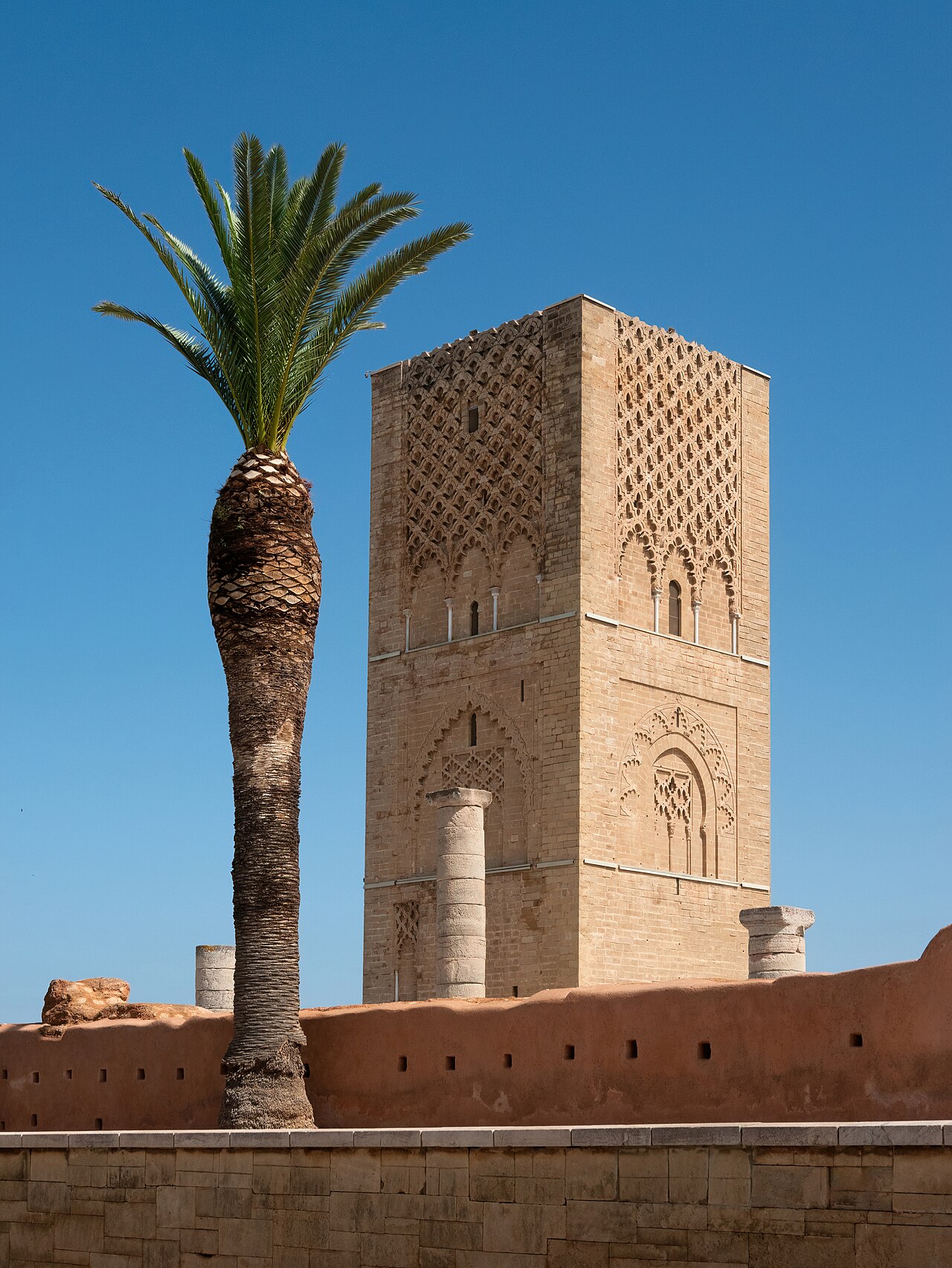
Rabat’s UNESCO inscription, awarded in 2012, covers two distinct urban layers that share the same ground without erasing each other. The older layer dates to the Almohad dynasty: the Hassan Tower, a sandstone minaret begun in 1195 under Sultan Yacoub al-Mansour, rises 44 metres above a field of broken columns — all that remains of what was intended to be the largest mosque in the western Islamic world. Construction stopped at the sultan’s death, leaving the tower at roughly half its planned height of 86 metres. The arrested ambition is readable in the stone, and that incompleteness is part of what the inscription protects.
Immediately to the north, the Kasbah of the Udayas occupies a promontory above the Atlantic and the Bou Regreg estuary. The Almohad gateway at its entrance — horseshoe arch framed by carved limestone — leads into a quarter of narrow whitewashed lanes, a 17th-century Andalusian garden of orange trees and geometric hedges, and views down to the ocean. The second layer is the French colonial city built from 1912, when Resident-General Lyautey chose Rabat as the administrative capital and commissioned a rational grid of wide boulevards, administrative palaces, and a formal Royal Palace complex. The two cities meet but do not merge, which is precisely the condition that UNESCO cited: neither swallowed the other.
Getting there: Both sites are walkable from the city centre; the Hassan Tower is 15 minutes on foot from the train station. Allow: Half a day for the tower, mausoleum, and kasbah combined. Best for: Visitors who want the full UNESCO context before heading to Fez or Volubilis.
Medina of Fez 200 km east — 2.5 hr by train
Fez el-Bali — the Old Fez, inscribed in 1981 — is the largest surviving medieval Islamic city in the world. The numbers give a first approximation of scale: over 9,000 streets and alleyways, 350 mosques, and a population living inside a medieval street plan that has not been restructured by a colonial grid or a mid-century highway. The University of al-Qarawiyyin, founded in 859 AD, holds the record as the oldest continuously operating university in the world; its library contains manuscripts that predate most European universities by centuries.
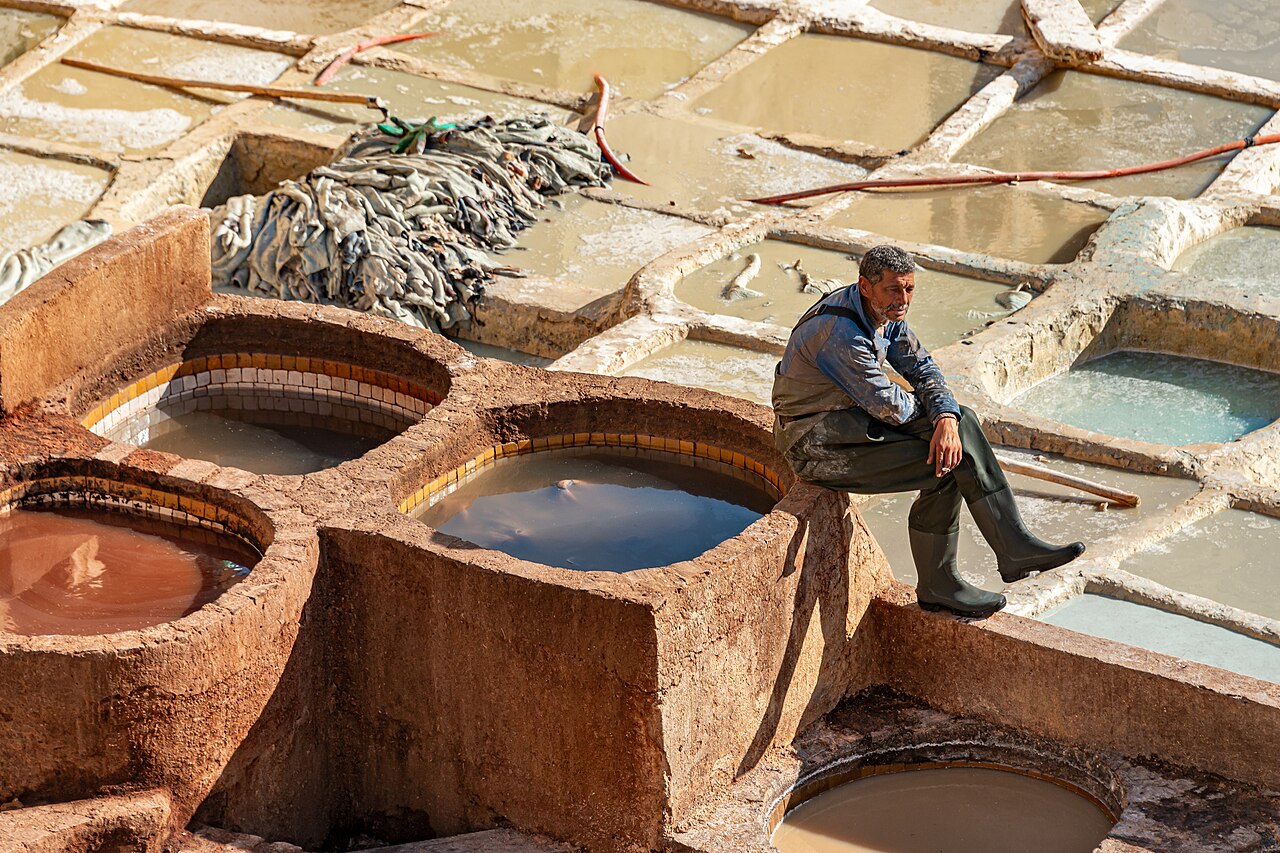
The most visited single point in Fez el-Bali is the Chouara Tannery, where leather has been dyed in round stone vats since at least the 11th century. The process is unchanged: skins are softened in vats of pigeon droppings (a natural source of ammonia), then dipped in vegetable dyes — saffron for yellow, indigo for blue, poppy for red, henna for orange. Viewing terraces on the surrounding buildings give the aerial angle that makes the pattern of coloured circles legible. The smell at ground level is immediate and undeniable; merchants at the terrace entrances offer sprigs of mint.
The medina requires orientation. Streets that look like dead ends often continue; districts specialise — brass workers, wood carvers, dyers, bakers — and the transitions between them are abrupt. A half-day with a guide covers the major gates, the tannery, the Bou Inania Madrasa, and the al-Qarawiyyin exterior. A full day allows the Andalusian quarter on the north bank of the Fez River, the Mellah (the Jewish quarter), and the covered Qayssariyya textile market.
Getting there: Direct ONCF trains from Rabat Ville station to Fez run several times daily; journey approximately 2.5 hours. Shared grands taxis also operate the route. Allow: A minimum of one full day; an overnight stay gives access to the medina at different hours. Best for: Anyone interested in medieval urban planning, Islamic architecture, and living craft traditions.
Archaeological Site of Volubilis 250 km east — 3 hr by road
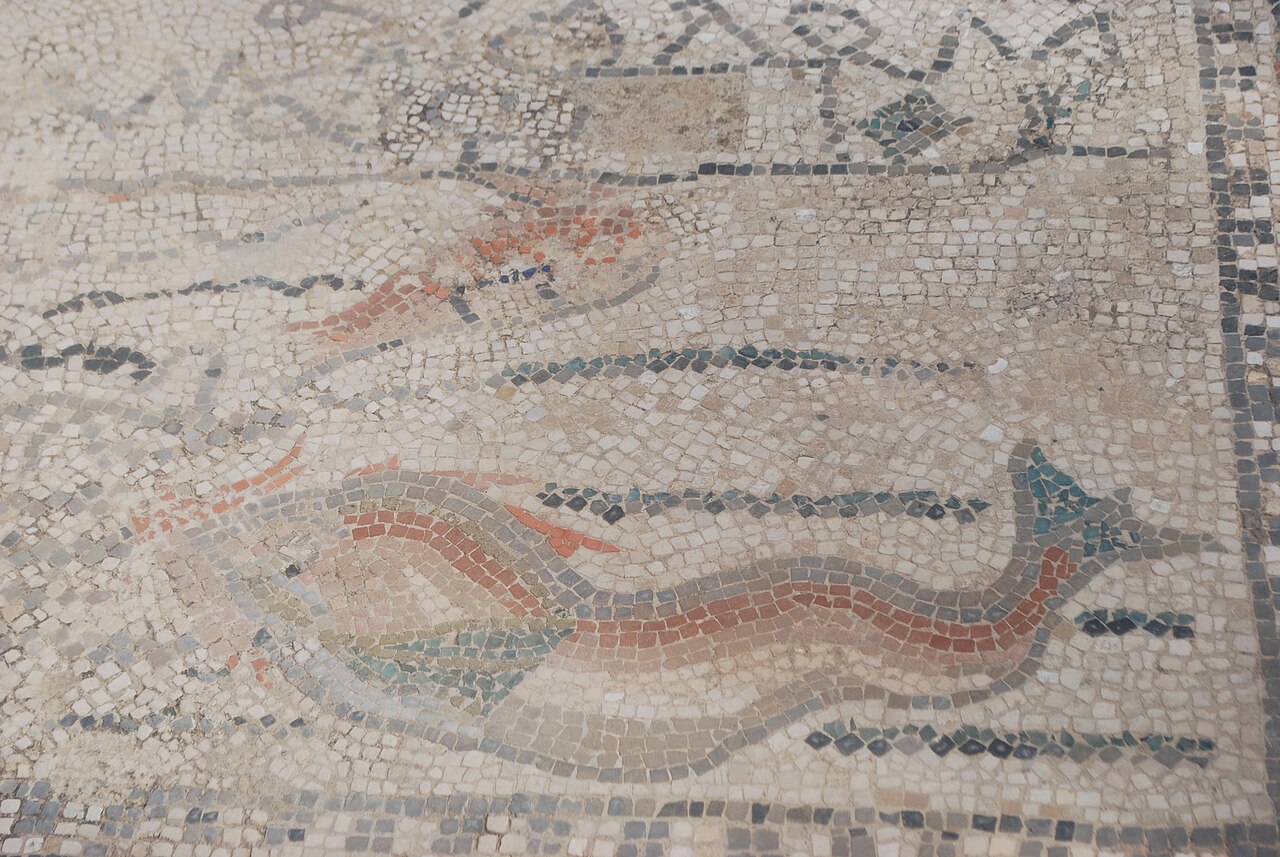
Volubilis, inscribed in 1997, is the best-preserved Roman city in North Africa. It served as the principal city of the province of Mauretania Tingitana from the 1st to the 3rd century AD, and its remains sit in open farmland on a plateau near Meknès, with the Atlas foothills visible to the south. The site is unusual in scale: approximately 40 mosaic pavements survive in situ across the excavated houses, rather than having been removed to a museum, which means the context — floor to wall to street — remains readable.
The three most significant domestic sites are the House of Orpheus, with a figural mosaic showing the mythological musician surrounded by animals; the House of the Labours of Hercules, whose central medallion depicts twelve scenes from the hero’s mythology in remarkably preserved colour; and the House of Venus, named for a mosaic showing the goddess bathing while attended by nymphs. Public monuments are equally intact: the Triumphal Arch of Caracalla, erected in 217 AD, stands at the end of the decumanus maximus; the Capitol, with its broad flight of steps and partial column reconstruction, dates to the 2nd century; and the Basilica retains its original apse. The site is un-roofed and best visited in the morning, before the sun is directly overhead.
Volubilis combines naturally with Meknès, a UNESCO site in its own right since 1996, located 30 km southeast. Meknès was built by Sultan Moulay Ismail in the late 17th century as the Moroccan answer to Versailles — monumental gates, granaries, and stables on an imperial scale — making a Volubilis-Meknès day trip the equivalent of walking from Roman antiquity into Islamic baroque within a single afternoon.
Getting there: No direct train to Volubilis; the most efficient approach from Rabat is by car or grand taxi to Meknès (2.5 hr by train), then a local taxi to the site (30 km, 30 min). Organised day tours from both Rabat and Fez include transport and a guide. Allow: 2–3 hours at the site; combine with Meknès for a full day. Best for: Visitors interested in Roman archaeology and travellers building a Rabat–Meknès–Fez circuit.
Frequently Asked Questions
How many UNESCO World Heritage Sites are near Rabat?
Three UNESCO sites are accessible from Rabat. Rabat itself holds an inscription (2012) covering the Almohad historic city and the French colonial capital. The Medina of Fez (1981), 200 km east, is reachable by train in 2.5 hours. The Archaeological Site of Volubilis (1997), 250 km east near Meknès, requires approximately three hours by road.
Can I visit Volubilis and Meknès in the same day from Rabat?
Yes, with an early start. Take the first morning train from Rabat to Meknès (around 2.5 hours), then a local taxi to Volubilis (30 km). Allow 2–3 hours at the Roman site, then return to Meknès to visit the Bab Mansour gate and the imperial quarter before catching an afternoon or evening train back to Rabat. The day is full but manageable.
When is the best time to visit these sites?
Spring (March to May) and autumn (September to November) offer the most comfortable temperatures for all three destinations. Volubilis, being an open-air site with little shade, is especially demanding in July and August when midday temperatures can exceed 38°C — morning visits are strongly advisable. The Medina of Fez is best in the morning before midday heat and peak crowds; the tannery is most colourful on sunny days when dye colours are saturated.
What makes Rabat’s UNESCO inscription unusual compared to other Moroccan sites?
Most UNESCO inscriptions recognise a historic city or a single monument. Rabat’s 2012 inscription covers the deliberate coexistence of two complete urban systems: the 12th-century Almohad city — including the Hassan Tower and the Kasbah of the Udayas — and the French colonial administrative city built from 1912. UNESCO cited this layering as a rare example of two distinct planning cultures occupying the same ground without either demolishing the evidence of the other.
Sources
- S1 — Rogerson, Barnaby. Marrakesh, Fez, Rabat. Cadogan Guides, 2000. ISBN 978-1-86011-973-6.
- S2 — Pennell, C. R. Morocco: From Empire to Independence. Oneworld Publications, 2003. ISBN 978-1-85168-303-1.
Spotted an error? Write to editorial@culturalheritageonline.com and we correct it the same day.


.jpg)
.jpg)
