Wikimedia Commons,
CC BY 4.0.
São Luís is the capital of Maranhão state in north-eastern Brazil, a city of roughly a million people built on an island at the mouth of the Mearim and Bacanga rivers. Founded by French colonists in 1612 — making it the only city in Brazil with French colonial origins — it was seized by Portugal three years later and over the following two centuries became the most tile-decorated city in the Americas, its colonial facades clad in Portuguese and Dutch azulejo tiles. UNESCO inscribed the Historic Centre of São Luís in 1997.
The only French colonial city in Brazil and the Americas’ greatest tile ensemble Maranhão state · North-east Brazil · 2.5 hr flight from São Paulo; direct flights from Lisbon
In September 1612, a French expedition led by Daniel de La Touche, sieur de La Ravardière, established the fort of Saint-Louis de Maragnan on a promontory at the northern end of the island of Upaon-Açu — a name in the Tupinambá language meaning “great island.” The French colonial project in equatorial Brazil was ambitious: the territory of “France Équinoxiale” was intended to be a permanent colony in competition with Portuguese Brazil to the south. La Ravardière named the settlement after the French king Louis XIII, whose patron saint was Louis IX, the crusader king canonised in 1297.
The French occupation lasted exactly three years. In November 1615, a Portuguese expedition from Belém under Jerônimo de Albuquerque retook the fort; the French garrison surrendered and departed in 1616. What they left behind was a settlement, a name, and a street grid on the promontory’s flat top that the Portuguese accepted and built upon for the next two centuries without substantially altering its layout. The street pattern of the historic centre — a regular grid of approximately ten blocks by eight, oriented to the prevailing wind — is thus of French colonial origin, even though every building on it is Portuguese or Brazilian in construction.
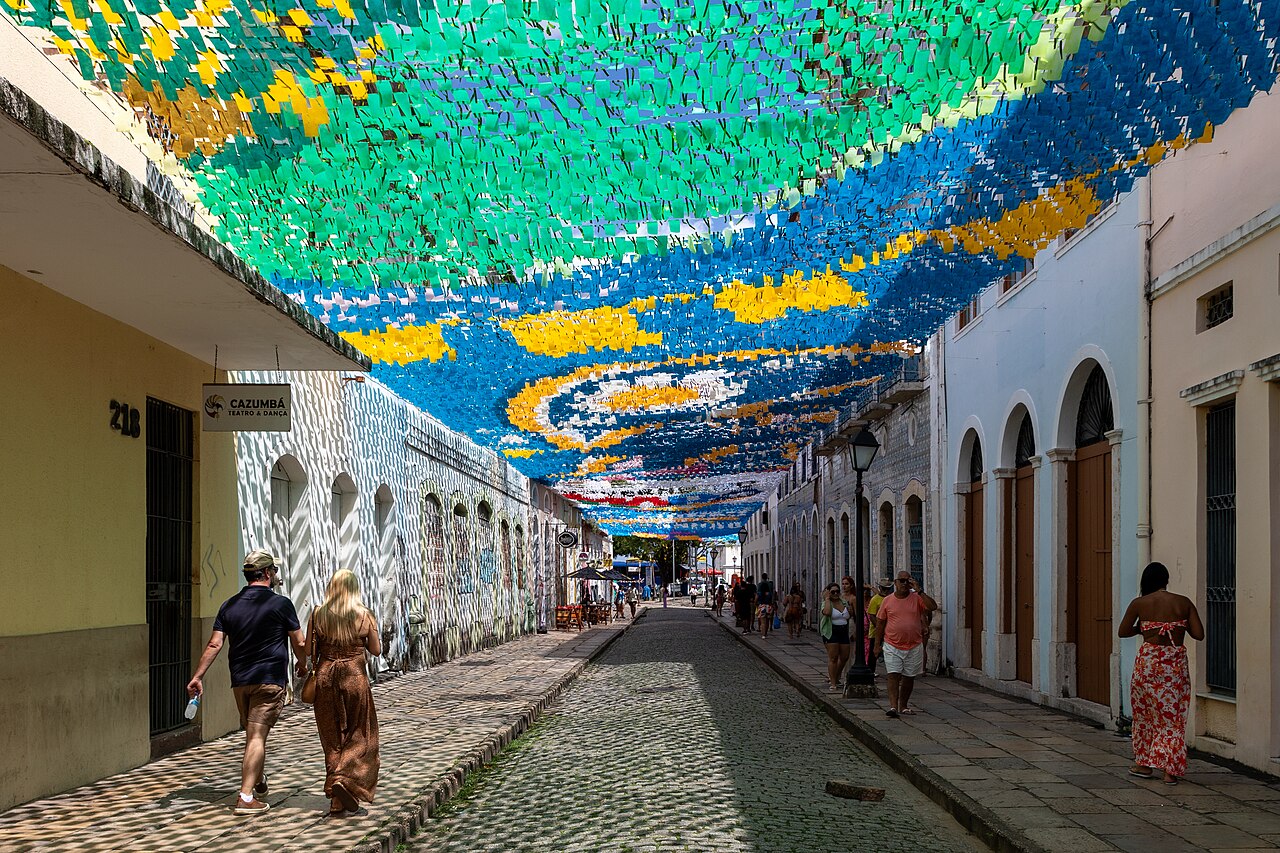
The azulejo tile tradition that defines São Luís’s visual character developed over a long period and for practical as well as aesthetic reasons. The climate of Maranhão — equatorial, with intense sun, high humidity, and heavy seasonal rainfall — attacks the lime plaster facades of colonial buildings with relentless efficiency. Tiles, impermeable and colour-stable, solved the maintenance problem permanently: a tiled facade required no repainting and resisted mould, moisture, and UV degradation far better than any painted surface. Portuguese merchants and administrators in São Luís began cladding their buildings in tiles — imported from Portugal, the Netherlands, and eventually from local Brazilian factories — from the late 18th century onward, and the practice accelerated dramatically in the 19th century as Maranhão’s cotton export economy brought new wealth to the city.
The scale and variety of the azulejo collection is extraordinary. UNESCO’s inscription cites São Luís as having the highest concentration of azulejo-clad colonial buildings outside Lisbon itself — an assessment supported by the count of over 3,500 azulejo-covered facades in the historic centre alone. The tiles range from simple blue-and-white geometric patterns of the 18th century to elaborate pictorial panels depicting pastoral scenes, maritime views, and mythological subjects from the 19th century. Some facades combine multiple tile generations — a 1780s geometric ground floor surmounted by 1850s pictorial panels added by a later owner — creating accidental compositions of considerable complexity.
The Bumba-meu-boi festival, proclaimed UNESCO Intangible Cultural Heritage of Humanity in 2019, is São Luís’s most celebrated cultural expression. A theatrical folk festival combining African, indigenous Brazilian, and Portuguese narrative traditions, Bumba-meu-boi centres on the story of a magical bull (boi) killed, resurrected, and celebrated; the performances involve elaborate costumes, music, and competitive dancing between rival groups (blocos). The festival fills the streets of São Luís from June to August, with the most intense celebrations around the feast of Saint John (24 June) and Saint Peter (29 June). The Casa do Maranhão, a cultural centre in the historic centre, maintains permanent exhibitions on the festival’s costumes, instruments, and history.
The economic underpinning of 19th-century São Luís — cotton cultivation and export — made the city for a brief period one of the wealthiest in Brazil. The so-called “Athens of Brazil” epithet, applied to the city in the 19th century in recognition of its literary and intellectual culture, reflects this wealth: its merchant families educated their children in Lisbon, Coimbra, and Paris, and the city produced a disproportionate number of poets, jurists, and abolitionists. The abolitionist movement in Maranhão, which had one of the largest enslaved populations in Brazil, was among the most militant in the country; Maranhão declared the abolition of slavery in 1884, four years before the national Lei Áurea of 1888.
Day trips: Lençóis Maranhenses and the colonial towns of the Maranhão interior 250-350 km south-east by road · organised tours from São Luís
The Lençóis Maranhenses National Park, approximately 250 km east of São Luís along the coast, is among the most visually dramatic landscapes in South America: an enormous field of white quartz sand dunes — the largest dune system in the Americas — punctuated after the rainy season (March-June) by thousands of turquoise freshwater lagoons trapped between the dune ridges. The visual contrast of white sand, blue sky, and green-blue water is remarkable, and the lagoons support a fish population despite being temporary; fish eggs survive in the sand during the dry season and hatch when the rains fill the lagoons again. The park is accessible from Barreirinhas, reachable from São Luís in approximately 4 hours by bus, or by 4WD tours operating from the city.
The historic towns of the Maranhão interior — Alcântara, Caxias, and Imperatriz — are less visited but historically significant. Alcântara, across the bay from São Luís (1 hour by boat), was the capital of Maranhão before São Luís and has the most complete set of 17th and 18th century colonial ruins in north-eastern Brazil: abandoned churches, a ruined palace, and an intact central square (Praça da Matriz) with original cobblestones. The sight of the ruined facades of colonial mansions slowly being consumed by tropical vegetation is haunting in a way that preserved colonial cities like Ouro Preto are not.
Practical information
Getting there: Marechal Cunha Machado International Airport (SLZ) serves São Luís with domestic connections to São Paulo, Rio de Janeiro, Brasília, Fortaleza, and Belém; GOL and LATAM fly the São Paulo route several times daily (2 h 30 min). TAP Air Portugal operates a direct Lisbon-São Luís route seasonally. The airport is approximately 16 km from the historic centre; taxis and ride-sharing apps (99 and Uber) operate the route in 30-40 minutes depending on traffic.
Getting around: The historic centre is walkable — the inscribed area covers approximately 220 hectares, but the most tile-dense streets (Rua Portugal, Rua do Giz, Rua de Nazaré, Rua da Palma) are within a 20-minute walk of each other. The centre sits on a promontory and is best explored on foot; the streets are hilly by Brazilian standards but not strenuous. Buses connect the historic centre to the beach districts and airport.
Best time to visit: July and August are the dry season and coincide with the tail end of the Bumba-meu-boi festival season; these months offer the most cultural programming. The rainy season (January-May) fills the Lençóis Maranhenses lagoons but makes the city itself hotter and stickier. December is pleasant and increasingly popular with Brazilian domestic tourists.
Practical tips: The historic centre has visible urban poverty in some areas; visitors should take the usual precautions with electronics and valuables. The best tile-viewing streets are entirely safe during daylight hours. The IPHAN (Instituto do Patrimônio Histórico e Artístico Nacional) office in the centre provides free maps of the inscribed area and is staffed with knowledgeable guides who can point out the finest tile collections.
Frequently Asked Questions
Why does São Luís have more azulejo tiles than any Brazilian city?
The combination of climate, commerce, and cultural prestige explains the tile concentration. The equatorial climate of Maranhão made tile-cladding a practical necessity — plaster facades in this humidity require constant maintenance, while ceramic tiles are effectively permanent. The cotton economy of the 19th century gave São Luís’s merchant class the wealth to import tiles from Lisbon, Oporto, and later from factories in Rio de Janeiro, and the cultural prestige attached to Portuguese metropolitan models made tile-cladding a mark of social standing. The combination of practical and symbolic motivations produced a self-reinforcing cycle: once the most prosperous streets were tiled, the remaining bare facades appeared backward, and owners competed to tile them as fast as their finances allowed. The result, by the mid-19th century, was a city almost entirely covered in ceramic — a visual identity so distinctive that it became the defining characteristic of São Luís in every external description of the city written from the 1850s onward.
What is the Bumba-meu-boi festival and where does it come from?
Bumba-meu-boi (also written Boi-Bumbá, Boi-Bumbá, or simply Bumbá depending on the regional variant) is a Brazilian folk festival found in various forms across the north and north-east of the country, but most elaborate and most important in Maranhão. Its narrative core — the death and resurrection of a magical ox — combines three distinct cultural streams: the African oral tradition of animal-hero stories, the indigenous Brazilian tradition of nature-worship, and the Portuguese Catholic tradition of theatrical religious performance. In São Luís, the festival is organised by competing groups (sotaques), each with their own musical style, costume aesthetic, and loyal neighbourhood following. The costumes for the principal characters — the Bull itself, the Curiango bird, the Cabocla de Lança (lance-carrying indigenous figure) — require months of preparation by specialist craftspeople and are among the most elaborate theatrical costumes in Latin America. UNESCO’s 2019 Intangible Heritage inscription covers the Maranhão expression of the festival specifically.
Is São Luís a safe city for tourists?
São Luís, like all large Brazilian cities, requires common-sense precautions with valuables, particularly in the evening and in less-frequented areas. The historic centre has undergone significant physical restoration since the UNESCO inscription and has a visible police presence on the main tourist streets during daylight hours. The beach districts (Ponta d’Areia, Calhau, Olho d’Água) to the north of the city are the main leisure areas for residents and tourists and are generally safe. Visitors should follow the standard Brazilian urban travel protocol: use licensed taxis or ride-sharing apps, avoid displaying expensive cameras or phones in crowded areas, and ask hotel staff about current neighbourhood conditions before exploring unfamiliar areas after dark. The IPHAN-managed historic streets and the cultural centres are safe destinations throughout the day.
Sources
- S1 — Meireles, Mário Martins. História do Maranhão. Editora Síntese, 1980. ISBN 978-85-85002-12-1.
- S2 — Smith, Robert C. The Art of Portugal: 1500-1800. Weidenfeld & Nicolson, 1968. ISBN 978-0-297-76412-0.
Spotted an error? Write to editorial@culturalheritageonline.com and we correct it the same day.