
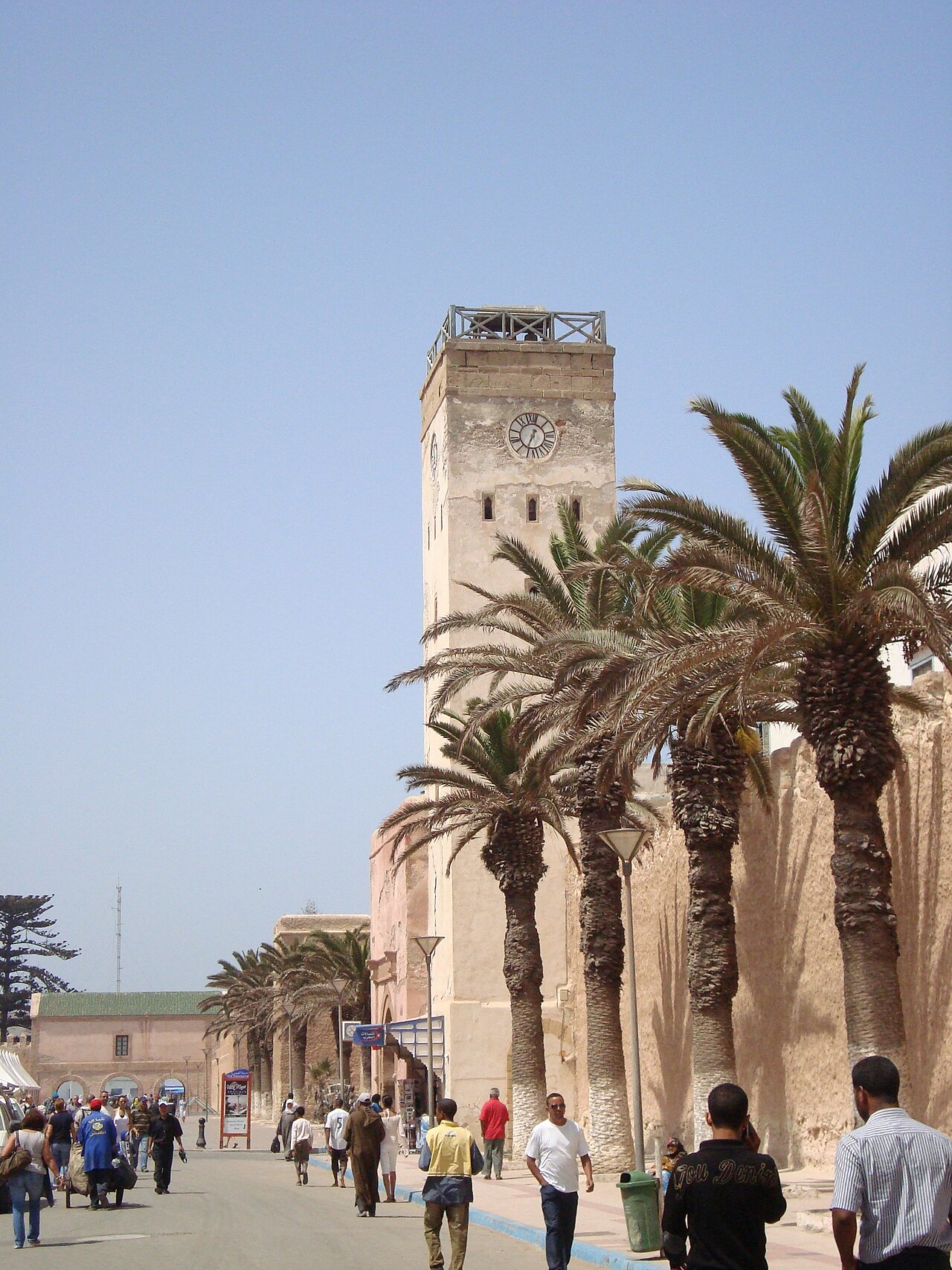
The Medina of Essaouira (formerly Mogador), inscribed in 2001, is the finest example of a late eighteenth-century European-influenced military architecture applied to a North African coastal town — a Moroccan Atlantic port city rebuilt from 1765 CE by the Alaouite Sultan Mohammed ben Abdallah to a plan by a French architect, whose blue-and-white rampart walls, regular grid of streets, and double-functioning as fortified port and trading city created an urban model without equivalent in the Maghreb.
Essaouira: Where Morocco Meets the Atlantic Wind Marrakesh-Safi region, Morocco, Atlantic coast, 175 km from Marrakesh
The Medina of Essaouira (inscribed in 2001 under criteria (ii), (iv)) is a coastal walled city on the Atlantic coast of Morocco — originally the site of a Phoenician trading post and later a Portuguese fortified settlement called “Mogador” (1506–1541 CE, and again 1628–1769 CE during two brief Portuguese reoccupations). The city as it stands today was built from 1765 CE on the instructions of Sultan Sidi Mohammed ben Abdallah (Mohammed III), who wished to create a new Atlantic trading port to compete with Agadir and to provide Morocco with a controlled export route for Saharan trade. The sultan engaged a French engineer, Théodore Cornut (a student of Vauban’s military architecture tradition), to design the fortifications; the result was the first planned Moroccan city with a European-style bastioned enceinte (a circuit of cannon-armed bastion walls on the European model, adapted to Moroccan building traditions) and a regular rectangular street grid (unknown in previous Moroccan medinas, which followed the organic curvilinear patterns of Islamic city planning). The combination of European military engineering with Moroccan medina urban culture (souks, mosques, riads, fondouks) within the same walls creates the Outstanding Universal Value recognized by UNESCO: a unique synthesis of European and Moroccan urban planning in a completely intact late eighteenth-century port city. The city is famous internationally for: (1) the constant Atlantic “Alizé” wind that makes it one of the world’s premier windsurfing and kitesurfing destinations (the wind blows at 30–40 km/h on most afternoons from June to September); (2) the Gnawa World Music Festival (a festival of Gnawa spiritual music — a Moroccan musical tradition derived from sub-Saharan African trance music brought to Morocco by enslaved people from the Gnawa people — held in Essaouira since 1998, currently one of Africa’s largest music festivals); and (3) the woodworking tradition of Essaouira’s artisans in thuya wood (a fragrant, close-grained Moroccan cedar used for marquetry boxes, furniture, and decorative objects).
The Skala and the Blue Ramparts Skala de la Kasbah, Essaouira medina
The Skala de la Kasbah (the sea bastion of the kasbah) is the most photogenic element of Essaouira’s defences — a 200-metre-long sea-wall platform on the north side of the medina, equipped with a row of Spanish bronze cannons (late 17th–early 18th century, gifts from European trading nations to Moroccan sultans, or captured from Portuguese and Spanish ships) still in situ on the rampart walkway. The Skala’s distinctive visual character — the blue-painted parapet over the white limestone bastion wall, overlooking the Atlantic waves — gave Essaouira its international identity as the “Blue City” of the Moroccan Atlantic coast. The cinematographic quality of the Skala attracted Orson Welles, who used Essaouira as the primary filming location for his 1952 film “Othello” (Palme d’Or, Cannes 1952); a bust of Welles faces the Skala from the medina side. The Skala de la Ville (the inland bastion on the south side of the medina, overlooking the medina’s kasbah quarter) is less visited but architecturally complete, with a view over the thuya wood workshops of the artisans’ quarter. The port (the Essaouira fishing port, adjacent to the old commercial port of the sultan’s period) is a working fishing harbour where blue-painted wooden fishing boats unload sardines and anchovies; the port’s fish market is the best place to eat fresh grilled fish in Morocco.
Practical information
Essaouira has no airport; the nearest is Marrakesh-Menara (RAK), 175 km east (2 hours 30 minutes by bus, approximately MAD 80; buses operate from Marrakesh’s Bab Doukkala bus station). CTM and Supratours buses connect Essaouira to Marrakesh (3 daily departures) and Agadir (2 hours south). The medina is entirely walkable (approximately 600 × 400 metres within the walls). Accommodation within the walls is in riad guesthouses; beach accommodation is south of the medina. The Gnawa World Music Festival (June) fills the city; June–August is windy (kitesurfers), hot and crowded. October–April is quieter, cooler, and recommended for medina exploration. Note: Essaouira is significantly cooler than Marrakesh in summer (Atlantic breeze keeps temperatures 10–15°C lower than inland).
Frequently Asked Questions
Is Essaouira a UNESCO World Heritage Site?
Yes. The Medina of Essaouira (formerly Mogador) was inscribed in 2001 under criteria (ii) and (iv). Morocco has 9 UNESCO World Heritage Sites (as of 2024): the Medina of Fez (1981), the Medina of Marrakesh (1985), the Ksar of Aït-Ben-Haddou (1987), the Historic City of Meknès (1996), the Archaeological Site of Volubilis (1997), the Medina of Tétouan (1997), the Medina of Essaouira (2001), the Portuguese City of Mazagan (El Jadida, 2004), and the Rabat, Modern Capital and Historic City (2012).
What is Gnawa music and why is it important?
Gnawa (also spelled Gnaoua) is a spiritual musical tradition of Morocco originating from the enslaved people of the Gnawa people (from the Saharan sub-Saharan region, primarily from present-day Mali, Senegal, and Guinea) who were brought to Morocco as enslaved workers from the sixteenth to the nineteenth century. The musical tradition combines trance music (the lila, an all-night healing ceremony), trance dance, and percussion instruments (the guembri, a three-stringed bass lute; the krakebs, iron castanets; hand drums) with Sufi spiritual practice and pre-Islamic African animist ritual — a syncretic tradition that has been recognized by UNESCO as an element of the Intangible Cultural Heritage of Humanity (Morocco, inscribed 2019). The Gnawa World Music Festival (Festival Gnaoua et Musiques du Monde), held in Essaouira since 1998, brings together Gnawa musicians with international jazz, world music, and electronic artists for fusion performances on outdoor stages throughout the medina; in pre-COVID years it attracted up to 500,000 spectators over three days, making it one of the largest music festivals in Africa. The festival’s significance was a major factor in the increasing international profile of Essaouira as a cultural destination from the early 2000s.
Why is Essaouira’s urban plan unique in Morocco?
All previous Moroccan medinas (Fez, Marrakesh, Meknès, Tétouan) followed the organic Islamic urban planning tradition — curvilinear streets radiating from the central mosque and souks, with blind alleys (derbs) providing private access to residential quarters and no regular geometric grid. The Essaouira medina, designed in 1765 by the French architect Théodore Cornut (the only known European architect to design a complete Moroccan medina), uses a rectangular grid of three main longitudinal streets and perpendicular cross-streets — a European town-planning convention with no precedent in Moroccan urban history. The reason was practical: Cornut’s commission was for a commercial port city, not a residential medina, and the rectangular grid facilitated the movement of goods between the port, the fondouks (merchants’ warehouses), and the souks. The rectangular grid has the secondary effect of making Essaouira the most navigable medina for first-time visitors to Morocco — unlike Fez or Marrakesh, where disorientation is the rule, the Essaouira medina can be mentally mapped after a single walk-through. The UNESCO inscription explicitly cites the “unique example of an 18th century fortified town” and the “blending of varied influences” (European military architecture + North African medina + Atlantic port) as the Outstanding Universal Values.
Sources
- S1 — Mana, Abdelkader. Essaouira: Perle de l'Atlantique. Éditions Eddif, 2005. ISBN 978-9981-09-114-6.
- S2 — Rogerson, Barnaby. Marrakesh, Fez, Rabat. Cadogan Guides, 2000. ISBN 978-1-86011-973-6.
Spotted an error? Write to editorial@culturalheritageonline.com and we correct it the same day.

-113160.jpg)