The Collegiate Church, Castle and Old Town of Quedlinburg, inscribed in 1994, is the cradle of the German nation — the Ottonian dynasty’s court and the site where the idea of a German kingdom was first articulated, with the tombs of Henry I (the first elected German king) and his queen Mathilde in the crypt of the St. Servatius Collegiate Church (921–1129 CE), one of the finest Romanesque crypts in Germany, and a remarkably intact half-timbered old town of 1,300 Fachwerk buildings.
Quedlinburg: Where the German Nation Was Born Harz district, Saxony-Anhalt, Germany, 115 km southwest of Berlin
The Collegiate Church, Castle and Old Town of Quedlinburg (inscribed in 1994 under criteria (iii), (iv)) is a small town of approximately 25,000 inhabitants in the foothills of the Harz Mountains whose historic significance vastly exceeds its size: Quedlinburg was the principal residence of the Ottonian dynasty (919–1024 CE) — the dynasty that created the Holy Roman Empire and the German kingdom — and the site of some of the most important events in the history of medieval Europe. Henry I of East Francia (c. 876–936 CE, the first member of the Saxon House to be elected German king in 919 CE by the tribal dukes of Saxony, Franconia, Bavaria, Thuringia, and Swabia) made Quedlinburg the centre of his court; his widow Queen Mathilde (895–968 CE) founded the Quedlinburg Abbey (Stift Quedlinburg) in 936 CE as a Benedictine women’s foundation on the castle hill above the town, in memory of Henry I and as a dynastic mausoleum. The abbey became the most prestigious female ecclesiastical foundation in the Ottonian Empire — the abbess of Quedlinburg was an imperial princess, equal in rank to a bishop, with her own territory, court, and subjects (the abbey was a Reichsstift, a house directly under imperial protection); successive abbesses (most of them members of the Ottonian dynasty) ruled the abbey until its secularization in 1803 CE. The physical core of the UNESCO inscription is the St. Servatius Collegiate Church (Stiftskirche St. Servatii, rebuilt 1021–1129 CE), whose crypt contains the marble sarcophagi of Henry I and Queen Mathilde — the oldest surviving graves of German rulers in their original location.
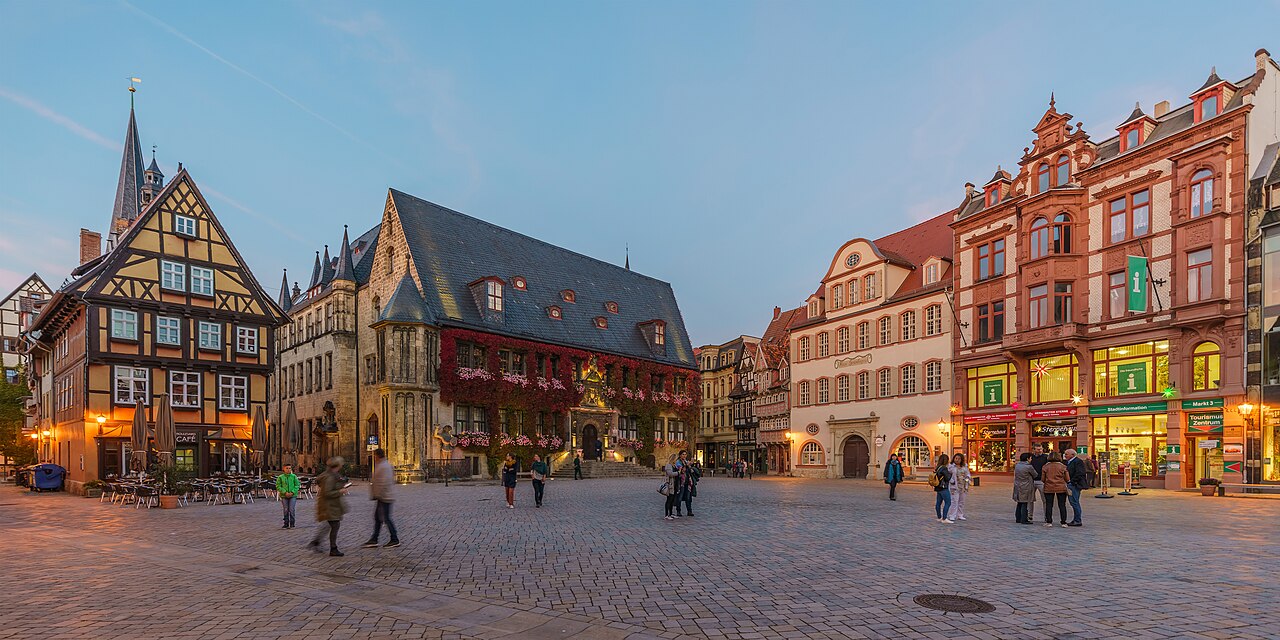
The Fachwerk Old Town: 1,300 Half-Timbered Buildings Quedlinburg old town, Saxony-Anhalt
The Quedlinburg old town below the castle hill is one of the most complete ensembles of German half-timbered (Fachwerk) buildings in existence — 1,300 timber-framed buildings spanning six centuries (13th–18th century CE) that represent the full range of the German Fachwerk tradition, from the simplest single-room peasant house to the elaborate carved and painted merchant houses of the fifteenth and sixteenth centuries. The Fachwerk tradition (structural timber frames filled with wattle-and-daub, brick, or plaster panels, with the exposed timber framework visible as the primary decorative element of the facade) was the standard building technique in Germany north of the Alps from the twelfth century onward, and Quedlinburg preserves its most complete surviving example because the town never experienced the industrial-era urban renewal that replaced timber buildings with stone or brick in other German towns. The oldest surviving Fachwerk house in Germany (the Ständerbau, c. 1270 CE, in the Wordgasse) is in Quedlinburg. The different regional styles of Fachwerk construction (Upper Saxon, Lower Saxon, Franconian) can be read in the changes of the timber framing patterns as one walks from the thirteenth-century core to the sixteenth-century extensions of the town. UNESCO’s inscriptions of the Quedlinburg old town was the first time Germany nominated a Fachwerk town; the inscription helped establish the precedent for subsequent German timber-town nominations including Goslar and the Rheinstein Valley.
Practical information
Quedlinburg has no airport and no direct high-speed rail connection; the nearest major airports are Berlin (BER, approximately 2 hours 30 minutes by regional train via Magdeburg or Halberstadt) and Hannover (HAJ, approximately 2 hours). From Magdeburg by regional train: approximately 1 hour 30 minutes. The castle hill (with the St. Servatius Church and the Crypt) is reached by a 10-minute walk from the market square; the Schlossmuseum (museum in the castle buildings, with the Ottonian treasury) is in the same complex. The old town is walkable (approximately 30–45 minutes to see the main Fachwerk streets: Wordgasse, Breite Strasse, Markt). The Quedlinburg Autumn Market (October) and the Christmas Market (December) are the most popular events. The Harz Mountains (Brocken, 1,141 m, the highest mountain in northern Germany) are 15 km away and accessible by the narrow-gauge Harz railway (Harzer Schmalspurbahn).
Frequently Asked Questions
Is Quedlinburg a UNESCO World Heritage Site?
Yes. The Collegiate Church, Castle and Old Town of Quedlinburg was inscribed in 1994 under criteria (iii) and (iv). Germany has 52 UNESCO World Heritage Sites (as of 2024). The Quedlinburg inscription is part of a cluster of UNESCO World Heritage Sites in Saxony-Anhalt — Germany’s most UNESCO-dense state per capita — that includes: the Collegiate Church of Quedlinburg (1994), the Luther Memorials of Eisleben and Wittenberg (1996), the Dessau-Wörlitz Garden Kingdom (2000), the Naumburg Cathedral (2018), and the Important Pre-historic Pile Dwellings around the Alps (partial, 2011, shared). Saxony-Anhalt was the core territory of the Carolingian and Ottonian dynasties; its density of UNESCO Sites reflects this exceptional concentration of early German medieval heritage.
Who was Henry I and why is his tomb significant?
Henry I (Heinrich I, “Henry the Fowler,” c. 876–936 CE) was the Duke of Saxony who was elected King of East Francia (the eastern Frankish kingdom, predecessor to the Holy Roman Empire and eventually to Germany) in 919 CE — the first election of a German king by the tribal dukes rather than by hereditary succession (though Henry’s Saxon background was a significant qualification). Henry I is considered the founder of the German state: his reign (919–936 CE) established the institutional and territorial foundations of the German kingdom (he organized the first German military against the Magyar (Hungarian) invasions from the east; he established the system of fortified towns that became the basis of medieval German urbanization; he brought Lotharingia into the German kingdom). His son Otto I (“Otto the Great”) became Holy Roman Emperor in 962 CE, founding the Holy Roman Empire. Henry I and his queen Mathilde (who founded Quedlinburg Abbey in 936 CE) are buried in the crypt of the St. Servatius Church in Quedlinburg — the oldest surviving royal tombs in Germany in their original location. The significance of the Quedlinburg crypt as a founding site of the German state is comparable to the significance of the St. Denis Basilica in France (where the French kings are buried) or Westminster Abbey in England.
What is the Quedlinburg Treasury and why was it looted in 1945?
The Quedlinburg Treasury (Domschatz) is one of the most important collections of early medieval sacred art in Germany — a collection of reliquaries, gospel books, textiles, and liturgical objects accumulated by the Quedlinburg Abbey from the tenth to the fifteenth century, including pieces donated by the Ottonian emperors and their families. The collection was hidden in a cave in the Harz Mountains in 1943 CE to protect it from Allied bombing; after the American capture of the Quedlinburg area in April 1945, a US Army officer, Lieutenant Joe Tom Meador from Whitewright, Texas, stole nine objects from the cave cache (including a ninth-century gospel cover of gold and enamel, a sixth-century rock crystal flask, and a tenth-century ivory comb) and sent them home to Texas, where they were discovered after his death in 1980. The nine stolen objects were identified by the Quedlinburg museum in 1990; after legal proceedings in the USA, Germany purchased the objects back from the Meador family for approximately USD 2.75 million in 1990–1991. The case was the subject of the book “The Treasure of Quedlinburg” and is one of the most significant cases of American military art theft during the Second World War.
Sources
- S1 — Wäscher, Hermann. Der Burgberg in Quedlinburg: Geschichte seiner Bauten. Henschelverlag, 1959. ISBN 978-3-86568-120-1.
- S2 — Binding, Günther. Deutsche Königspfalzen: Von Karl dem Großen bis Friedrich II. Primus Verlag, 1996. ISBN 978-3-89678-016-4.
Spotted an error? Write to editorial@culturalheritageonline.com and we correct it the same day.