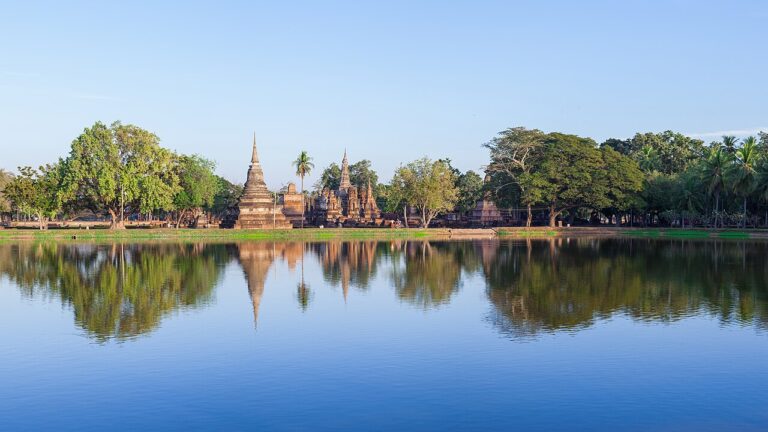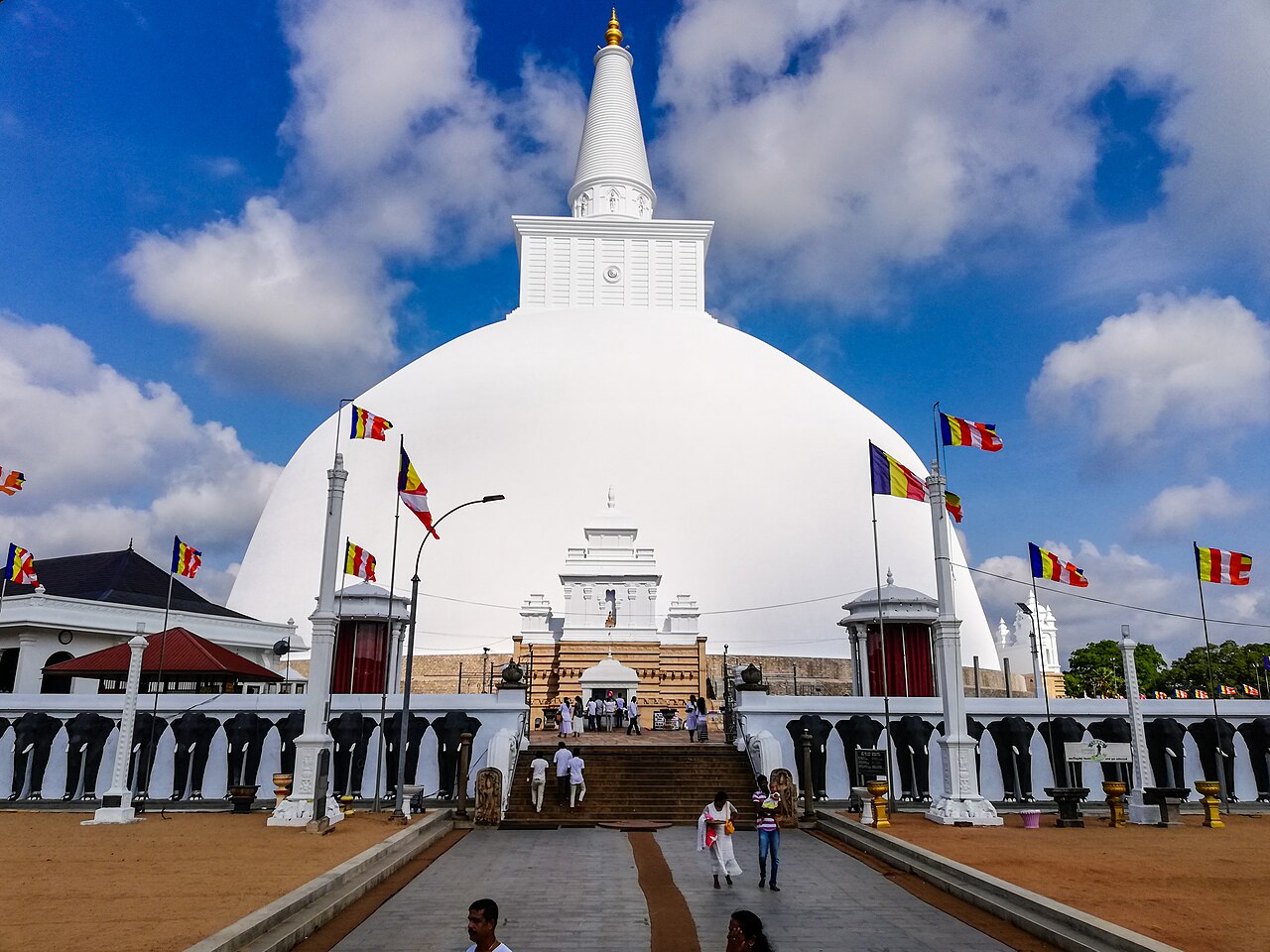
The Sacred City of Anuradhapura, inscribed in 1982, is one of the oldest continuously inhabited cities in the world — the capital of the Sinhalese kingdom for 1,300 years (c. 400 BCE–993 CE), home to the Jaya Sri Maha Bodhi (the oldest documented living tree in the world, grown from a cutting of the original Bodhi Tree under which the Buddha attained enlightenment, planted c. 288 BCE), and the site of the greatest Buddhist dagobas (stupas) of the ancient world, including the Ruwanwelisaya (c. 140 BCE) and the Jetavanarama (third century CE).
Anuradhapura: 1,300 Years of the Sinhalese Capital North Central Province, north-central Sri Lanka, 200 km north of Colombo
The Sacred City of Anuradhapura (inscribed in 1982 under criteria (ii), (iii), (vi)) was the first capital of the Sinhalese kingdom of Sri Lanka, established (according to the Mahavamsa chronicle) by King Pandukabhaya in 380 BCE, and remained the principal royal capital until 993 CE when it was abandoned after the South Indian Chola king Rajaraja I (the greatest of the medieval Chola emperors) sacked the city. Over its 1,300 years as capital, Anuradhapura accumulated the most significant concentration of Buddhist monuments in Sri Lanka — a sacred landscape of enormous dagobas (hemispherical stupas of brick and plaster, used to enshrine Buddhist relics), monastery complexes, royal palaces, and pleasure gardens spread over approximately 40 km² of north-central Sri Lanka. The city’s most significant individual monuments are: (1) the Jaya Sri Maha Bodhi (see below); (2) the Ruwanwelisaya Dagoba (Ruwanweli Maha Seya, “Great Sand Stupa,” built by King Dutugemunu, c. 140 BCE, approximately 103 metres high, one of the largest structures in the ancient world — comparable in volume to the Pyramid of Menkaure in Giza); (3) the Jetavanarama Dagoba (built by King Mahasena, c. 277–304 CE, originally approximately 122 metres high, making it the third-tallest structure in the ancient world after the two largest Egyptian pyramids, and the tallest brick structure ever built in antiquity); and (4) the Thuparamaya (the oldest dagoba in Sri Lanka, built by King Devanampiya Tissa in c. 246 BCE, reportedly to enshrine the collarbone relic of the Buddha brought to Sri Lanka by the missionary monk Mahinda, son of Emperor Ashoka of India).
The Jaya Sri Maha Bodhi: The World’s Oldest Tree Mahamewna Gardens, Anuradhapura
The Jaya Sri Maha Bodhi (Sri Mahabodhi, “Sacred Great Bodhi Tree”) is a sacred fig tree (Ficus religiosa) planted c. 288 BCE — the oldest documented living tree in the world with a reliably dated planting record. The tree is a grown-from-cutting successor to the original Bodhi Tree under which the historical Buddha (Siddhartha Gautama, c. 563–483 BCE) attained enlightenment at Bodh Gaya in present-day Bihar, India. According to the Mahavamsa chronicle, a branch of the Bodhi Tree was brought to Sri Lanka in 288 BCE by Princess Sangamitta (the daughter of Emperor Ashoka of India and twin sister of the missionary monk Mahinda), planted at Anuradhapura under the auspices of King Devanampiya Tissa, and has been continuously venerated and protected by an unbroken succession of monastic guardians since that date — making it the only living object with a continuous documented history of over 2,300 years. The tree (now an old, gnarled specimen supported by golden pillars and enclosed by a golden railing) is the most sacred non-human object in Theravada Buddhism; Sri Lankan Buddhists consider it to be literally the same tree (or the same root lineage) as the original Bodhi Tree, and pilgrims from Sri Lanka, Thailand, Burma, and other Theravada Buddhist countries visit Anuradhapura specifically to make offerings to the tree. The original Bodhi Tree at Bodh Gaya (in India) was cut down by the Mughal Emperor Aurangzeb in 1670 CE; the current tree at Bodh Gaya was regrown from cuttings of the Anuradhapura tree in the nineteenth century — making the Anuradhapura tree the ancestral source of the current sacred tree at the site of the Buddha’s enlightenment.
Practical information
Anuradhapura is 200 km north of Colombo (3 hours by train or 4 hours by bus). Sigiriya Rock Fortress (UNESCO 1982) is 60 km southeast. The ancient city is spread over a large area; bicycle rental (available from guesthouses near the train station) is the best way to see the main sites. The principal attractions are the Sacred Bodhi Tree, the Ruwanwelisaya Dagoba, the Jetavanarama, and the Thuparamaya (allow 5–6 hours). Dress code: remove shoes and cover arms and legs at all active temple sites. The annual Poson Poya festival (June full moon) celebrates the arrival of Buddhism in Sri Lanka in 246 BCE and is the largest annual pilgrimage to Anuradhapura. The best season is January–April (dry season in the north); the monsoon (May–September) makes road conditions difficult.
Frequently Asked Questions
Is Anuradhapura a UNESCO World Heritage Site?
Yes. The Sacred City of Anuradhapura was inscribed in 1982 under criteria (ii), (iii), and (vi). Sri Lanka has 8 UNESCO World Heritage Sites (as of 2024): Anuradhapura (1982), Polonnaruwa (1982), Sigiriya (1982), Sinharaja Forest Reserve (1988, natural), Sacred City of Kandy (1988), Old Town of Galle and its Fortifications (1988), Dambulla Cave Temple (1991), and the Central Highlands of Sri Lanka (2010, natural).
How large were the ancient Anuradhapura dagobas and how were they built?
The three largest dagobas of Anuradhapura — the Jetavanarama (originally c. 122 m high, approximately 93 m today after collapse of the upper section), the Abhayagiri (c. 115 m originally), and the Ruwanwelisaya (c. 103 m) — were among the largest structures in the ancient world. The Jetavanarama (built c. 277–304 CE by King Mahasena) consumed approximately 93.3 million fired bricks; the sheer mass of material required a logistics operation comparable to a major pyramid-building project. The construction technique was: a rubble-and-brick hemispherical core was built first; over it was applied a thick layer of lime plaster (chunam) to create the smooth hemispherical profile; the final finish was white lime plaster (which reflects heat and prevents water penetration). The dagoba’s proportions follow a canonical Buddhist formula: the base diameter equals the height (for the hemispherical section) plus the height of the “neck” (a cylindrical element at the top) and the “finial” (the spire); the whole structure represents the cosmic mountain (Mount Meru) in Buddhist cosmology. The structural engineering challenge was drainage: the solid brick core must resist water infiltration that would cause the lime mortar to dissolve; the ancient builders addressed this with a drainage system of clay-sealed conduits within the brick core.
What happened to Anuradhapura in 993 CE and where did the capital move?
The city of Anuradhapura was sacked in 993 CE by the Chola king Rajaraja I (985–1014 CE, the greatest of the medieval South Indian Chola emperors), who had embarked on a programme of imperial expansion across South and Southeast Asia. Rajaraja captured the northern Sri Lankan capital, destroyed the royal palace complex, and transferred control of the northern half of Sri Lanka to the Chola Empire; the Sinhalese capital was moved south to Polonnaruwa (approximately 60 km southeast of Anuradhapura), which became the seat of the Chola viceroy and subsequently (after the Sinhalese reconquest under King Vijayabahu I in 1070 CE) the capital of the restored Sinhalese kingdom. Polonnaruwa remained the Sinhalese capital from 993 CE to approximately 1293 CE (also inscribed by UNESCO in 1982); Anuradhapura was never re-occupied as a major settlement after 993 CE and its ruins were overgrown by jungle until British colonial archaeological surveys in the nineteenth century began their clearance and documentation.
Sources
- S1 — Bandaranayake, Senake. Sinhalese Monastic Architecture: The Viharas of Anuradhapura. Brill, 1974. ISBN 978-90-04-03992-6.
- S2 — de Silva, K. M. A History of Sri Lanka. University of California Press, 1981. ISBN 978-0-520-04320-6.
Spotted an error? Write to editorial@culturalheritageonline.com and we correct it the same day.