The Museum Plantin-Moretus in Antwerp holds two of the world’s oldest surviving printing presses, the world’s largest collection of type punches and matrices, and a first edition of Thomas More’s Utopia printed 13 years before Thomas More was executed. It was the first museum, library, or printing house ever inscribed as a UNESCO World Heritage Site, in 2005 — and it has operated continuously on the same premises since 1555.
The Most Productive Press in 16th-Century Europe Vrijdagmarkt, Antwerp city centre
Christophe Plantin was born in France around 1520 and arrived in Antwerp in the 1540s, initially working as a bookbinder and leather worker. In 1555 he established a printing press at a house on what is now the Vrijdagmarkt, and within fifteen years it had grown into the largest and most productive commercial printing operation in Europe. At its peak in the 1570s, the Plantin Press operated twenty-two printing presses simultaneously — a number no contemporary competitor approached. Plantin’s method was not simply mechanical: he employed the best type designers, engravers, and scholars in the Low Countries, built relationships with universities from Leiden to Salamanca, and cultivated royal patronage with systematic care.
The press remained in the same building and, crucially, in the same family after Plantin’s death in 1589. His son-in-law Jan Moretus I inherited the business, and the Moretus family operated it continuously for the next three centuries, expanding the premises, preserving the archives, and never dispersing the collection of type punches, matrices, manuscripts, and printed books that accumulated on the shelves. In 1876, the last Moretus heir sold the entire property — house, presses, type, library, correspondence, and furniture — to the City of Antwerp for 1.2 million Belgian francs. The city opened it as a museum the following year. Nothing had been sold, moved to another institution, or lost.
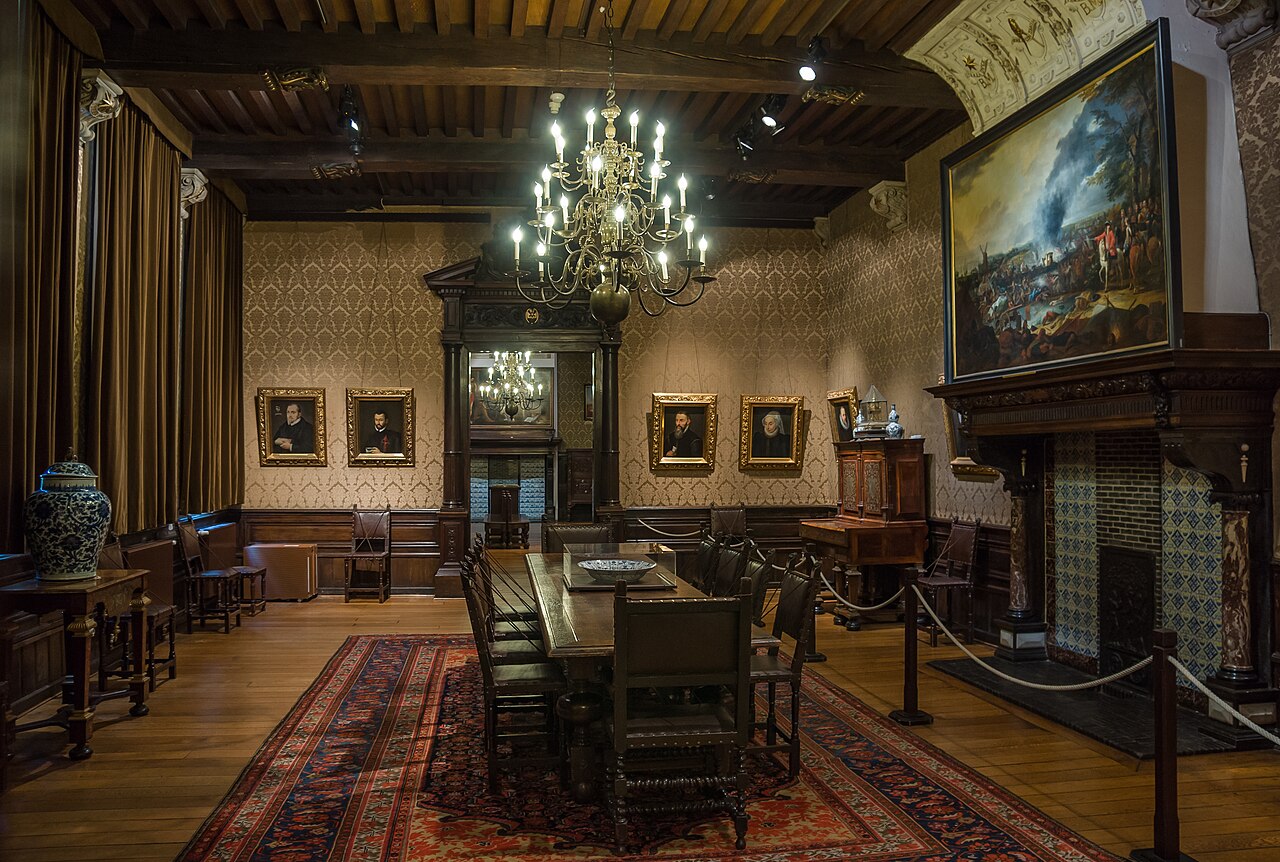
This continuity is the foundation of the site’s UNESCO designation. The World Heritage Committee noted in 2005 that the Plantin-Moretus complex is “the only printing house in the world dating from the 15th and 16th centuries which has been conserved intact.” The two printing presses on the ground floor, both dating to approximately 1600, are operational. The type cases contain original typefaces in Latin, Greek, Hebrew, Arabic, Syriac, and Armenian — the full range of languages in which the Plantin Press produced editions during the 16th century. The compositing rooms where individual metal letters were assembled into page forms by hand survive with their original furniture and tools.
The library holds approximately 150 manuscripts dating from the 12th century onward, along with first editions that track the full output of Antwerp printing from the mid-16th century. Among them is the first edition of Thomas More’s Utopia, published in Antwerp in 1516 by Dirk Martens — not by Plantin, who was not yet in business, but preserved in the Plantin-Moretus collection because Antwerp was then the publishing capital of northern Europe and because the Moretus family collected systematically. More’s Utopia was printed in Antwerp because the city was the intellectual and commercial centre of the Low Countries, and because More’s friend Erasmus of Rotterdam arranged the publication through Martens during a diplomatic mission.
The Biblia Regia and the House Rubens Visited Vrijdagmarkt 22, 5 minutes from the Cathedral of Our Lady
Plantin’s masterwork was not a literary text but a diplomatic and scholarly achievement of staggering complexity. The Biblia Regia — also known as the Antwerp Polyglot Bible — was commissioned by Philip II of Spain and produced between 1568 and 1572 in eight folio volumes. Each opening presented the same biblical text in four languages in parallel columns: Hebrew, Aramaic (the Targum), Greek (the Septuagint), and Latin (the Vulgate). The Greek New Testament volume added a fifth column. To produce a Bible in four languages simultaneously required Plantin to hold in type, simultaneously, texts set in four different scripts, each with its own technical demands. The Aramaic required a font that did not exist: Plantin commissioned it from Robert Granjon, one of the greatest type designers of the 16th century, who cut the Syriac font specifically for this project.
Philip II funded the project — or rather, agreed to fund it and then repeatedly delayed payment, driving Plantin into debt and near bankruptcy during the production years. The completed Bible was submitted to the Spanish Inquisition for doctrinal review, and Plantin was required to travel to Madrid to defend the textual choices before theologians. He was ultimately cleared, and 1,213 copies of the complete Biblia Regia were printed. The project is considered the most technically complex printing undertaking of the 16th century, and the archive in the museum contains the full correspondence between Plantin and the Spanish court, detailing every delay, debt, and doctrinal dispute.
Peter Paul Rubens, whose father Jan Rubens had served as legal secretary to William I of Orange and whose mother had connections to the Antwerp merchant class, was a frequent visitor to the Plantin-Moretus house. The archive contains letters between Rubens and Jan Moretus I. More practically, Rubens designed frontispiece engravings for Plantin-Moretus editions — the elaborate engraved title pages that announced the publisher and content of serious scholarly books in the early 17th century. Several of these engraved frontispieces, based on Rubens’s drawings, are preserved in the collection. Rubens also designed the ornamental cartouche above the main entrance of the building, which remains in place. The connection between the press and the painter was not sentimental: Rubens was the most prominent visual artist in Antwerp, and his designs guaranteed the prestige of the books that bore them.
The courtyard of the museum, visible from the main entrance gate, was laid out in the 16th century and preserves a Renaissance garden with a vine-covered pergola and clipped box hedging. The building’s exterior façade on the Vrijdagmarkt was designed in part by Jan Rubens — Peter Paul’s father — though the attribution of specific architectural elements remains contested in the scholarly literature. What is not contested is that the building’s interior, from the library to the compositing rooms to Plantin’s personal study with its original desk and letter press, survives in a state of preservation without equivalent in European printing history.
Practical information
The Museum Plantin-Moretus is at Vrijdagmarkt 22, 2000 Antwerp. It is open Tuesday to Sunday, 10:00 to 17:00; closed on Mondays and on 1 January, 1 May, Ascension Day, 1 November, and 25 December. Adult admission is €12; reduced admission (seniors, students) is €10; children under 18 enter free. Combined tickets with the Royal Museum of Fine Arts Antwerp are available at the museum desk.
The museum is a 10-minute walk from Antwerp Central Station (Antwerpen-Centraal), which is served by Thalys, Intercity, and local trains from Brussels (35 minutes from Brussels-Midi/Zuid), Amsterdam (1 hour 10 minutes), and Rotterdam. From the station, walk west along Meir shopping street and then south through the old town. Alternatively, tram lines 3 and 5 stop at Groenplaats, a 3-minute walk from the museum entrance.
The Cathedral of Our Lady (Onze-Lieve-Vrouwekathedraal), which contains four Rubens paintings including “The Raising of the Cross” and “The Descent from the Cross,” is a 5-minute walk from the museum at Handschoenmarkt. It is not a UNESCO site but is directly relevant to visitors interested in the Rubens–Plantin-Moretus connection. The Grand-Place in Brussels, a UNESCO World Heritage Site, is 45 kilometres southwest and is reachable by train from Antwerp Central in under 45 minutes.
Frequently Asked Questions
Why is the Museum Plantin-Moretus a UNESCO World Heritage Site rather than simply a national museum?
The UNESCO inscription, awarded in 2005, rests on the combination of three attributes that nowhere else on earth coincide. First, the physical continuity: the printing house has operated on this site since 1555, and the building was purchased by the City of Antwerp in 1876 without any dispersal of its contents. Every piece of type, every press, every letter in the archive, and every book in the library remained in place. Second, the documentary completeness: the Plantin-Moretus archive contains the full commercial and intellectual correspondence of a major European publisher across three centuries — letters from scholars, kings, inquisitors, and artists, including Philip II of Spain and Peter Paul Rubens. Third, the technical significance: the two ca. 1600 printing presses are the oldest surviving examples of European letterpress printing equipment anywhere in the world in their original operational setting. UNESCO’s designation specifically notes that the site “constitutes the most complete example of a printing and publishing house of the 15th and 16th centuries conserved in the world.” No comparable institution — not the Gutenberg Museum in Mainz, not the Bibliothèque nationale de France — preserves all three dimensions simultaneously.
What is the Biblia Regia and where can it be seen today?
The Biblia Regia (Royal Bible), also called the Antwerp Polyglot Bible, was produced by Christophe Plantin between 1568 and 1572 under commission from Philip II of Spain. It presents the complete text of the Old and New Testaments in four languages in parallel columns — Hebrew, Aramaic (Targum), Greek (Septuagint), and Latin (Vulgate) — across eight folio volumes. The fifth volume of the New Testament added a fifth column. At 1,213 copies in the completed print run, it was the largest single publication project of 16th-century Europe by technical complexity. Several complete sets survive in major European libraries. The Museum Plantin-Moretus holds a copy, along with the production archive — correspondence with the Spanish court, type specimens, and proofsheets — that documents every stage of the eight-year project. The Bodleian Library in Oxford holds another complete copy. The British Library in London holds two copies, one of which belonged to King George III. A complete set presented to Philip II as the dedication copy is held at the Real Biblioteca del Monasterio de El Escorial, near Madrid.
Is there a connection between the Museum Plantin-Moretus and Thomas More’s Utopia?
The connection is geographical and historical rather than direct. Thomas More’s Utopia was first published in Antwerp in December 1516 by the printer Dirk Martens (also spelled Thierry Martens), not by Christophe Plantin, who did not establish his press until 1555. However, the Museum Plantin-Moretus holds a first edition of the Utopia as part of its library collection, which is consistent with its systematic preservation of significant Antwerp printed books from the 15th and 16th centuries. More wrote Utopia while in Antwerp on a diplomatic mission for Henry VIII, and his friend Erasmus of Rotterdam — who lived in Antwerp intermittently — arranged for Martens to print it. The text was printed in Latin, in a small quarto volume of 100 pages, illustrated with a map of the imaginary island of Utopia drawn by Erasmus’s friend Ambrosius Holbein (brother of Hans Holbein the Younger). The copy in the Plantin-Moretus collection can be examined during museum visits by arrangement with the curatorial staff. The 2016 quincentenary of the Utopia’s publication prompted a major exhibition at the museum that documented Antwerp’s role as the intellectual publishing centre of northern Europe in the early 16th century.
Sources
- S1 — Voet, Leon. The Plantin Press (1555-1589). Van Hoeve, 1980. ISBN 978-90-222-0258-6.
- S2 — Bowen, Karen L., and Dirk Imhof. Christopher Plantin and Engraved Book Illustrations in Sixteenth-Century Europe. Cambridge University Press, 2008. ISBN 978-0-521-85276-0.
Spotted an error? Write to editorial@culturalheritageonline.com and we correct it the same day.