
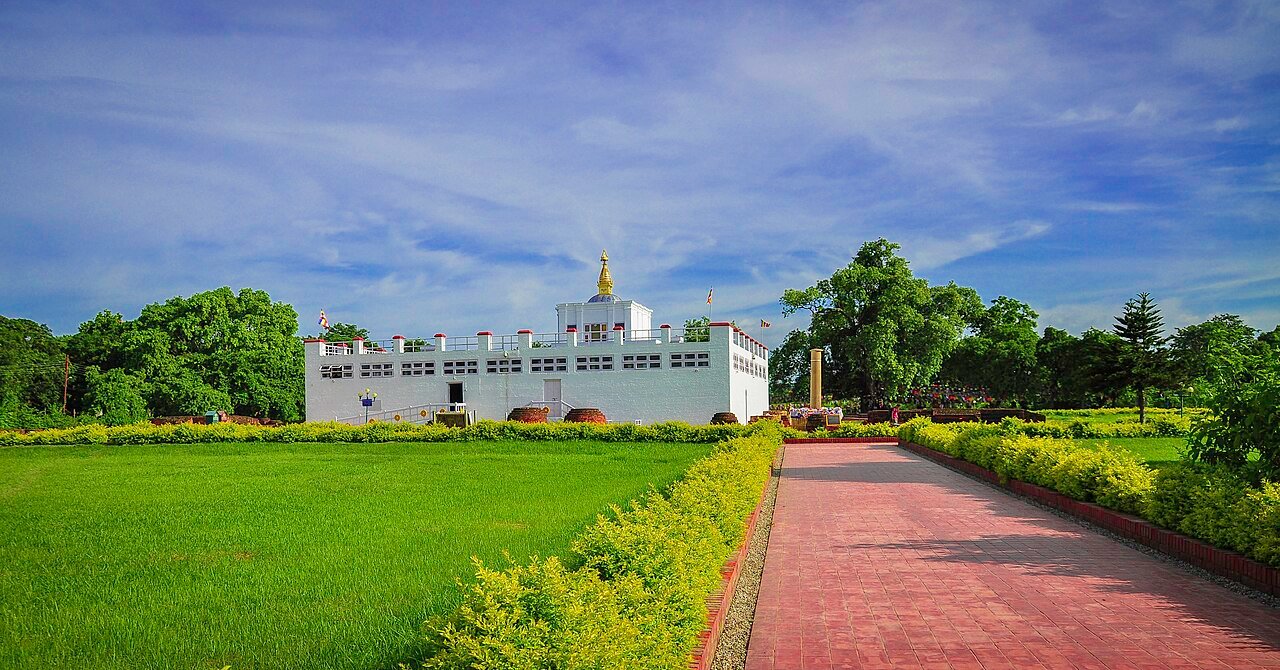
Lumbini, in the Terai lowlands of Rupandehi District in southern Nepal, is the site where Buddhist tradition holds that Queen Maya Devi gave birth to Prince Siddhartha Gautama — the future Buddha — around the 5th to 6th century BCE. Inscribed by UNESCO in 1997, it is one of the most significant pilgrimage sites on Earth for the world’s roughly 500 million Buddhists. The Sacred Garden at its centre preserves the Mayadevi Temple, a stone pillar erected by the Emperor Ashoka in 249 BCE, and the remains of monastic complexes spanning more than a millennium.
The Sacred Garden and the Nativity Stone Core UNESCO zone
The account of the birth is precise in early Buddhist texts. Queen Maya Devi was travelling from Kapilavastu to her parents’ home in Devadaha when she stopped at the Lumbini grove and, while grasping the branch of a sal tree (Shorea robusta), gave birth to Siddhartha Gautama. Historical scholarship places the date somewhere between 624 and 448 BCE, with the 5th century BCE now the most widely accepted range. At the moment of birth, the infant is said to have taken seven steps in each of the four cardinal directions and declared, “I am chief in the world.” This declaration follows the established narrative pattern of a mahapurusha — a “great man” — common to both chakravartins (world-rulers) and buddhas in Indian tradition, and marks the birth as cosmically significant rather than merely royal.
The confirmation that this location is that grove came from an unlikely direction: imperial epigraphy. In 249 BCE, the Mauryan Emperor Ashoka undertook a pilgrimage to the major Buddhist sacred sites and visited Lumbini. He commissioned a stone pillar inscribed in Brahmi script that reads: “Hida Budhe jāte Sakyamuni iti” — “Here the Buddha, Sakyamuni, was born.” This pillar, still standing in the Sacred Garden, is the earliest epigraphic evidence linking the name “Buddha Shakyamuni” to a specific physical location. Without it, the identification of Lumbini would rest on textual tradition alone.
The most sacred object within the UNESCO-protected area is the Nativity Stone — a sandstone marker rediscovered in 1895 by the archaeologist Alois Anton Führer beneath the site of the Ashoka Pillar. It is understood to mark the exact spot of the birth. The Mayadevi Temple that shelters it today is a modern structure built over ancient foundations; excavations beneath the temple floor have revealed successive brick platforms going back to the 3rd century BCE, confirming continuous veneration of the spot.
The Sacred Garden also contains the Puskarini, the sacred pond where, according to tradition, Queen Maya Devi bathed before the birth and where the infant Siddhartha was given his first ritual bath. Surrounding the pond are the excavated remains of Buddhist monasteries and votive stupas dating from the 2nd century BCE through to the 9th century CE, documenting more than a thousand years of unbroken religious activity at the site.
The Monastic Zone and the wider Lumbini complex 280 km SW of Kathmandu
Beyond the Sacred Garden, the broader Lumbini Development Zone covers a planned area conceived by the Japanese architect Kenzo Tange in 1978. Tange’s master plan organises the monastic zone along a formal north-south central canal, with two zones branching east and west. The East Monastic Zone is dedicated to Theravada Buddhist nations — countries including Sri Lanka, Thailand, Myanmar, Cambodia, and China have built monasteries here. The West Monastic Zone houses Mahayana and Vajrayana traditions, with monasteries funded by Korea, Japan, Germany, France, and several other nations. Twenty-six monasteries from across the Buddhist world are completed or under construction, each expressing the architectural idiom of its home tradition and together constituting one of the most architecturally diverse religious ensembles of the modern era.
The approach to the Sacred Garden runs along a reflecting pool flanked by the monasteries, building a visual axis that terminates at the white mass of the Mayadevi Temple. The effect is deliberately processional — the path is designed as an act of pilgrimage in itself, regardless of the visitor’s faith. At the north end, outside the planned zone, the town of Lumbini village provides guesthouses, restaurants, and bicycle hire, since the monastic zone is best explored on two wheels. The entire development zone covers roughly 4 km from the Cultural Centre at the south to the Sacred Garden at the north, and cycling is both practical and conventional.
Access has improved substantially since the upgrading of Gautam Buddha International Airport at Bhairahawa, 50 km away, which now receives international flights from Delhi, Doha, and Singapore. From Kathmandu, the journey by road takes 6-7 hours along the Prithvi and Siddhartha highways, with the final descent from the Himalayan foothills onto the flat Terai plain offering a striking change in landscape. The closest large city is Bhairahawa (also called Siddharthanagar), with hotels at every price point; budget accommodation is available in Lumbini itself, and several mid-range hotels have opened near the Sacred Garden in recent years to serve the growing pilgrimage economy.
Practical information
The Sacred Garden at Lumbini is open daily from 6:00 to 18:00. Entry to the outer development zone is free; a ticket (approximately USD 3-5 for foreign visitors) is required to enter the Sacred Garden and the Mayadevi Temple. Photography is permitted throughout the complex, though shoes must be removed before entering the temple. The site receives its heaviest footfall during Buddha Jayanti, the festival celebrating the Buddha’s birth, enlightenment, and death (observed on the full moon of the Nepali month of Baisakh, typically April-May), when hundreds of thousands of pilgrims converge. Outside festival periods, early morning is the best time to visit: mist off the Terai gives the sal trees and the white temple a remarkable atmosphere, and the pilgrimage paths are quiet. The Terai lowlands are hot and humid from April to September; October to March offers the most comfortable temperatures (15-25°C daytime). Nepal’s visa-on-arrival is available to most nationalities at Bhairahawa airport and at the Belahiya border crossing from India (the Indian town of Nautanwa/Sunauli is 22 km from Lumbini, making the site highly accessible for visitors on an India circuit including Varanasi and Bodh Gaya).
Frequently Asked Questions
What is the Ashoka Pillar at Lumbini and why does it matter?
The Ashoka Pillar at Lumbini is a monolithic sandstone column erected on the orders of the Mauryan Emperor Ashoka during his pilgrimage to Buddhist sacred sites in 249 BCE, approximately two centuries after the birth of the Buddha. It is one of several dozen pillars Ashoka placed across his empire to mark holy sites and propagate the dhamma (Buddhist moral law). What makes the Lumbini pillar singular is its inscription, written in the Brahmi script in the Pali language, which explicitly names the site as the birthplace of “Buddha Shakyamuni.” The key line — “Hida Budhe jāte Sakyamuni iti” — constitutes the earliest known written record to identify Siddhartha Gautama by the title “Shakyamuni” and to connect him to a specific geographic point. The pillar was rediscovered in 1896 by the German archaeologist Alois Anton Führer, who was working with the Nepal Durbar under the General Khadga Shamsher Rana. Before Führer’s discovery, the exact location of Lumbini had been lost to the outside world for centuries. The pillar stands to a height of approximately 6.1 metres above ground (part of the original shaft is buried). It shows a crack from lightning damage, historically documented in records from the 14th century. Its existence is why Lumbini, and not any of the other candidate sites proposed during the 19th-century scholarly debates about the Buddha’s birthplace, holds UNESCO inscription status.
How does Lumbini relate to the other Buddhist pilgrimage sites in the region?
The Buddhist pilgrimage circuit of the Indian subcontinent traditionally identifies four “great places” (mahāsthāna) that every devout Buddhist should ideally visit: Lumbini (birthplace), Bodh Gaya in Bihar, India (site of the enlightenment under the Bodhi Tree), Sarnath near Varanasi, India (where the Buddha gave his first teaching, the Deer Park Sermon), and Kushinagar in Uttar Pradesh, India (site of the parinirvana, the final passing). Lumbini is the only one of the four in Nepal; the other three are all in the Gangetic plain of northern India within a roughly 500 km arc. Modern pilgrimage tours typically begin at Lumbini, cross the border into India at Sunauli/Belahiya, and proceed by road or train through the circuit. The early Buddhist texts (including the Pali Canon’s Mahaparinibbana Sutta) explicitly instruct devotees to visit these four places, making the circuit one of the oldest organised pilgrimage traditions in the world. The Tibetan Buddhist tradition adds a second tier of sites, including Rajgir and Nalanda (both in Bihar), and Shravasti in Uttar Pradesh, where the Buddha spent many rainy-season retreats. For visitors approaching from Nepal, Lumbini makes a natural starting point; for those arriving from Delhi or Varanasi, it is typically the final stop on a westward circuit.
What is the significance of the Mayadevi Temple and the Nativity Stone inside it?
The Mayadevi Temple at Lumbini is the focal point of the entire complex and the building that most pilgrims have in mind when they picture the site. The current structure is a modern building completed in 2003, but it encloses and protects the archaeological layers of seven earlier structures on the same foundations, the oldest dating to the 3rd century BCE. Excavations revealed that the site was venerated continuously from the Ashokan period through the medieval era, with each successive Buddhist community rebuilding and expanding the shrine. The temple is named after Maya Devi, the Buddha’s mother, and contains the carved Nativity Panel — a sculpted relief depicting the birth scene, with Maya Devi grasping the sal tree branch, the infant standing upright, and celestial figures in attendance. The panel dates to around the 2nd century BCE and is among the earliest known narrative depictions of the Buddha’s birth in South Asian art. More significant still, in archaeological terms, is the Nativity Stone: a flat sandstone marker beneath a skylight within the temple, identified during the 1992-1996 excavations as the original sacred stone venerated by Ashokan-era pilgrims. It sits directly below the carved Nativity Panel and is interpreted as marking the exact birth spot. Visitors are permitted to approach but not touch the stone; many make offerings of flowers and incense at the surrounding perimeter. The atmosphere inside the temple is one of quiet intensity, with pilgrims from dozens of countries gathered around a single unremarkable stone that may be the oldest continuously venerated object in the Buddhist world.
Sources
- S1 — Weise, Kai, ed. The Sacred Garden of Lumbini: Perceptions of Buddha's Birthplace. UNESCO Publishing, 2013. ISBN 978-92-3-001208-3.
- S2 — Bidari, Basanta. Lumbini: A Haven of Sacred Refuge. Hillside Press, 2002. ISBN 978-99933-722-1-9.
Spotted an error? Write to editorial@culturalheritageonline.com and we correct it the same day.


