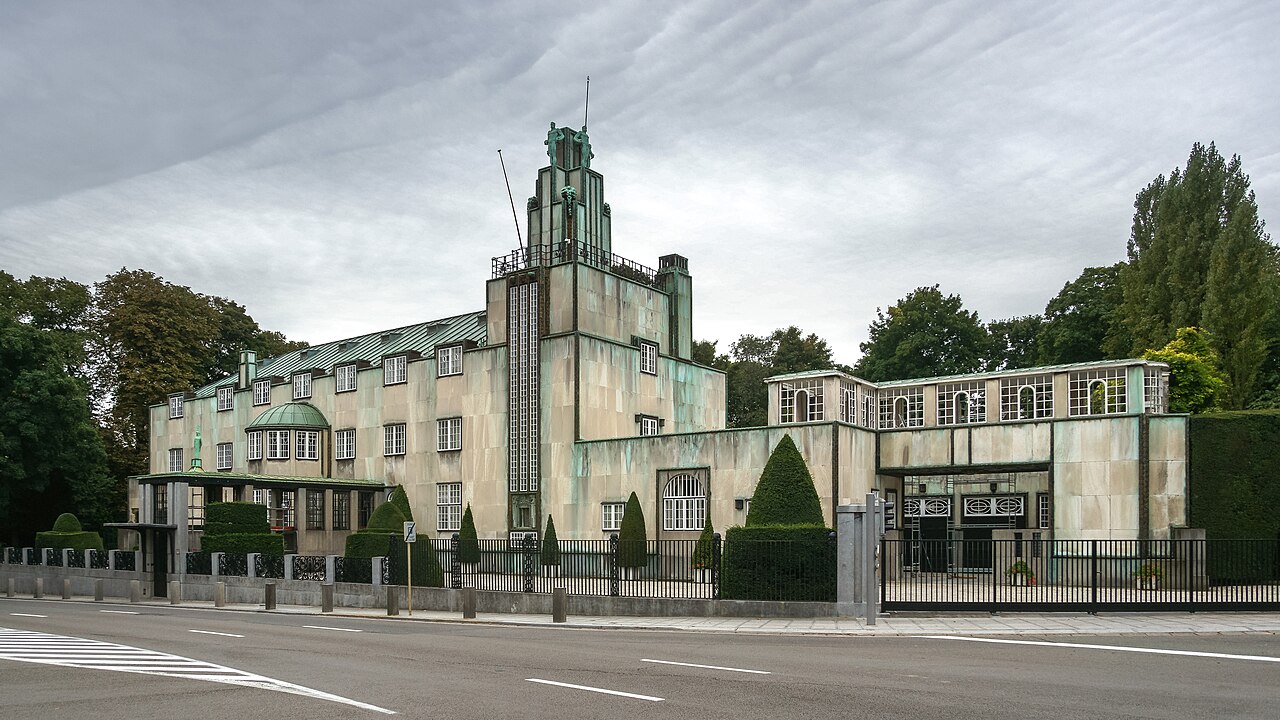
The Stoclet Palace in Brussels’s Woluwe-Saint-Pierre municipality is a UNESCO World Heritage Site you cannot enter: privately owned by the Stoclet family since its completion in 1911, it has never admitted the public. It is the only UNESCO-listed property in Belgium inscribed entirely on the basis of what lies inside — including Gustav Klimt’s most ambitious decorative work, a mosaic frieze that cost its patron a sum that was never even calculated.
A Blank Cheque and a Total Work of Art Woluwe-Saint-Pierre, Brussels
In 1904, Belgian banker Adolphe Stoclet commissioned Austrian architect Josef Hoffmann to design a private residence in Brussels with a single instruction: there was no budget. Hoffmann, a co-founder of the Vienna Secession and a director of the Wiener Werkstätte craft workshop, treated the commission as a philosophical statement. The result, constructed between 1905 and 1911, is the most fully realised example of the Gesamtkunstwerk — the “total work of art” — in the history of European design.
The exterior is clad in white Norwegian marble, cut to precise dimensions and fitted over a steel frame. At each corner, gilded copper bands wind upward in a laurel-wreath pattern designed by sculptor Franz Metzner. The tower that crowns the composition terminates in four gilded bronze figures of Nike, the Greek goddess of victory, also by Metzner — their wings outstretched over the roofline at Avenue de Tervueren. The geometry is absolute: Hoffmann used no curved lines on the exterior, a deliberate rejection of the sinuous Art Nouveau forms that dominated European architecture at the moment of construction.
Inside, every object — every door handle, every curtain hook, every piece of cutlery — was designed by Hoffmann or a colleague from the Wiener Werkstätte. No element was left to chance or sourced outside the design system. The furniture is black-stained oak with ivory inlays. The light fixtures are bronze and opaque glass. The dining room walls are lined in black marble. Nothing, in over 1,700 square metres of residence, was purchased from a catalogue.
The Stoclet commission had a direct effect on the trajectory of early modernism. Mies van der Rohe cited the palace’s precise geometry and integration of materials as a formative influence. Le Corbusier visited Brussels in 1910, a year before the building’s completion. The palace demonstrated that the rejection of ornament and the embrace of engineered materials — marble, steel, bronze — could produce architecture of greater emotional power than the decorative excess it replaced. That argument would define European modernism for the next four decades.
UNESCO inscribed the Stoclet Palace in 2009 under criteria (i), (ii), and (iv): outstanding individual achievement, significant human interchange, and an outstanding example of a type of building that illustrates a significant stage in human history. The inscription is unusual in acknowledging that the site cannot be visited. The World Heritage Committee justified this by stating that the palace represents “an unrepeatable masterpiece” whose integrity depends on its continued private ownership and the preservation of every interior element in its original condition.
The Klimt Frieze: Mosaic Panels in a House No One Enters Woluwe-Saint-Pierre, 8 km from Brussels city centre
In 1905, Adolphe Stoclet approached Gustav Klimt — then at the peak of his reputation following the controversy of his University of Vienna ceiling paintings — with a commission for the dining room walls. Klimt spent four years producing cartoons for a mosaic frieze that would run along three walls of the room at eye height. The cartoons were completed in 1909; the mosaics themselves were executed between 1910 and 1911 by the Viennese firm of Leopold Forstner, using gold leaf, semi-precious stones, coral, enamel, and mother-of-pearl set into a base of marble and faience.
The frieze is divided into three compositional panels. The two flanking panels depict the Tree of Life — a spiralling gold form against a black ground, its branches terminating in geometric spirals and eyes. The central panel, positioned opposite the window, depicts two embracing figures in an image Klimt called “Fulfilment” (Erfüllung). This is the resolved and serene version of the embrace that Klimt would depict in turbulent, gold-laden form in “The Kiss” (1907-1908), now in the Belvedere in Vienna.
The original full-scale cartoons for the Stoclet Frieze — drawn in pencil, watercolour, and gouache on paper, measuring approximately 2 metres high and 30 metres in length — are held by the Museum für angewandte Kunst (MAK) in Vienna, where they can be examined in the permanent collection. They are among the most complete surviving design documents for any major decorative programme by Klimt. The mosaics themselves remain where they were installed: in a private dining room in Brussels, visible only to the Stoclet family and their guests.
For this reason, photographic documentation of the interior is fragmentary. The most complete archival photographs were taken in the 1970s by the Art Institute of Chicago. No public institution has been granted access for systematic photography since. What exists in the scholarly literature is a partial record of the most comprehensively designed private interior in the history of European art.
The nearest publicly accessible UNESCO site is the four Town Houses by Victor Horta, inscribed in 2000 and located approximately 5 kilometres southwest in the municipality of Saint-Gilles and Ixelles. The Hôtel Tassel (1892-1893), the Hôtel Solvay (1894-1900), the Hôtel van Eetvelde (1895-1901), and the Maison & Atelier Horta (1898-1901) together represent the founding vocabulary of Art Nouveau architecture. Horta’s buildings can be visited; the Maison & Atelier Horta operates as a museum. Together, Horta’s houses and the Stoclet Palace define the full arc of Belgian art at the turn of the twentieth century — from Horta’s flowing botanical forms to Hoffmann’s geometric abstraction.
Practical information
The Stoclet Palace stands at Avenue de Tervueren 279-281, 1150 Woluwe-Saint-Pierre, Brussels. It is not open to the public and there are no admission procedures or waiting lists. The exterior can be viewed from the pavement on Avenue de Tervueren; the best view of the tower and the corner detailing is from the intersection with Rue de l’Astronomie.
To reach the palace from central Brussels, take metro line 1 towards Stockel (Stokkel) and exit at Montgomery or Thieffry; from there it is approximately a 10-minute walk east along Avenue de Tervueren. By tram, line 94 runs along Avenue de Tervueren and stops within 300 metres of the building.
The Victor Horta Town Houses, the nearest UNESCO comparison, are open to visitors by appointment or during set visiting hours. The Maison & Atelier Horta (now the Horta Museum) at Rue Américaine 25, Saint-Gilles, is open Tuesday to Sunday. For the Hôtel Solvay and Hôtel van Eetvelde, guided visits must be booked in advance through their respective owners or through Visit Brussels.
The MAK Vienna, which holds the Klimt cartoons for the Stoclet Frieze, is a separate destination entirely, located in Vienna’s first district at Stubenring 5. The cartoons are on permanent display and represent the only way to examine Klimt’s original designs for the Brussels dining room at full scale.
Frequently Asked Questions
Can visitors see inside the Stoclet Palace?
No. The Stoclet Palace has never been open to the public since its completion in 1911, and there are no indications that this will change. It remains the private residence of descendants of the original Stoclet family. UNESCO’s 2009 inscription explicitly acknowledges the building’s inaccessibility and states that the site’s “outstanding universal value” is preserved precisely because it has remained in private hands with all original furnishings intact. The World Heritage Committee made an exceptional decision in inscribing a site where public access is not possible and never has been. Visitors can view the exterior from Avenue de Tervueren. The Klimt cartoons for the interior frieze — the closest available substitute for seeing the dining room — are on permanent display at the Museum für angewandte Kunst (MAK) in Vienna. No reproduction of the interior approaches the original: existing photographs are fragmentary, taken at various points between 1911 and the 1970s, and no comprehensive photographic survey has been published.
Why is the Stoclet Palace considered more important than Victor Horta’s buildings?
The question conflates two different arguments. Victor Horta’s Town Houses in Brussels, inscribed by UNESCO in 2000, are considered the founding documents of Art Nouveau as an architectural movement — Horta invented the formal vocabulary that spread across Europe between 1893 and 1910. They are accessible, well-documented, and directly influential on thousands of subsequent buildings. The Stoclet Palace, inscribed in 2009, occupies a different position in architectural history: it represents the moment at which Art Nouveau’s decorative programme was distilled into an abstract geometric system, which then fed directly into the International Style of the 1920s and 1930s. Hoffmann’s precise geometry, his integration of industrial materials, and his elimination of the sinuous botanical forms characteristic of Horta’s work produced a building that influenced Mies van der Rohe and Le Corbusier more directly than Horta’s houses did. The two inscriptions are complementary rather than competitive: one documents the origin of a movement, the other documents its culmination and the transition to what came next.
What is the Wiener Werkstätte and why does it matter for the Stoclet Palace?
The Wiener Werkstätte (Vienna Workshops) was a cooperative of artists and craftsmen founded in Vienna in 1903 by Josef Hoffmann and Koloman Moser, with financial backing from industrialist Fritz Waerndorfer. Its stated goal was to produce everyday objects — furniture, textiles, metalwork, ceramics, jewellery — designed as unified aesthetic programmes rather than as individual commodities. The Werkstätte drew direct inspiration from the Arts and Crafts movement of William Morris and Charles Rennie Mackintosh, both of whom Hoffmann had studied. The Stoclet commission gave the Werkstätte its most complete opportunity to realise this philosophy: because Adolphe Stoclet provided unlimited funds and unlimited confidence in Hoffmann, every object in the house could be designed from scratch as part of a single coherent system. No compromise was necessary. The result was the only building in history in which the Werkstätte’s programme was applied at full scale and without external constraint. The Stoclet Palace therefore serves as the definitive physical document of what the Werkstätte intended — more complete than any museum display of individual Werkstätte objects could be, precisely because the objects remain in the context for which they were designed.
Sources
- S1 — Freixa, Mireia. El Palacio Stoclet de Bruselas: Obra maestra de Josef Hoffmann. Alianza Editorial, 1993. ISBN 978-84-206-7112-3.
- S2 — Sekler, Eduard F. Josef Hoffmann: The Architectural Work. Princeton University Press, 1985. ISBN 978-0-691-06572-4.
Spotted an error? Write to editorial@culturalheritageonline.com and we correct it the same day.