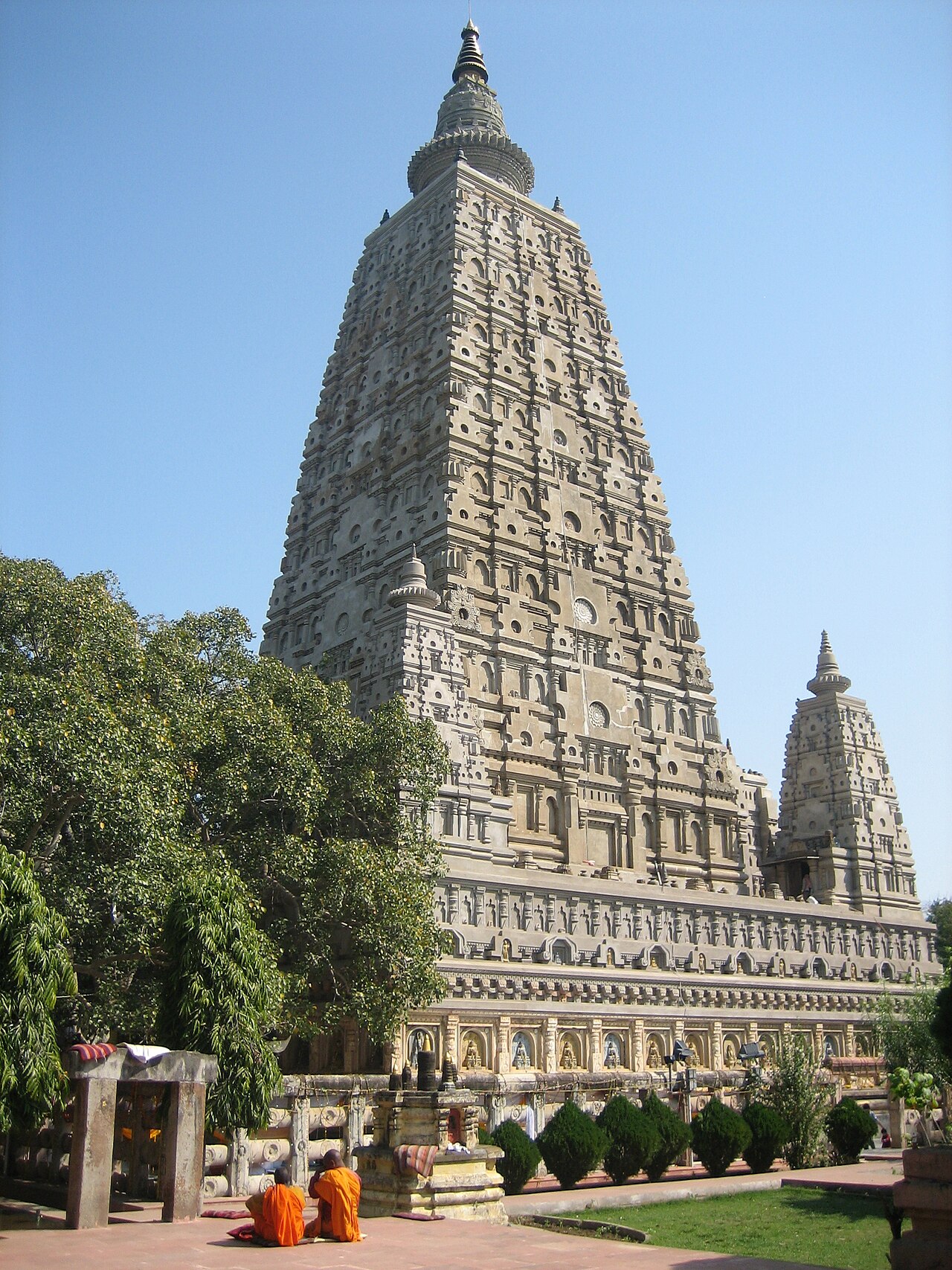
The nearest World Heritage site to the Mahabodhi Temple Complex at Bodh Gaya is Nalanda Mahavihara, 67 km away in a straight line, followed by the Ancient Buddhist Site of Sarnath (212 km) and Santiniketan (295 km), all in India. Bodh Gaya itself is one of four holy sites tied to the life of the Buddha, and the one where he attained Enlightenment. UNESCO inscribed it in 2002.
Which World Heritage sites lie around Bodh Gaya?
The distances below are straight lines between the reference points UNESCO publishes for each property. They show what is close, not how long the road takes.
| Site | Country | Distance | Inscribed | Type |
|---|---|---|---|---|
| Archaeological Site of Nalanda Mahavihara at Nalanda, Bihar | India | 67 km | 2016 | Cultural |
| Ancient Buddhist Site of Sarnath | India | 212 km | 2026 | Cultural |
| Santiniketan | India | 295 km | 2023 | Cultural |
| Chitwan National Park | Nepal | 319 km | 1984 | Natural |
| Kathmandu Valley | Nepal | 333 km | 1979 | Cultural |
| Lumbini, the Birthplace of the Lord Buddha | Nepal | 353 km | 1997 | Cultural |
Three of these properties belong to one story. The ICOMOS evaluation names the significant sites of the Buddha’s life: Lumbini, Bodh Gaya, Sarnath, where he gave his first sermon after Enlightenment, and Kusinagar, where he died. UNESCO describes Nalanda as a monastic and scholastic institution dating from the 3rd century BCE to the 13th century CE, which transmitted knowledge without interruption for 800 years.
Who built the Mahabodhi Temple, and when?
The answer has two layers. UNESCO says the first temple was built by Emperor Asoka in the 3rd century BCE and that the present temple dates from the 5th or 6th century CE. The ICOMOS evaluation adds the detail: Asoka made a pilgrimage to the spot around 260 BCE, built a balustrade around the Bodhi Tree and a small temple near it, and placed a Vajrasana, a Diamond Throne, where the Buddha was believed to have sat.
Who commissioned the present building is less clear. The Bodhgaya Temple Management Committee, which runs the site, writes that how long it took to create the structure, or whose creation it is, “still remains a mystery” for lack of comprehensive historical data. What can be dated comes from outside the building. The Chinese traveller Faxian mentions the main temple and the Bodhi Tree in 404–5 CE. When Xuanzang arrived in 637 CE he found the tree inside strong walls and, within them, a temple 160 ft (50 m) tall, built of bluish bricks and plaster, with niches holding gilded statues. UNESCO gives today’s temple as 50 m high, and the committee says it still keeps the dimensions and broad features of Xuanzang’s day.
UNESCO counts it among the earliest Buddhist temples built entirely in brick that are still standing in India, from the late Gupta period. ICOMOS adds that the sculpted stone balustrades are some of the oldest sculptural reliefs found in the country.
What survives of Asoka’s time, and is the Bodhi Tree the original?
Beside the tree stands the Vajrasana, a polished sandstone platform that UNESCO says was installed by Asoka to mark the spot where the Buddha sat and meditated. A sandstone balustrade once encircled it, but only a few of the original pillars remain in place.
The tree is a Ficus religiosa, the peepal. UNESCO calls it a “supposed direct descendant” of the original, and the committee is franker still: the present tree is, in its words, “probably the fifth succession” of the original, which was destroyed several times by human and natural causes. There is a second thread outside Bodh Gaya. UNESCO’s text on the Sacred City of Anuradhapura in Sri Lanka says that city was established around a cutting from the tree of enlightenment, brought there in the 3rd century BCE by Sanghamitta, founder of an order of Buddhist nuns. Neither source describes the tree now at Bodh Gaya as grown from that Sri Lankan cutting, so that chain of descent is tradition, not documented record.
Why was the temple abandoned, and who restored it?
ICOMOS records a long decline. Repairs between the 7th and 11th centuries are poorly documented, though the Burmese appear to have carried out extensive works in the 11th. After the Muslim conquest in the 13th century the temple was deserted and gradually fell into ruin. UNESCO puts the abandonment at the 13th to 18th centuries.
Recovery began in the 19th century, when Burmese kings started repairs and the British continued in 1880–84. The committee dates a thorough renovation to a Burmese mission under King Mindon in 1874, completed in 1884 under Sir Alexander Cunningham and Beglar. ICOMOS says these works were based on existing evidence and that no new features are reported to have been added; the ruined front pavilion was rebuilt from a stone model found at the temple.
Who has managed the temple since 1949?
For centuries it was not in Buddhist hands. The committee records that a Shaivite monk, Mahant Ghamandi Giri, settled at Bodh Gaya in 1590 and claimed to be the legitimate heir of the Mahavihara. Sir Edwin Arnold called for its return to the Buddhists in 1885, and Anagarika Dharmapala of Ceylon took up the cause in 1891. The Bodhgaya Temple Act (Bihar XVII of 1949) received the Governor’s assent on 19 June 1949, and the Mahant formally handed over management on 23 May 1953.
Under the Act the Committee has a chairman and eight members nominated by the state government, all of whom must be Indian. UNESCO adds that conservation work is carried out under the guidance of the Archaeological Survey of India and that the main source of finance is donations from devotees.
Frequently Asked Questions
Which UNESCO World Heritage sites are near Bodh Gaya?
Nalanda Mahavihara is the nearest, 67 km away in a straight line. Next come Sarnath (212 km), Santiniketan (295 km), Chitwan National Park (319 km), the Kathmandu Valley (333 km) and Lumbini (353 km). These are distances between UNESCO reference points, not road times.
Who built the Mahabodhi Temple?
Emperor Asoka built the first temple in the 3rd century BCE, according to UNESCO. The present temple dates from the 5th or 6th century CE. Who commissioned it is not recorded; the Bodhgaya Temple Management Committee calls the question a mystery for lack of comprehensive historical data.
Is the Bodhi Tree at Bodh Gaya the original tree?
Not in any documented line. UNESCO calls it a supposed direct descendant of the original tree under which the Buddha attained Enlightenment. The Bodhgaya Temple Management Committee says the present tree is probably the fifth succession, the earlier ones having been destroyed by human and natural causes.
Why was the Mahabodhi Temple inscribed on the World Heritage List?
In 2002, under criteria (i), (ii), (iii), (iv) and (vi). Criterion (vi) rests on the temple’s direct association with the Buddha’s Enlightenment. The others cover its early brick architecture, its influence over later building, and the exceptional record of worship from Asoka onwards.
Sources
- UNESCO World Heritage Centre, Mahabodhi Temple Complex at Bodh Gaya (inscribed 2002). https://whc.unesco.org/en/list/1056/
- ICOMOS, Advisory Body Evaluation of the nomination of the Mahabodhi Temple Complex at Bodh Gaya (No 1056 rev), March 2002. https://whc.unesco.org/document/151635
- Bodhgaya Temple Management Committee, History. https://bodhgayatemple.com/history/
- Bodhgaya Temple Management Committee, About Mahabodhi Temple. https://bodhgayatemple.com/about-mahabodhi-temple/
- Bodhgaya Temple Management Committee, The Sacred Bodhi Tree. https://bodhgayatemple.com/the-sacred-bodhi-tree/
- UNESCO World Heritage Centre, Sacred City of Anuradhapura. https://whc.unesco.org/en/list/200/
- UNESCO World Heritage Centre, Nalanda Mahavihara (1502), Sarnath (927), Santiniketan (1375), Chitwan (284), Kathmandu Valley (121), Lumbini (666). https://whc.unesco.org/en/list/
Spotted an error? Write to editorial@culturalheritageonline.com and we correct it the same day.