Socotra, an archipelago of four islands and two rocky islets in the Arabian Sea, lies 240 km east of the Horn of Africa and 380 km south of the Arabian Peninsula — close enough to both landmasses to fall under human influence, yet remote enough from each that it evolved in near-total biological isolation for six to seven million years. The result is one of the highest concentrations of endemic species anywhere on Earth: more than a third of Socotra’s 825 plant species, nearly all its reptiles, and almost all its land snails exist nowhere else. UNESCO inscribed it as a Natural World Heritage Site in 2008; since 2021 it has been on the In Danger list, its extraordinary ecosystems threatened by the consequences of the Yemen civil war.
A laboratory of evolution: the biology of isolation Arabian Sea, 240 km from the Horn of Africa
The comparison to the Galápagos is imprecise — Socotra’s endemism is concentrated in plants and invertebrates rather than land vertebrates — but the underlying logic is the same: extreme geographic isolation over geological time, combined with a harsh and specific climate (the southwest monsoon renders the islands almost inaccessible by sea for five months of the year), produces organisms that diverge radically from their nearest continental relatives. Socotra separated from the Arabian Peninsula during the late Miocene, and from Africa somewhat later, as the Gulf of Aden rifted open. For several million years, the islands were warm, dry, and largely cut off, allowing species to adapt to conditions found nowhere else.
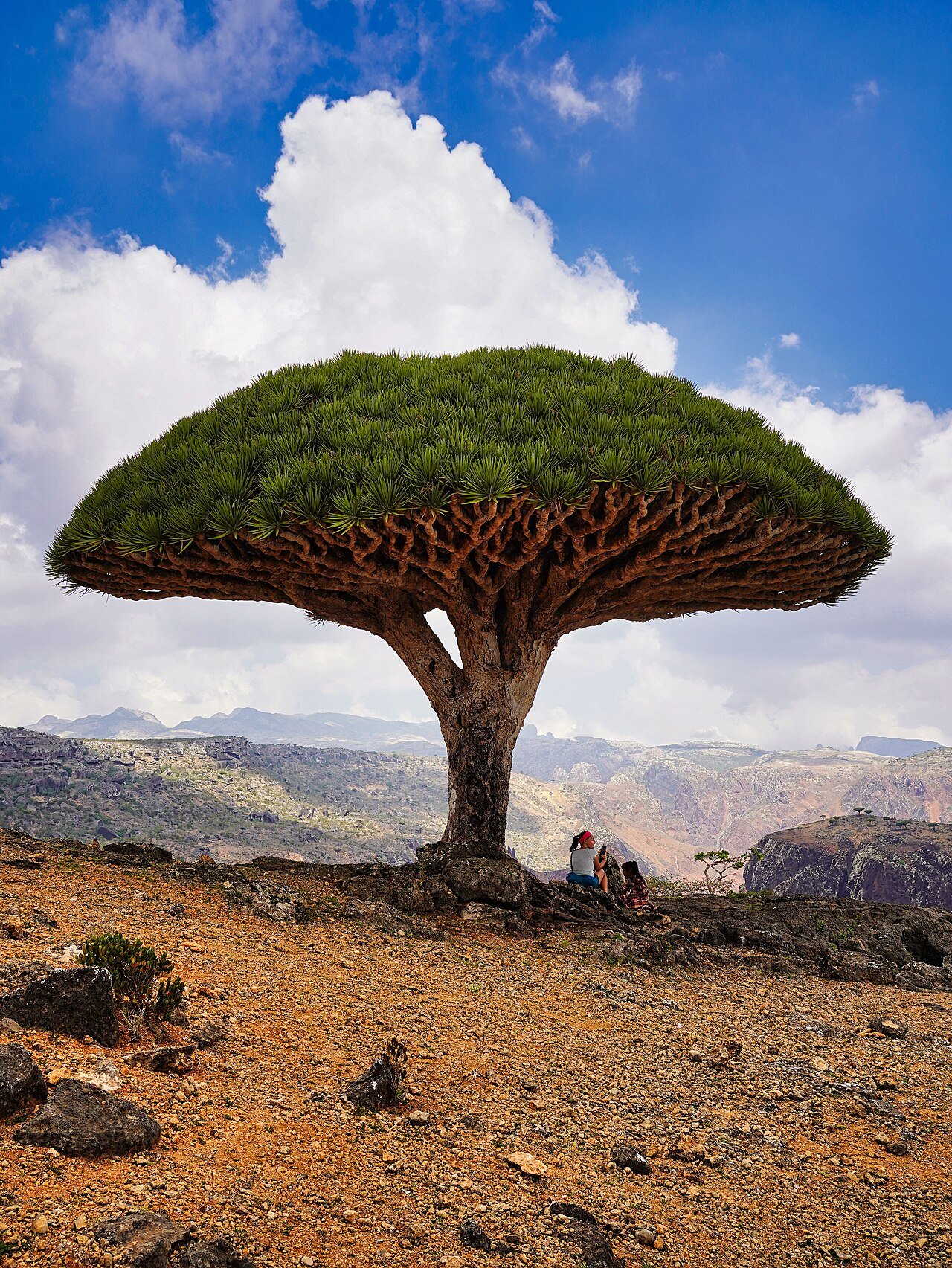
The signature plant is the dragon blood tree (Dracaena cinnabari), which has become the visual emblem of Socotra. Its most striking feature is the canopy: instead of the branching architecture of most trees, the dragon blood tree produces a dense, flat-topped umbrella shape that looks, in profile, like a mushroom cloud of foliage. This form is an adaptation to the island’s particular precipitation regime — not regular rainfall but seasonal mist and light dew off the monsoon clouds. The flat canopy captures moisture and channels it down the branches and trunk to the shallow root system. The tree’s other defining trait is its sap: when the bark is cut, it bleeds a vivid red resin known as cinnabar or dragon’s blood. This resin has been exploited by humans for at least 2,000 years as a dye, a wood varnish, and a medicine; Socotran dragon’s blood was traded across the ancient world and appears in Roman, Arab, and medieval European sources. Today the trees grow primarily on the high limestone plateaus of the Haggeher Mountains in the island’s interior.
The desert rose (Adenium socotranum) is Socotra’s other visually arresting plant: a succulent with a grotesquely swollen trunk that stores water through the long dry season, topped during the flowering period with clusters of bright pink blooms. Like the dragon blood tree, it has been shaped by the island’s water stress into a form unlike anything on the nearby mainland. The Boswellia elongata, an endemic frankincense tree found only on Socotra, produces a resin slightly different from the Boswellia sacra of Oman and Yemen; Socotran frankincense was specifically prized by Arab and Roman traders in antiquity and was a significant component of the island’s ancient economy. The archipelago also hosts endemic fig and pomegranate species, and its coastal waters are notable for reef fish diversity and sea turtle nesting beaches.
Human Socotra: language, history, and the In Danger listing Hadibo, north coast; flights from Abu Dhabi and Muscat
Socotra has been continuously inhabited for at least 3,000 years. Its roughly 80,000 residents speak Socotri, a South Semitic language belonging to the Modern South Arabian group — a family that includes Mehri, Shehri, and several other languages of the Yemen-Oman border region, all of which diverged from ancient South Arabian thousands of years before the spread of Arabic. Socotri is entirely distinct from Arabic in grammar, phonology, and vocabulary, though Arabic has been the dominant written and administrative language since Islamisation in the early centuries CE. Crucially, Socotri has no traditional writing system — it is, and has always been, an oral language, with an extensive tradition of poetry, narrative, and botanical knowledge transmitted without text. The Socotri oral literature includes precise descriptions of hundreds of plant uses, constituting an ethnobotanical archive that has no written equivalent.
The island’s control passed through Arab traders (who made it a key entrepôt for frankincense, dragon’s blood, and aloe), the Portuguese (who established a fort in the early 16th century in an unsuccessful attempt to control the spice route through the Red Sea), the Mahra Sultanate, and eventually the British Raj, which incorporated Socotra into the British Protectorate of Aden in 1876. After independence and the unification of the two Yemeni states, Socotra became part of the Republic of Yemen. It is administratively part of Hadhramaut Governorate, though the island’s geographic remoteness has always produced a degree of de facto autonomy from the mainland government.
The UNESCO In Danger designation, assigned in 2021, reflects the cascading effects of the Yemen civil war that began in 2015. Aid organisations have documented large-scale illegal land seizures, deforestation for charcoal production, and unregulated construction in areas previously protected. The civil war has also severely disrupted the administrative capacity to enforce environmental regulations. The conservation situation is monitored by IUCN and UNESCO, but conditions on the ground remain difficult to assess. When access is feasible, Socotra’s main international connections are through Aden or via charter and scheduled services from Abu Dhabi (Etihad) and Muscat (Oman Air); the situation changes with political conditions and should be verified before any planned visit.
Practical information
As of 2024-2025, travel to Socotra is technically possible for foreign visitors but requires careful advance planning and current security assessment. Most tour operators reaching Socotra route through Abu Dhabi or Muscat, using charter arrangements when scheduled services are suspended. The Yemeni government’s Ministry of Tourism nominally issues permits; in practice, most foreign visitors arrive with established tour operators who manage documentation. Entry to the island requires coordination with local guides, as independent travel is not feasible given road conditions and language barriers. The capital, Hadibo, has basic guesthouses; specialist eco-lodges exist on the Dihamri beach coast and in the Haggeher highlands. The best visiting period, when the monsoon has not closed the sea lanes, is October through April; the southwest monsoon (June to September) cuts the island off almost entirely. The UNESCO World Heritage property is the Socotra Archipelago’s natural areas, not any specific built site — the landscape itself, the dragon blood tree forests on the Diksam and Firmihin plateaus, the sand dunes of Archer and Ras Shoab, and the freshwater lake at Detwah are the primary attractions. Currency is the Yemeni rial; US dollars are widely accepted. There is no banking infrastructure for international cards. All travellers should consult their government’s travel advisory before planning a visit, given the ongoing civil conflict in Yemen.
Frequently Asked Questions
Why does Socotra have such an extraordinary number of endemic species?
Socotra’s endemism — 37% of its plant species, approximately 90% of its reptile species, and roughly 95% of its land snail species found nowhere else — results from the intersection of three factors: geological age, geographic isolation, and a distinctive climate. The islands separated from the African-Arabian landmass during the late Miocene epoch, approximately six to seven million years ago, as the Gulf of Aden continued to rift open. This gave evolution on the islands an extremely long uninterrupted run without the genetic exchange that would occur through land connections or regular colonisation from the mainland. The second factor is Socotra’s climate: the southwest monsoon, which drives 100 km/h winds and heavy seas across the Arabian Sea from June to September, renders the island nearly inaccessible by sea for almost half the year. This seasonal barrier has further reduced the frequency of new species arrivals from the mainland. The combination of long isolation and reduced gene flow allowed the island’s species to diverge markedly from their continental relatives, producing organisms adapted specifically to Socotra’s limestone plateaus, granite mountains, coastal plains, and monsoon fog regime. The dragon blood tree’s inverted-umbrella canopy — evolved to harvest moisture from mist rather than rain — is perhaps the most visually dramatic example of this island-specific adaptation. A similar process produced the Galápagos endemics and the lemurs of Madagascar; in each case, an island or archipelago separated long enough ago that its colonising ancestors had time to evolve into forms radically different from anything on the nearest continent.
What is the status of Socotri, the language spoken on the island?
Socotri is a Modern South Arabian (MSA) language, a group that includes Mehri, Shehri (Jibbali), Harsusi, and Bathari — all spoken in the Yemen-Oman border region and on Socotra. These languages are not dialects of Arabic; they belong to a different branch of the South Semitic family and diverged from the other South Semitic languages (including Arabic and Ethiopic) thousands of years before Arabic’s expansion across the Arabian Peninsula in the 7th century CE. Socotri has around 70,000-80,000 speakers today, almost all on Socotra and in the Socotri diaspora communities in Yemen and the Gulf states. The language has no indigenous writing system: it has been exclusively oral throughout its history, which makes it unusual among the languages of the Arabian world and gives its oral literature unusual importance as the sole repository of vocabulary, knowledge, and tradition. Linguists from several European and American universities have worked with Socotri speakers to produce dictionaries and grammars using Roman or Arabic script transcription. UNESCO classifies Socotri as “vulnerable” — not yet “endangered” in the technical sense, but at risk from the dominance of Arabic in education, media, and administration. The civil war in Yemen has complicated both documentation efforts and the transmission of the oral tradition, as many younger Socotris have left the island for Aden, Mukalla, and the Gulf states.
Is it currently safe to visit Socotra, and how does access work in practice?
The honest answer is that Socotra’s accessibility varies significantly from year to year and even season to season, depending on the state of the Yemen civil war and the political arrangements between the various parties controlling the island and the mainland. Socotra is not a conflict zone in the direct sense — there has been no sustained fighting on the island itself — but it is subject to the administrative and logistical disruption that the civil war has created throughout Yemen. Between 2015 and the early 2020s, the island was at various times under Houthi influence, Yemeni government administration, and UAE-backed Southern Transitional Council control. The UAE withdrew its forces in 2019 but retained significant influence. The practical consequence for travellers is that official permissions and flight arrangements are unstable. Most foreign nationals who have reached Socotra in recent years have done so through specialist adventure travel operators who maintain local contacts and monitor the access situation continuously. Visas and permits are issued by Yemeni authorities in Aden or through the Socotra-based local government; the process is not transparent and benefits from local intermediary assistance. Before any planned visit, travellers should consult their national government’s Yemen travel advisory (most Western governments advise against all travel to Yemen, though some distinguish Socotra as a lower-risk area), contact a specialist operator with recent on-the-ground experience, and ensure comprehensive travel insurance that covers evacuation from conflict-adjacent environments.
Sources
- S1 — Miller, Anthony G., and Miranda Morris. Ethnoflora of the Soqotra Archipelago. Royal Botanic Garden Edinburgh, 2004. ISBN 978-1-872291-59-8.
- S2 — Wranik, Wolfgang. Fauna of the Socotra Archipelago: Field Guide. Universitätsbibliothek Rostock, 2003. ISBN 978-3-86009-245-3.
Spotted an error? Write to editorial@culturalheritageonline.com and we correct it the same day.