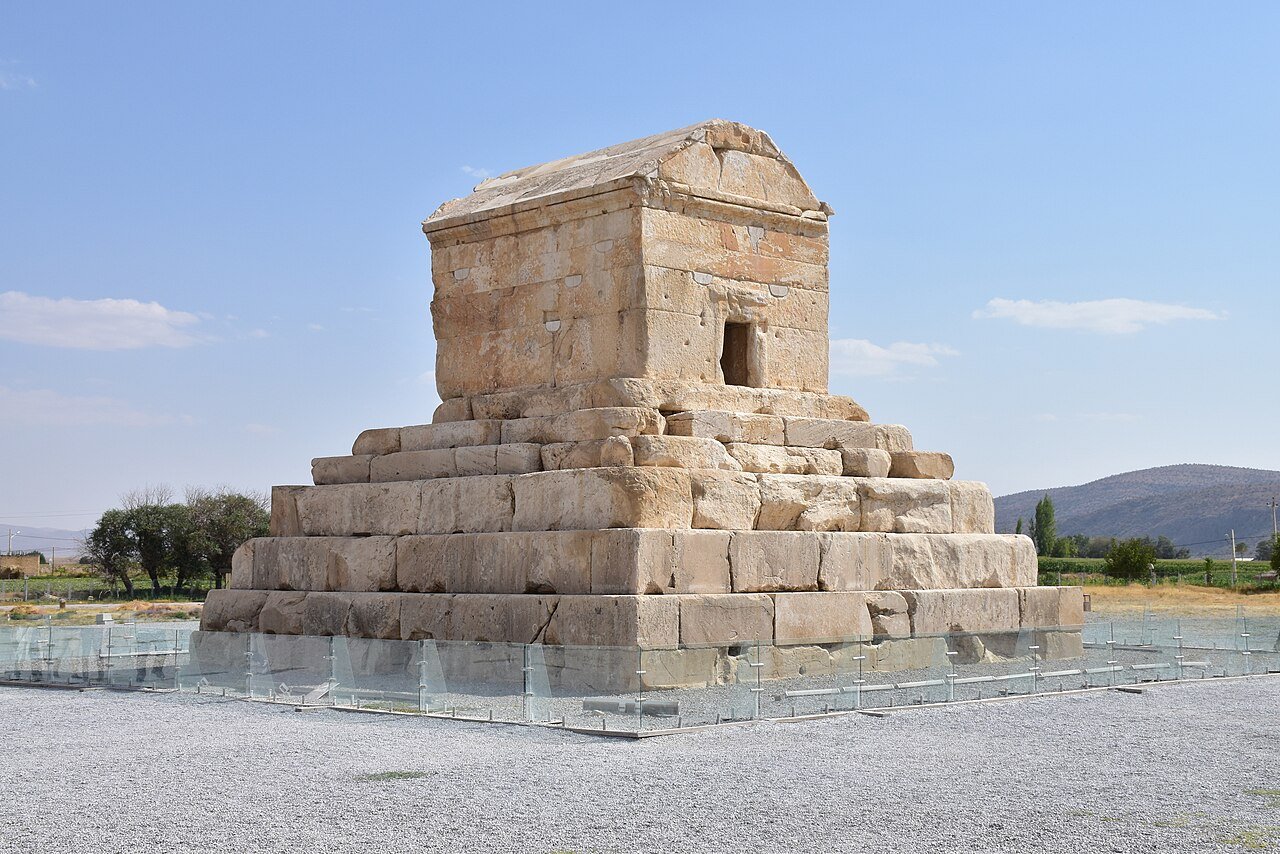
Pasargadae, on the Morghab Plain of Fars Province in southwestern Iran, was the first capital of the Achaemenid Persian Empire — founded around 546 BCE by Cyrus the Great, who in the space of three decades defeated the Median, Lydian and Babylonian empires to build the largest polity the world had yet seen. The site’s most enduring monument is the Tomb of Cyrus: a plain gabled chamber of white limestone on six stepped platforms, 11 metres tall and quietly unlike anything the ancient world’s other empire-builders chose for their burials.
Cyrus, the Morghab Plain and the first world empire Fars Province, 130 km from Shiraz, 90 km north of Persepolis
The choice of the Morghab Plain for the first Achaemenid capital was not accidental. Cyrus II, who ruled from approximately 559 to 530 BCE and earned the epithet “the Great” in antiquity, belonged to the Persian tribes of the Anshan region — the heartland of the Iranian plateau south of the Zagros mountains. When he defeated his Median overlord Astyages in around 550 BCE and unified the Medes and Persians into a single ruling coalition, he located his capital in the territory of the Persian tribes who had supported him, establishing a symbolic geography of loyalty and origin. The plain was also practical: well-watered, defensible and positioned at the junction of routes connecting the Persian heartland to Mesopotamia, Anatolia and the eastern Iranian plateau.
The empire Cyrus built between 550 and 530 BCE was without precedent in scale. He defeated Croesus of Lydia — whose legendary wealth had made him a byword for riches across the ancient world — in around 547 BCE, annexing Asia Minor and its Greek coastal cities. He took Babylon in 539 BCE, a conquest marked by his famous Cyrus Cylinder — a clay inscription in which he presented himself as a liberator rather than a conqueror, restoring displaced peoples to their homelands and allowing the Jews exiled to Babylon by Nebuchadnezzar to return to Judah and rebuild their temple. The Cyrus Cylinder’s account of this policy has led some scholars to describe it as the world’s first human rights document, though historians of the ancient Near East are careful to note that it was also sophisticated imperial propaganda designed to legitimise Achaemenid rule in the eyes of Babylonian religious elites. Cyrus died in 530 BCE on campaign in Central Asia and was returned to Pasargadae for burial.
The city he built at Pasargadae was architecturally innovative. The Achaemenid approach to palatial architecture — an open, garden-integrated ensemble of audience halls, residential pavilions and reception spaces distributed across a large designed landscape, rather than the dense urban fabric of Mesopotamian palace complexes — appears here in its earliest known form. The Tall-e Takht (Throne Hill), a massive stone-faced platform at the site’s northern end, served as the ceremonial location for the coronation of subsequent Achaemenid kings; the Cyrus Cylinder’s successors, Cambyses and Darius, were crowned here before building their own more elaborate palace complexes at Persepolis and Susa. The gateway structure at Pasargadae bears an inscription in three languages — Old Persian, Elamite and Babylonian — that reads, in the reconstructed form: “I, Cyrus, the Achaemenid king, built this.” The four-winged figure carved in the gateway niche — a protective spirit combining Egyptian, Mesopotamian and Persian iconographic elements — exemplifies the cosmopolitan visual language of the first world empire, drawing from every tradition its founder had conquered.
The formal gardens of Pasargadae are documented in the archaeological record as the earliest known example of a quadripartite water-channel garden — the chahar-bagh, or “fourfold garden,” in which a central pavilion is surrounded by four watercourses dividing the planting into quarters. The Old Persian word for this enclosed, walled garden was paradaida, which passed through Greek as paradeisos and into English as “paradise.” The garden at Pasargadae is, quite literally, where paradise began as a word and as a designed landscape concept. The water channels, stone-lined and precisely levelled, survive in the archaeological remains; the pavilion they surrounded is now a low foundation outline on the plain.
The Tomb of Cyrus and Alexander’s visit Accessible by road from Shiraz; nearest accommodation in Shiraz or Marvdasht
The Tomb of Cyrus is the most visited and most immediately striking monument at Pasargadae. It stands at some distance from the palace complex, on a slight rise in the plain, visible from several kilometres away. The form is architectural in its simplicity: a rectangular gabled chamber approximately 5.4 metres long, 3.2 metres wide and 2.1 metres high internally, built of finely cut white limestone blocks laid without mortar in the standard Achaemenid ashlar technique. The chamber sits on a six-stepped platform that raises the total structure to approximately 11 metres above the plain. No column, no relief carving, no inscription decorates the exterior. The stone is white in the morning light, silver in overcast weather, warm gold in late afternoon. The effect is the opposite of the elaborately decorated tombs of the Pharaohs or the ornate mausoleums of later Persian tradition: this is a monument that makes its statement through restraint and proportion rather than accumulation.
Ancient sources report an inscription on the tomb that read: “O man, I am Cyrus who won the empire for the Persians. Grudge me not, therefore, this little earth that covers my body.” The inscription itself has not survived — whether it was destroyed, never existed in the form reported, or was on a surface now lost is debated — but it is quoted in accounts by the Greek historians Strabo and Arrian, both of whom describe Alexander the Great’s visit to the tomb after his conquest of the Persian Empire in 330 BCE. Alexander found the tomb had been looted by soldiers in his own army: the gold sarcophagus, the ornaments, the weapons and the robes that had been placed in the chamber were gone. He ordered the tomb restored to its previous condition as closely as possible, punished the perpetrators, and reinstated the traditional Zoroastrian priest-guards — the Magi — who had maintained the site under the Achaemenid kings. This act of pious restoration at the tomb of his greatest predecessor is one of very few recorded instances of Alexander showing reverence for a conquered culture’s sacred sites rather than appropriating or damaging them. The reasons for his behaviour at Pasargadae have been debated since antiquity; the most plausible interpretation is that Alexander was engaged in a systematic performance of Persian royal legitimacy, presenting himself to Persian elites as the successor to the Achaemenid tradition rather than its destroyer.
The tomb was known in medieval and early modern Persian tradition as the “tomb of Solomon’s mother” or the “throne of the mother of Solomon” — associations derived from Islamic identification of various ancient sites with Quranic figures. It was the recognition of the Achaemenid cuneiform inscriptions elsewhere at Pasargadae, in the nineteenth century, that established the connection to Cyrus and allowed the site to be understood within its historical context. Pasargadae was inscribed as a UNESCO World Heritage Site in 2004, the same year as the adjacent inscription of Persepolis (UNESCO 1979), recognising the two sites as together representing the founding and apex moments of Achaemenid civilisation.
Persepolis, 90 kilometres to the south, is the inevitable companion site: Darius I began building there around 518 BCE as the new ceremonial capital, and the massive terrace with its Apadana audience hall, its relief-carved staircases and its Gate of All Nations represents the mature Achaemenid imperial style in full elaboration. The contrast between the two sites — Pasargadae’s spare proto-imperial landscape and Persepolis’s densely carved palatial platform — traces thirty years of rapid development in Achaemenid architectural ambition. Shiraz, 130 kilometres south of Pasargadae, is the practical base for visiting both.
Practical information
Pasargadae lies approximately 130 kilometres northeast of Shiraz along the Shiraz-Isfahan highway. The nearest town is Marvdasht, approximately 40 kilometres south of the site. Most visitors arrive from Shiraz by private car or organised tour; no regular public transport connects to the site directly. The drive from Shiraz takes roughly 1.5 to 2 hours. The site is open daily during daylight hours; entry tickets are purchased at the gate and are modest in cost. The archaeological area is large and the monuments widely spread: allow two to three hours minimum, longer if combining with the village of Pasargad and the Zoroastrian fire temple visible on the plain. The Iranian climate in this part of Fars Province is hot and dry from June to September; spring (March to May) and autumn (September to November) offer the most comfortable visiting conditions. Foreign visitors require an Iranian visa, which is available on arrival for citizens of many countries through Iranian airports; check current requirements before travel. Shiraz has a well-developed accommodation offer across all price categories. A combined visit to Pasargadae and Persepolis is achievable in a single long day from Shiraz, though two days is preferable for a more unhurried pace.
Frequently Asked Questions
Why is the Tomb of Cyrus so architecturally plain compared to other ancient royal tombs?
The restraint of the Tomb of Cyrus is one of the most discussed questions in Achaemenid archaeology, precisely because it seems counterintuitive: the founder of the largest empire the world had yet seen chose a burial monument of almost aggressive simplicity at a time when the Egyptian Pharaohs were still building elaborately decorated pyramid complexes and the Babylonian royal tombs were richly furnished and inscribed. Several explanations have been proposed. The first is functional: the stepped platform with its gabled chamber was a practical solution to the problem of raising a burial above the plain’s flood level while making it visually prominent from a distance — the combination of height and proportion achieves monumental presence without decorative elaboration. The second is ideological: Cyrus’s imperial project was built partly on a claim of tolerance and legitimate succession rather than violent conquest, and a tomb that claimed no symbolic domination over the landscape may have been a deliberate choice consistent with that political identity. The third is simply chronological: Pasargadae was the first Achaemenid royal building project, and the tomb was built before the elaborate decorative vocabulary of the mature Achaemenid style — as seen at Persepolis — had been developed. What looks like restraint may partly be the starting point of a tradition rather than a deliberate departure from it. The Achaemenid royal tombs at Naqsh-e Rostam, carved into a cliff face near Persepolis for Darius I and his successors, are far more elaborately decorated — which suggests that the Pasargadae approach was indeed distinctive to the site and to Cyrus’s specific funerary choices.
What is the Cyrus Cylinder and why does it matter today?
The Cyrus Cylinder is a clay barrel inscription, approximately 23 centimetres long, written in Babylonian cuneiform and discovered by Hormuzd Rassam in Babylon in 1879. It is now held in the British Museum. The inscription records Cyrus’s conquest of Babylon in 539 BCE in terms designed to appeal to Babylonian religious sentiment: Cyrus presents himself as the chosen instrument of the Babylonian god Marduk, who selected him to restore order and right after the failures of the preceding Babylonian king Nabonidus. The text includes claims that Cyrus freed peoples who had been deported to Babylon — including, by implication, the Jewish exiles whose return is described in the Hebrew Bible’s books of Ezra, Nehemiah and Isaiah — and that he restored temples and cult statues to their original locations. Since the mid-twentieth century, the Cylinder has been described in some political and cultural contexts as the “first charter of human rights,” a claim that has been vigorously contested by ancient historians who point out that it was standard ancient Near Eastern royal propaganda, not a document of universal principle. The Iranian government has placed particular emphasis on the Cylinder as a symbol of Persian civilisation and humanitarian tradition; a replica stands at UN headquarters in New York. For historians, its significance is more specific and more interesting: it is the most detailed surviving account of Achaemenid policy toward conquered peoples, and it documents the mechanism by which Cyrus maintained administrative continuity in conquered territories by working with existing local elites and religious institutions rather than replacing them — a practice that was genuinely distinctive in the ancient world and that helps explain how a relatively small Persian tribal coalition managed to administer an empire stretching from Egypt to Central Asia within a single generation.
How does Pasargadae relate to Persepolis, and which should a visitor prioritise?
Pasargadae and Persepolis were both Achaemenid royal centres, separated by about 90 kilometres of Iranian plateau and approximately 30 years of construction history. Pasargadae came first: Cyrus began building there around 546 BCE, and the site represents the founding generation of the empire, when the architectural vocabulary of Achaemenid power was being invented rather than elaborated. Persepolis came next: Darius I began the great terrace around 518 BCE and his successors Xerxes and Artaxerxes I continued it through the fifth century BCE. If Pasargadae is the sketch, Persepolis is the fully realised composition — a massive stone platform covered in relief carvings depicting the tribute-bearing delegations of the empire’s subject peoples, the royal guards of the Immortals, and the formal processions of the Achaemenid court. For sheer visual impact, Persepolis is one of the great archaeological sites of the ancient world. But Pasargadae offers something Persepolis cannot: the sense of beginning, the moment before the vocabulary was fixed. The Tomb of Cyrus, standing alone on the plain, has a quality of presence that the crowded relief carvings of Persepolis, magnificent as they are, do not quite replicate. Most visitors with more than one day in the region visit both; those with only one day should choose Persepolis for visual impact or Pasargadae for historical resonance, according to their temperament.
Sources
- S1 — Stronach, David. Pasargadae: A Report on the Excavations Conducted by the British Institute of Persian Studies from 1961 to 1963. Oxford University Press, 1978. ISBN 978-0-19-813190-8.
- S2 — Curtis, John, and Nigel Tallis, eds. Forgotten Empire: The World of Ancient Persia. University of California Press, 2005. ISBN 978-0-520-24731-4.
Spotted an error? Write to editorial@culturalheritageonline.com and we correct it the same day.