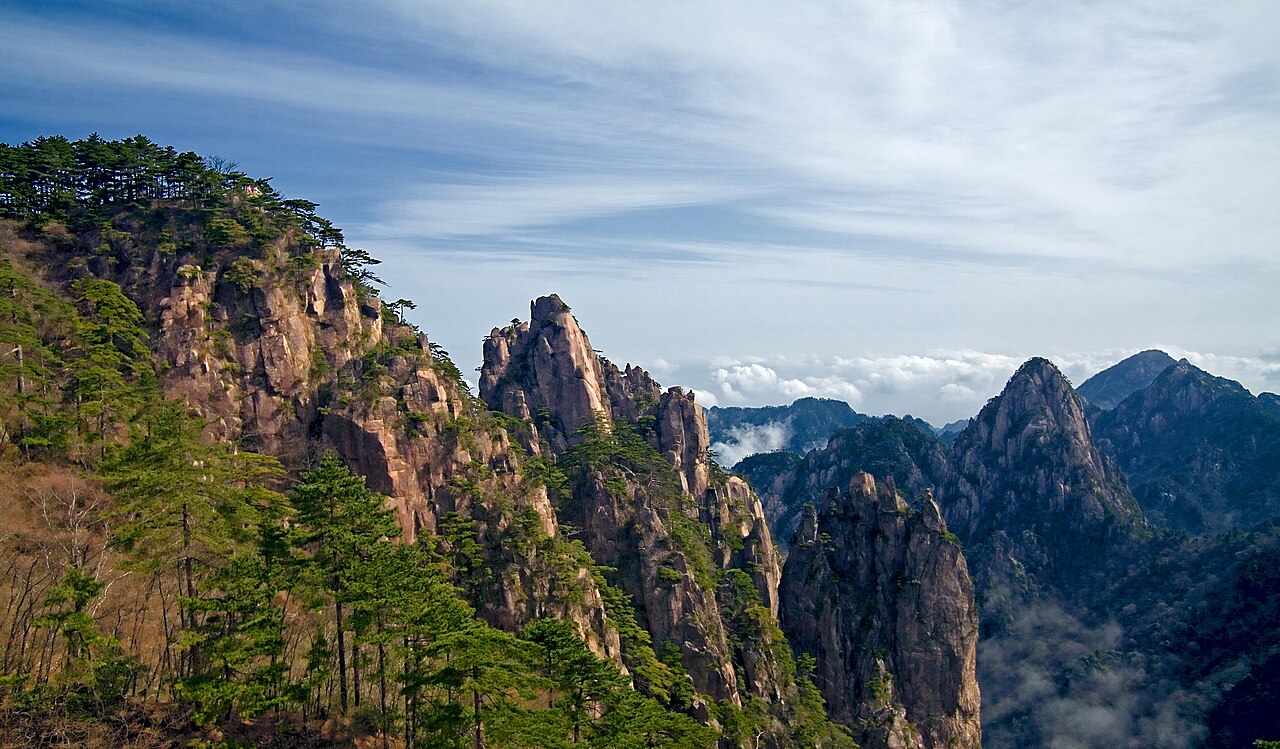
Huangshan — the Yellow Mountains — is a granite mountain range in southern Anhui province, China, covering approximately 160 square kilometres with 72 named peaks. Its granite monoliths, cloud inversions, and wind-contorted pine trees became the defining visual vocabulary of Chinese landscape painting in the 17th century, when the Anhui School of painters rejected classical imitation and worked directly from the mountain’s forms. UNESCO inscribed Huangshan as a mixed natural and cultural World Heritage site in 1990.
Granite Spires, Gnarled Pines, and a Sea of Clouds Above Anhui Southern Anhui Province, China
Huangshan’s geology begins approximately 100 million years ago. The granite batholith — a mass of magma that intruded into the surrounding rock during the Cretaceous period and cooled slowly underground — was later exposed by erosion and shaped by the mechanical action of water and ice during the Pleistocene glaciations. The result is a landscape of vertical granite monoliths, separated by narrow valleys and connected by ridges, with the highest peak — Lotus Peak (Lian Hua Feng) — reaching 1,864 metres.
The rock’s physical properties are responsible for the landscape’s distinctive form. Granite fractures along two sets of joint planes roughly perpendicular to each other, and Huangshan’s joints happen to be nearly vertical. Erosion along these joints isolated the granite masses into the pillar-like forms that characterise the mountain — narrow at the base where erosion has cut deeply along joint planes, broader toward the summit where the rock is less fractured. These forms bear strong visual resemblance to the brushstroke conventions for representing mountains that developed in Chinese ink-wash painting — a visual correspondence that made the mountain a natural subject for landscape artists from the Tang dynasty onwards and a validating real-world reference for painters working in the Chinese tradition.
The Huangshan pine (Pinus huangshanensis) is a species found only in the Huangshan range. It grows from crevices in the granite, forcing rootlets into hairline fractures in the rock and extracting minimal moisture from the stone itself. On the exposed ridges and peak faces, the trees are shaped by the prevailing winds into asymmetric, cantilevered forms — branches extending to one side, trunks bent at shallow angles from the cliff face, silhouettes that appear to reach outward rather than upward. Approximately 54,000 individual named pines are registered in the Huangshan Administration’s records; naming trees individually is a cultural practice that reflects centuries of Buddhist and Taoist pilgrimage to the mountain, during which specific trees became associated with poetic images or religious allegories. The most famous individual pine is the Guest-Greeting Pine (Ying Ke Song), estimated at approximately 800 years old, which grows near the Jade Screen Tower cable car station on the mountain’s main tourist circuit. An image of the tree appears on the back of a Chinese tourism banknote. A team of arborists has been assigned to monitor the tree’s health on a permanent rotation basis.
The sea-of-clouds (yunhai) effect — one of the four phenomena most associated with Huangshan — occurs when temperature inversions cause cloud layers to form at mid-mountain elevation, filling the valleys between the granite peaks and leaving only the upper monoliths and pine silhouettes visible above a white surface. The effect is most common from late autumn through early spring, when cold air draining into the valleys at night creates the necessary temperature gradient. At sunrise, when the light strikes the cloud surface from below the horizon before it reaches the peaks, the visual effect — granite and pine above a sea of glowing white — corresponds closely to the archetypal ink-wash mountain composition: dark forms above pale atmospheric ground, with the foreground dissolved into mist. This correspondence is not coincidental; it is the direct reason that Huangshan became the model for Chinese landscape painting rather than any of the country’s higher or more dramatic mountain ranges.
The Anhui School, 54,000 Named Pines, and the Emperor Who Gave the Mountain Its Name 50 km from Ancient Villages Xidi and Hongcun (UNESCO)
In the 17th century, a group of painters working in the Huangshan region developed an approach to landscape that broke decisively with the conventions of the preceding Song and Yuan dynasties. The dominant tradition in Chinese landscape painting at that time was the practice of copying — or working in the style of — the acknowledged masters of the Northern and Southern Song periods, whose compositions had become canonical models for how mountains, water, trees, and mist should be represented. The Anhui School, also called the Huangshan School, rejected this tradition of transmitted style in favour of direct observation. Painters such as Hongren (ca. 1610–1664), Kuncan (ca. 1612–1673), and Shitao (ca. 1642–1707) climbed Huangshan repeatedly — sometimes living on the mountain for extended periods — and developed compositional vocabularies derived from the specific forms they found there: the vertical granite columns, the horizontal pine branches, the cloud inversions that isolated specific peaks into floating islands of rock and vegetation.
Hongren, who became a Buddhist monk after the fall of the Ming dynasty in 1644 and took the name Jiangzhigu, produced spare ink-wash compositions that stripped Huangshan’s forms down to their geometric essence: sharp-edged granite outlines, minimal brushwork on the rock faces, a few carefully placed pines. His style influenced painters for two centuries. Shitao, who was a descendant of the Ming imperial family and spent much of his life as a wandering Buddhist monk, developed a more kinetic approach — dynamic brushwork that attempted to capture the energy of the mountain’s forms rather than their outlines. His treatise on painting, the Huayu Lu (Sayings on Painting), explicitly rejected the imitation of masters in favour of direct contact with the natural world.
The cultural influence of Huangshan’s visual forms has extended far beyond Chinese ink-wash painting. The “ink-wash mountain” aesthetic visible in the background environment design of Disney’s “Mulan” (1998) — vertical spires rising from mist, pine silhouettes against pale sky — was directly informed by Chinese landscape painting conventions derived from the Huangshan tradition. The film’s art directors studied Song and Yuan dynasty landscape scrolls and the Anhui School painters as primary reference sources. The visual language is now so widely distributed through animation, commercial illustration, and digital art that Huangshan’s granite forms have become a global shorthand for “Chinese mountain landscape” in popular culture.
The mountain’s name — Huangshan, “Yellow Mountains” — derives from a mythological association with the Yellow Emperor (Huangdi), the legendary progenitor of the Chinese people. According to the Taoist tradition, the Yellow Emperor came to this range to cultivate immortality, gathering medicinal herbs and practising alchemical arts, and eventually achieved transcendence here. The Tang dynasty emperor Xuanzong renamed the mountains “Huangshan” in 747 CE, replacing the earlier toponym “Yishan,” to honour this mythological connection. Taoist mountain asceticism made Huangshan a pilgrimage destination long before the landscape painting tradition attached aesthetic significance to its forms; the two traditions — religious pilgrimage and aesthetic contemplation — ran in parallel for centuries and reinforced each other’s claims on the mountain’s cultural importance.
The nearby villages of Xidi and Hongcun, approximately 50 kilometres south of the Huangshan scenic area, are inscribed separately on the UNESCO World Heritage List (2000) as examples of Ming and Qing dynasty vernacular architecture. The two sites together form the standard itinerary for visitors arriving in the Huangshan region.
Practical information
Huangshan is reached most quickly from Huangshan Tunxi Airport (TXN), which receives direct flights from Shanghai (1 hour), Beijing (2 hours), Chengdu, Chongqing, and several other Chinese cities. High-speed rail service connects Huangshan North Station with Shanghai Hongqiao in approximately 2 hours and with Hangzhou East in approximately 1.5 hours; the station sits at the base of the mountain and shuttle buses run to the cable car terminals. Three cable car systems serve the mountain’s upper area from different approach points; the Yungu Cable Car on the eastern approach is most commonly used and covers the bulk of the main scenic circuit. Walking the full circuit to Lotus Peak, Bright Summit (Guangming Ding), and the Western Sea Canyon takes 6 to 8 hours and requires a reasonable level of fitness; shorter circuits of 3 to 4 hours cover the most visited viewpoints. The mountain’s upper area has several hotels, including summit lodges at the Jade Screen Tower and Beihai areas that allow overnight stays for sunrise and sunset viewing — the sea-of-clouds effect is most reliably observed at these times. Visitor numbers are highest from May through October and during the Chinese National Holidays (1–7 October); advance ticket booking is required. Winter (December–February) offers snow coverage and significantly lower crowds, though some paths are icy. The Ancient Villages of Xidi and Hongcun lie approximately 50 kilometres south and are typically visited on arrival or departure days.
Frequently Asked Questions
What is the Huangshan pine and why are individual trees given names?
The Huangshan pine (Pinus huangshanensis) is a species in the genus Pinus found exclusively in the Huangshan range of Anhui province, growing at elevations between approximately 800 and 1,800 metres. It is closely related to the Taiwan red pine (Pinus taiwanensis) but adapted to the specific conditions of granite mountain environments: thin, acidic soils derived from decomposed granite, frequent cloud cover and high humidity, strong winds on exposed ridges, and extreme temperature differentials between summer and winter. The trees grow slowly — 800-year-old individuals have trunk diameters of less than 60 centimetres — and the combination of slow growth, wind exposure, and the mechanical stress of rooting in granite fractures produces the characteristic asymmetric, cantilevered branching forms that define Huangshan’s silhouette. The Huangshan Administration registers approximately 54,000 individual pines by number and location; of these, trees above a certain age or visual prominence are given names based on their form or associated legend. The Guest-Greeting Pine (Ying Ke Song) appears to extend one branch toward incoming visitors; the Black Tiger Pine is associated with a Taoist legend; the Connecting Root Pine has two trunks sharing a common root system exposed by erosion. The practice of naming trees reflects centuries of Taoist and Buddhist pilgrimage culture on the mountain, in which specific natural features — stones, springs, trees, and peaks — were incorporated into religious and poetic narratives that accumulated over generations. For pilgrims, encountering a named tree at a specific point on the mountain path served a function analogous to passing a waymarker shrine on a European pilgrimage route.
How did Huangshan influence Chinese landscape painting?
Huangshan’s influence on Chinese landscape painting operates at two distinct levels: as a subject and as a model. As a subject, the mountain attracted painters from at least the Tang dynasty, and its visual forms — vertical granite pillars, horizontal pine branches, cloud inversions — appear in Chinese painting as early as the 10th century CE. As a model, however, its decisive influence came in the 17th century through the Anhui School painters, who used Huangshan not merely as a subject but as a corrective to what they saw as the ossification of the painting tradition. By the Ming dynasty (1368–1644 CE), Chinese literati painting had become highly self-referential: painters demonstrated mastery by working “in the manner of” Song or Yuan dynasty masters, and original observation was subordinated to transmitted style. The Anhui School painters — particularly Hongren, Kuncan, and Shitao — rejected this approach and worked directly from the mountain’s specific forms, developing compositional strategies derived from what they saw rather than what the tradition prescribed. Their influence propagated through the 18th and 19th centuries: the Yangzhou Eccentrics of the Qing dynasty, who extended the Anhui School’s emphasis on originality and direct observation, cite Shitao specifically as a formative influence. In the 20th century, the Huangshan tradition was reasserted by Chinese painters working to reconcile ink-wash techniques with modernist approaches; artists such as Zhang Daqian and Fu Baoshi made extended visits to Huangshan and positioned it as the ground truth for Chinese landscape values.
What is the best time to see the sea-of-clouds effect at Huangshan?
The sea-of-clouds (yunhai) phenomenon at Huangshan occurs when temperature inversions cause dense cloud or fog layers to form at mid-mountain elevations, filling the valleys between the granite peaks and leaving the upper monoliths visible above the cloud surface. The conditions required are: relatively warm, moist air at lower elevations combined with cooler air at summit elevations that is cold enough to cause condensation; these conditions occur most reliably in late autumn and winter (November through February) and in spring (March and April), when the temperature gradient between valley floors and mountain summits is steepest. Summer — the peak tourist season — is the least reliable period for the cloud-sea effect, because high temperatures throughout the elevation range reduce the temperature differential needed for inversion. The most consistent approach for seeing the cloud-sea is to stay overnight in one of the summit hotels and observe conditions at both sunrise and sunset; the effect is most pronounced in the hour after dawn and the hour before dusk, when temperature changes are most rapid. The four named viewing positions for the cloud-sea are the Jade Screen Pavilion (southeastern aspect, good for afternoon light), Beihai (northern aspect, good at sunrise), Danxia Peak (northwestern aspect), and Xihai (Western Sea Canyon, best in morning). Weather forecasting for the cloud-sea is unreliable more than 24 hours in advance; experienced visitors plan 2 to 3 nights on the mountain to increase the probability of encountering the effect.
Sources
- S1 — Lothar Ledderose — Ten Thousand Things: Module and Mass Production in Chinese Art, Princeton University Press, Princeton, 2000, ISBN 978-0691009575
- S2 — James Cahill — The Compelling Image: Nature and Style in Seventeenth-Century Chinese Painting, Harvard University Press, 1982, ISBN 978-0674152809
Spotted an error? Write to editorial@culturalheritageonline.com and we correct it the same day.