Bergpark Wilhelmshöhe is a 240-hectare Baroque landscape park climbing the wooded slopes of the Habichtswald above Kassel, crowned by a 71-metre ensemble of cascades, grottos, aqueducts, and a copper Hercules statue that has dominated the city’s skyline since 1717. Created for Landgrave Karl of Hesse-Kassel from 1696, the park’s central feature is a water cascade system — one of the most ambitious Baroque hydraulic engineering projects in Europe — that carries water 850 metres downhill to the Wilhelmshöhe Palace below. The park was inscribed on the UNESCO World Heritage List in 2013.
The Hercules Monument and the Cascade System Hillside above Kassel, western Germany
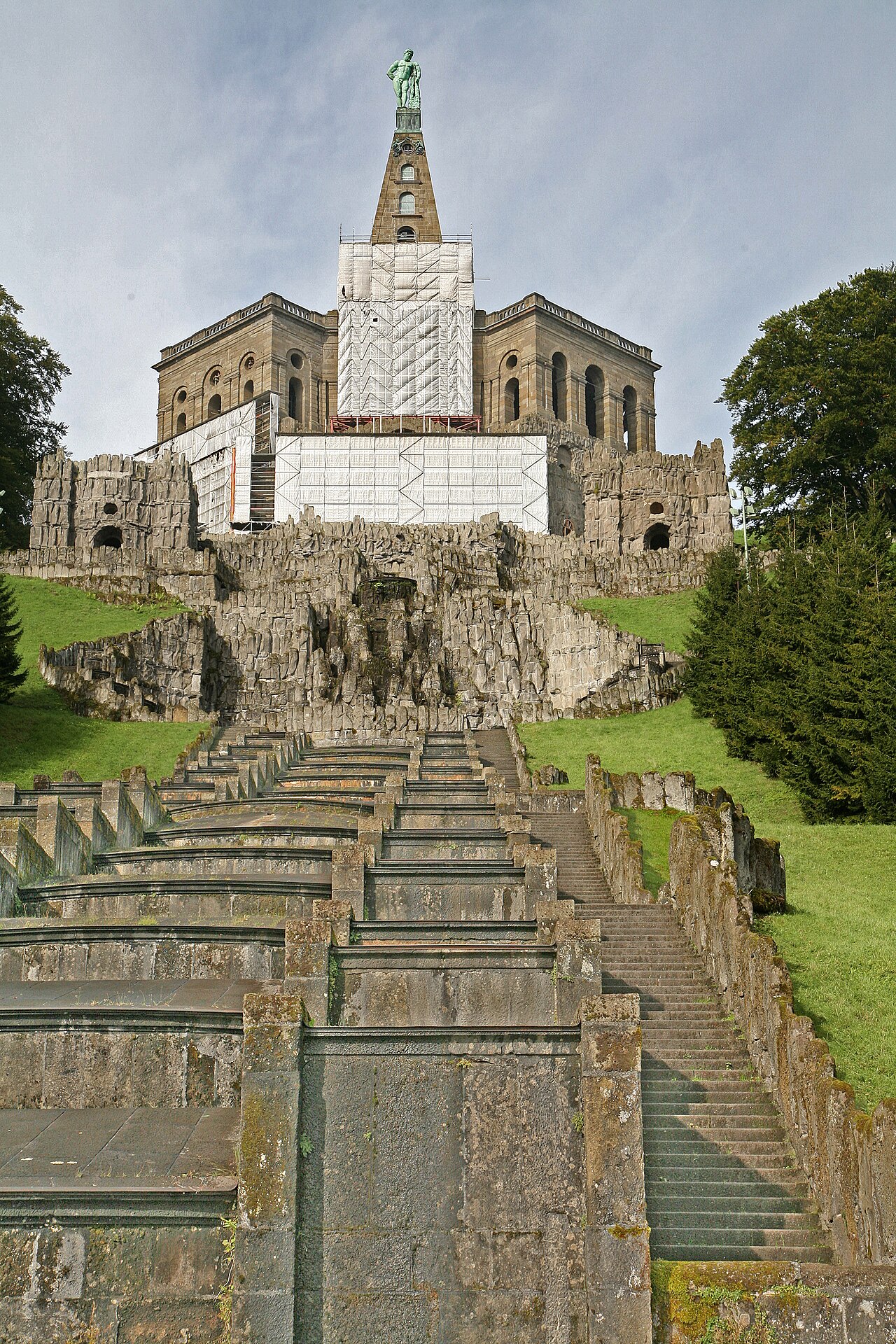
The Herkules monument is the park’s defining vertical element and the image that identifies Kassel from any distance. The structure begins with the Octagon, an eight-sided stone building at 526 metres altitude whose interior once contained a cascade grotto. On top of the Octagon stands a stepped pyramid, and above that — on a circular platform — the copper statue of Hercules himself, eight and a half metres tall, modelled loosely on the Farnese Hercules then in the Palazzo Farnese in Rome. The total height of the ensemble from the base of the Octagon to the tip of Hercules’ club is 71 metres. When Landgrave Karl commissioned the structure in the early 18th century, he was participating in a pan-European competition among Protestant princes to demonstrate cultural parity with Catholic courts, and particularly with Versailles. Hercules, the mythological figure associated with strength, virtue, and the taming of nature, was a deliberate choice of symbol for a Hessian prince attempting to project dynastic power through architecture.
The cascade system runs from a reservoir behind the Octagon down the hillside in a sequence of carefully engineered stages. Water released from the reservoir flows first through the Octagon’s grotto, then down a broad stone cascade staircase — the Kaskaden — before passing through a series of artificial waterfalls, rock grottos, and aqueduct bridges including the Teufelsbrücke (Devil’s Bridge), a deliberately rustic masonry arch designed to look ancient. The water crosses a flat section through underground channels and re-emerges in the English-style landscape section of the park below, eventually feeding the Great Fountain (Fontäne) near the Wilhelmshöhe Palace, whose jet reaches 52 metres in height. The entire sequence takes approximately 70 minutes when running. The cascade operates on Sundays and public holidays between May and October, drawing substantial crowds to the hillside.
The hydraulic engineering behind this display was sophisticated for its era. Giovanni Francesco Guerniero, the Italian engineer who designed the cascade in 1701, calculated the water volumes and pressure differentials needed to sustain the flow across 850 metres of descent and re-ascent. The system requires no pumping: gravity alone moves the water from reservoir to fountain, exploiting the 200-metre altitude difference between the Octagon and the palace. The aqueduct sections carry water horizontally across terrain that would otherwise interrupt the flow, and the underground channels that feed the Fontäne create the pressure for the vertical jet. The reliability of this system across three centuries — requiring periodic maintenance but no fundamental engineering revision — is itself part of what makes the park historically significant.
Wilhelmshöhe Palace, the Löwenburg and Three Centuries of History Lower park area, accessible by park tramway
Wilhelmshöhe Palace sits at the foot of the cascade axis, where the water arrives after its 850-metre journey. The current palace was built between 1786 and 1798 for Elector Wilhelm I (the title of the Hessian rulers was elevated from Landgrave to Elector in 1803), designed in Neoclassical style by Simon Louis du Ry and Heinrich Christoph Jussow. It replaced an earlier Baroque palace on the site and was conceived as the centrepiece of a redesigned English-style landscape park that spread across the lower slopes, contrasting with the formal Baroque geometry of the upper cascade system. The palace now houses the Gemäldegalerie Alte Meister, one of the more important provincial picture collections in Germany, with significant holdings of Dutch and Flemish 17th-century painting, including works attributed to Rembrandt and Rubens.
The palace acquired unexpected historical significance in the late 19th century. After the French defeat at the Battle of Sedan in September 1870, Napoleon III was taken prisoner and held at Wilhelmshöhe from September 1870 until March 1871. Bismarck used the palace as his working headquarters during portions of the Franco-Prussian War, conducting negotiations here before the armistice. The occupation of Kassel and its imperial palace by the Prussian-led German confederation at the moment of German unification gave Wilhelmshöhe a specific role in 19th-century European political history that goes beyond its architectural significance.
Within the upper park, separate from the cascade axis, stands the Löwenburg — a deliberately ruinous medieval-style castle built between 1793 and 1801 as a Romantic folly. The Löwenburg was designed by Jussow for Elector Wilhelm I as an artificial ruin: it was built to look as though a genuine medieval castle had been partially destroyed and abandoned, complete with a broken tower, irregular masonry, and a drawbridge. The interior was fitted as a functioning residential space, however, with a chapel and apartments. Wilhelm I used it as a retreat and was buried there, as was Elector Wilhelm II. The Löwenburg represents a specific 18th-century European taste for constructed antiquity — the deliberate manufacture of historical atmosphere where none naturally existed — that makes it an architectural document as well as a garden ornament.
No other UNESCO World Heritage site sits immediately adjacent to Kassel; the nearest inscribed site is several hours away. The park’s isolation in the Habichtswald hills means it functions as a self-contained heritage destination rather than as one stop on a multi-site itinerary.
Practical information
Bergpark Wilhelmshöhe is open year-round and entry to the park itself is free. Kassel’s city tram line 1 runs from the central station (Kassel Hauptbahnhof or Kassel-Wilhelmshöhe ICE station) to the Wilhelmshöhe terminus in approximately 25 minutes. From the tram stop, the Wilhelmshöhe Palace is a short walk; the Hercules monument at the top of the park is reached either on foot (a 40-minute uphill walk) or by the seasonal park shuttle bus.
The Wilhelmshöhe cascade runs on Sundays and public holidays from May 1 to early October, beginning at 14:30; the full sequence from Octagon to Fontäne takes approximately 70 minutes. Arrive before the cascade starts to position yourself on the hillside for an unobstructed view. The Hercules monument interior and the Octagon are open for guided tours; the Löwenburg and the palace picture gallery charge separate admission.
Kassel is served by ICE trains on the Berlin–Frankfurt axis; journey time from Frankfurt is approximately 1 hour, from Berlin approximately 2 hours. The city also hosts the documenta contemporary art exhibition every five years (next edition 2027), so accommodation during documenta years books out months in advance.
Frequently Asked Questions
Why did Landgrave Karl choose Hercules as the symbol for the Wilhelmshöhe park?
The choice of Hercules was embedded in a wider European political iconography of the late 17th and early 18th centuries. After Louis XIV of France adopted Apollo as the solar emblem of Versailles — positioning himself as a god of order and civilisation — Protestant princes competing for cultural prestige often reached instead for Hercules, who represented active virtue, strength in service of justice, and the overcoming of chaos through physical and moral effort. For Landgrave Karl, who was attempting to demonstrate that a mid-sized German Protestant principality could produce architecture and landscape design comparable to the great Catholic courts, Hercules also carried a useful ambiguity: he was a classical figure palatable to Protestant theology (no saints, no Marian imagery), associated with labour and achievement rather than aristocratic leisure, and available for interpretation as a dynastic patron deity. The specific Hercules chosen for Wilhelmshöhe — the club-bearing, lion-skin-wearing figure of the Farnese type — was the most recognisable classical image of the hero in educated European circles. That the statue was made of copper (green with patina, visible from the city below) and mounted at the highest point of the composition ensured it functioned as a territorial marker as much as an artistic statement: this hill, and this park, belong to Hesse-Kassel.
How does the Baroque cascade system at Wilhelmshöhe compare to other major European water gardens?
The Wilhelmshöhe cascade belongs to a distinct tradition of hillside water theatres that developed in Italian Baroque garden design — the Villa d’Este at Tivoli, the Villa Aldobrandini at Frascati — and was transferred to northern Europe by Italian engineers working for Protestant princes eager to match Catholic patronage. What distinguishes Wilhelmshöhe within this tradition is the scale of the altitude difference (approximately 200 metres from reservoir to palace) and the length of the water journey (850 metres). Versailles, by contrast, operates on flat terrain and required massive pumping infrastructure — the Machine de Marly — to lift water from the Seine, whereas Wilhelmshöhe relies entirely on gravity. The Peterhof palace outside St. Petersburg, created for Peter the Great partly in emulation of Versailles, uses a similar gravity-fed system but was completed later (1723) than the Wilhelmshöhe cascade design (1701). The Wilhelmshöhe system is therefore earlier and larger in terms of altitude drop than Peterhof, though Peterhof’s total number of fountains and variety of water effects is greater. The engineering comparison matters for understanding why Wilhelmshöhe received UNESCO status: the cascade is not simply a decorative amenity but a significant achievement in hydraulic engineering that influenced subsequent European water garden design.
What happened to Bergpark Wilhelmshöhe during and after the Second World War?
The park and its structures survived the Second World War without significant damage, largely because Kassel itself — the city and its industrial areas — was subjected to heavy Allied bombing in October 1943, when a raid destroyed approximately 90% of the city centre and killed around 10,000 people, but the hillside park west of the city was not a military target. The Wilhelmshöhe Palace was used by the Nazi government and the park was partially neglected during the war years, but the core structures — the Hercules, Octagon, cascade channels, and palace — remained intact. After 1945, Kassel was in the American occupation zone and later in West Germany; the palace collection had been dispersed for safekeeping during the war and was gradually reassembled through the postwar decades. The cascade was restored to working order and the park was re-opened to the public. The decision to apply for UNESCO inscription came in the context of a broader reassessment in the 2000s and early 2010s of Germany’s Baroque heritage landscapes, several of which received inscription around the same period. The 2013 inscription of Bergpark Wilhelmshöhe was straightforward in the sense that the site’s authenticity was not seriously contested — the structures had not been rebuilt or significantly altered — and the Outstanding Universal Value case rested on the combination of hydraulic engineering, landscape design, and the completeness of the surviving ensemble.
Sources
- S1 — Kroll, Frank-Lothar. Kassel und Wilhelmshöhe: Architektur und Gartenkunst. Hirmer Verlag, 2013. ISBN 978-3-7774-2112-4.
- S2 — Becker, Jörg. Der Herkules und die Wasserspiele im Bergpark Wilhelmshöhe. Edition Minerva, 2008. ISBN 978-3-938832-42-4.
Spotted an error? Write to editorial@culturalheritageonline.com and we correct it the same day.