The Wuyi Mountains in Fujian province, southeastern China, hold a UNESCO World Heritage designation granted in 1999 — one of fewer than 40 sites worldwide to qualify under both natural and cultural criteria. The range’s 99,975 hectares contain Bronze Age boat coffins fixed to cliff faces 80 metres above valley floors, a river that winds through red sandstone gorges in nine distinct bends, and the original four bushes of the most expensive tea in the world measured by leaf weight. Thirty kilometres to the south, the Fujian Tulou earthen buildings — a separate World Heritage site — add a second inscription to any journey through this corner of China.
The Nine Bend River and the Hanging Boat Coffins Wuyishan City, Fujian
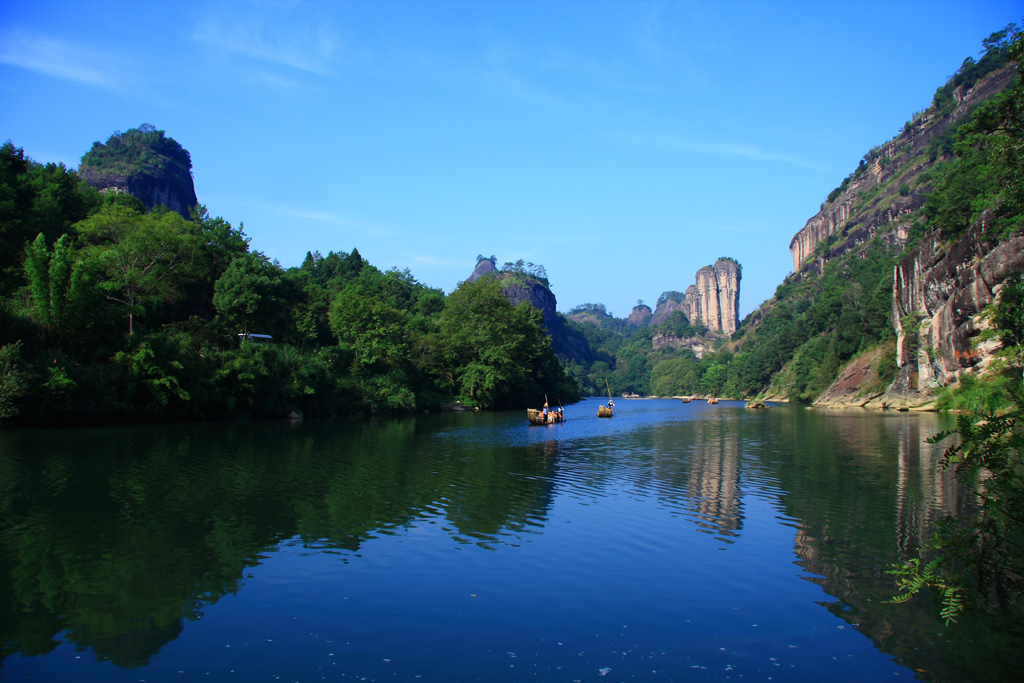
The Jiuqu Xi, or Nine Bend River, is a 9.5-kilometre waterway that cuts through the core of the Wuyi Mountains in a series of sharp loops between red sandstone cliffs. The cliffs reach heights of up to 400 metres, and the river’s nine distinct bends mean that travellers moving downstream encounter a new rock face orientation every few hundred metres. Traditional bamboo rafts — flat-bottomed, poled by two operators — remain the standard way to travel the river today, following a practice documented since at least the Song dynasty. The most photographed rock formation along the route is Tianyou Peak, also called Bird Nest Peak, a near-vertical column of layered sandstone rising directly from the valley floor.
Along the cliff faces above the river hang some of the most unusual funerary monuments in China. Bronze Age communities — identified as the ancient Minyue people — placed boat-shaped wooden coffins on narrow natural ledges and in shallow caves carved into the sandstone cliffs between approximately 1000 and 400 BCE. Some of these coffins sit more than 80 metres above the valley floor. The wood has survived because the ledges provide shelter from direct rain while the dry mountain air limits decay. Fragments of the coffins, along with bronze tools and silk fabrics found inside, are preserved in the Wuyi Mountain museum at the base of the scenic area. The coffins are among the best-preserved Bronze Age burial objects in China, and the engineering logic of how they were placed on cliff faces at those heights remains a subject of ongoing archaeological discussion. Modern analysis suggests the placements required scaffolding or lowering systems that left no material trace on the rock.
The nine-bend journey by bamboo raft takes approximately 90 minutes at the pole operators’ pace. Walking trails along the ridges above the river allow a different perspective on the same geography, with the narrow valley visible below through subtropical forest canopy. The forest cover within the UNESCO area is among the most intact subtropical montane forest remaining in southeastern China, sheltering endemic species such as the Wuyi pit viper (Protobothrops wuyiensis) and the Wuyi cat snake, as well as dozens of endemic plant species whose ranges do not extend beyond the mountain range.
Zhu Xi, Dahongpao Tea and Six Centuries of Intellectual Dominance Wuyishan City, Fujian
The philosopher Zhu Xi was born in 1130 CE and spent the most productive decades of his career working at the foot of the Wuyi Mountains. He synthesised the classical Confucian texts with Buddhist-influenced metaphysics to produce what became known as Neo-Confucianism, or the Cheng-Zhu school. In 1313, the Yuan dynasty adopted his commentaries on the Four Books as the official examination texts for the imperial civil service. This decision made Zhu Xi’s interpretation of Confucian thought the intellectual framework of Chinese governance from 1313 until 1905, when the examination system was abolished — a span of nearly 600 years across the Yuan, Ming, and Qing dynasties. The Wuyi Academy (Wuyuan Jingshe), where he taught and wrote, was rebuilt and restored multiple times across those dynasties and still stands as a site within the heritage area.
The mountains also produced one of the world’s most historically valued agricultural products. The Wuyi rock teas — grown in the mineral-rich soils of the mountain’s interior valleys and known collectively as yancha — include the subcategory called Dahongpao (Big Red Robe). Four original Dahongpao bushes survive on a cliff face within the heritage area. Their combined annual yield is measured in grams rather than kilograms. In 2002, a 20-gram box of leaves harvested from these original mother bushes sold at auction for 180,000 yuan. The Chinese government declared the mother bushes a protected national cultural relic in 2006 and ended all commercial harvesting from them. Cuttings taken from these plants are cultivated across the Wuyi area, and the tea produced from the second- and third-generation plants — sold as Dahongpao but distinguishable from the original — is among the most traded premium oolongs in China. The taste is described by tea specialists as mineral-forward with a persistent finish called huigan (returning sweetness), a characteristic attributed to the specific sandstone and organic composition of the mountain soils.
The combination of the Confucian scholarly tradition and tea cultivation history means the Wuyi Mountains function as a landscape where intellectual and agricultural heritage overlap directly with the natural environment that sustained both. The UNESCO inscription cites this integration explicitly as a reason for the mixed designation.
Practical information
The Wuyi Mountains are accessible from Wuyishan City (Wuyishan Shi), served by Wuyishan Airport with direct flights from Shanghai, Beijing, and Guangzhou, and by high-speed rail from Fuzhou (approximately 2 hours) and Xiamen (approximately 3 hours) via the Hehe Railway. The scenic area entrance is 13 kilometres south of the city centre by taxi or shuttle bus. Entry to the scenic area requires a separate ticket from the bamboo raft experience; combined tickets are available at the main gate. Raft journeys operate from early morning; booking in advance is recommended in peak season (April–May and September–October). The Hanging Coffins are visible from the river and from specific cliff-top viewpoints; they cannot be approached directly. The Wuyi Academy is a short walk from the southern edge of the scenic area. Tea purchasing is concentrated in the commercial district of Wuyishan City; established tea houses offer tasting sessions for yancha varieties. The nearest UNESCO site, the Fujian Tulou earthen buildings, is approximately 180 kilometres south by road, requiring a half-day journey; tours combining both sites over two to three days operate from Xiamen.
Frequently Asked Questions
How old are the Hanging Boat Coffins of the Wuyi Mountains, and how were they placed on the cliff faces?
The boat-shaped wooden coffins along the cliff faces of the Wuyi Mountains date to the Bronze Age, placed between approximately 1000 and 400 BCE by communities identified archaeologically as the ancient Minyue people. The coffins are hewn from single logs and shaped to resemble the hull of a boat — a form associated in many Bronze Age East Asian cultures with the journey to the afterlife or the status of the deceased as a skilled river or sea people. Their contents, examined in the fragments that have been recovered and analysed, included bronze implements, silk textiles, and personal ornaments consistent with other Minyue burial assemblages. The placement on ledges and in shallow caves 50 to 80 metres above the valley floor is the feature that continues to attract the most attention from archaeologists. No direct evidence of the placement method survives on the rock faces, but researchers have proposed that wooden scaffolding — constructed from the abundant timber available in the mountain forests and dismantled after use — was the most probable technique, possibly combined with rope systems lowering coffins from above in cases where overhanging ledges made scaffolding from below impractical. The dry mountain air, the shelter provided by the cliff overhangs, and the antimicrobial properties of the wood species used (primarily camphor) account for the survival of organic material across three thousand years. The Wuyi Mountain Museum near the scenic area entrance displays recovered fragments and contextual material.
What is Dahongpao tea and why are the original bushes so valuable?
Dahongpao, literally “Big Red Robe,” is a heavily oxidised oolong tea produced from a specific cultivar grown within the Wuyi Mountains of Fujian. The name derives from a Ming dynasty legend in which a scholar, cured of an illness by tea from a cliff-face bush, returned to drape his red examination robe over the plant in gratitude. Four bushes on a cliff face within the current UNESCO scenic area are identified as the original mother plants; they are now protected as national cultural relics, and commercial harvesting from them was officially ended in 2006. Their total annual leaf production is in the range of a few hundred grams. Before the ban, small quantities came to market and commanded extraordinary auction prices — a 20-gram box sold for 180,000 yuan in 2002. The characteristics attributed to the original bushes and their direct cuttings are described as mineral (from the iron-rich red sandstone soils), with a complex roasted-nut flavour profile resulting from the traditional charcoal-firing process, and a quality called huigan: a sweetness that returns to the palate minutes after swallowing. Commercial Dahongpao available today is grown from cuttings taken from the original plants across several generations and is priced far below the historic auction figures, though it remains among the more expensive Chinese oolongs by weight. The Wuyi rock tea category (yancha) more broadly includes several other named cultivars grown in the mountain’s interior valleys.
What is the connection between the Wuyi Mountains and the philosopher Zhu Xi?
Zhu Xi (1130–1200 CE) was a Song dynasty Confucian thinker who spent the majority of his adult life in the vicinity of the Wuyi Mountains in Fujian. He established a private academy at the foot of the mountains — the Wuyi Academy (Wuyuan Jingshe) — where he lectured, wrote commentaries, and corresponded with other scholars across China. His intellectual project was the synthesis of classical Confucian texts (the Four Books: the Great Learning, the Doctrine of the Mean, the Analects, and the Mencius) with the metaphysical frameworks that had developed in Chinese thought under Buddhist influence during the preceding centuries. The resulting philosophical school, known as Neo-Confucianism or the Cheng-Zhu school (after Zhu Xi and his intellectual predecessors the Cheng brothers), gave Confucian ethics a systematic cosmological and psychological grounding it had previously lacked. In 1313, the Yuan dynasty mandated Zhu Xi’s commentaries as the authoritative texts for the imperial civil service examination — the primary mechanism for recruiting administrators across the Chinese empire. This decision remained in effect through the Ming and Qing dynasties, until the abolition of the examination system in 1905. For nearly 600 years, Zhu Xi’s reading of Confucianism structured the education, values, and official culture of the Chinese state. The Wuyi Academy, rebuilt and maintained across those centuries, stands within the heritage area today as a documented site of this intellectual history.
Sources
- S1 — Daniel K. Gardner — Chu Hsi and the Ta-hsueh: Neo-Confucian Reflection on the Confucian Canon, Harvard University Press, Cambridge, 1986, ISBN 978-0674130654
- S2 — Hoyt Cleveland Tillman — Confucian Discourse and Chu Hsi's Ascendancy, University of Hawaii Press, Honolulu, 1992, ISBN 978-0824814168
Spotted an error? Write to editorial@culturalheritageonline.com and we correct it the same day.