

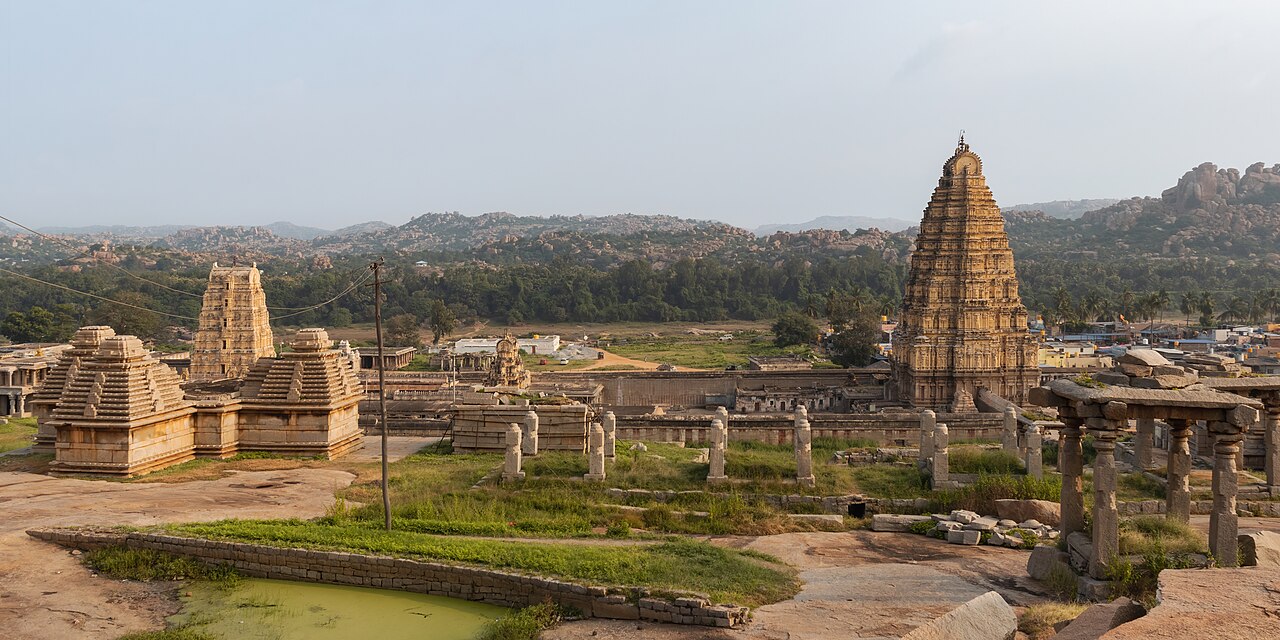
The Group of Monuments at Hampi, inscribed in 1986, preserves the ruins of Vijayanagara — one of the largest cities in the world at its height (estimated 500,000 residents), capital of the last great Hindu empire of southern India, sacked in 1565 and never rebuilt. The Group of Monuments at Pattadakal extends the Chalukya architectural heritage 140 kilometres to the north.
Hampi: Capital of the Vijayanagara Empire 40 km from Hospet junction
The Group of Monuments at Hampi, inscribed in 1986 under criteria (i), (iii), and (iv), covers the ruins of Vijayanagara — founded in 1336 CE by Harihara I of the Sangama dynasty on the south bank of the Tungabhadra River, on a site of extraordinary geological character: a landscape of enormous granite boulders piled in natural formations over 25 square kilometres, through which the river channels and the city streets were cut. By the early sixteenth century under Krishnadevaraya (r. 1509–1529), Vijayanagara was the largest city in India and among the five largest in the world; the Portuguese traveller Domingo Paes, visiting in 1520–1522, described it as “as large as Rome” with streets “full of merchants from every part of the world.” The Vittala Temple, begun under Devaraya II (1423–1446) and completed under Krishnadevaraya, is the supreme achievement of Vijayanagara architecture: its stone chariot in the courtyard (built as a processional vehicle for Garuda, Vishnu’s mount, the wheels once rotating on ball bearings), the musical pillars of the main hall (each pillar of a different stone producing a different note when struck — 56 pillars in one hall), and the elaborated sculptural programme of the outer walls combine to make it among the most decorated temples in India. The empire’s sudden end came at the Battle of Talikota on 23 January 1565, when an alliance of four Deccan Sultanates defeated the Vijayanagara army; the city was sacked and burned over the following six months and never rebuilt.
Virupaksha Temple: The Continuously Operating Ancient Shrine Hampi village centre
The Virupaksha Temple in Hampi village is not a ruin — it has been in continuous religious operation since at least the seventh century CE, predating the Vijayanagara Empire and remaining active through the centuries of abandonment around it. The 49-metre eastern gopuram (temple tower), added in 1510 by Krishnadevaraya to mark his coronation, dominates the Hampi bazaar street that was the city’s main commercial artery; the temple elephant Lakshmi, trained to receive offerings from devotees, greets visitors at the inner courtyard. The temple’s inner sanctum houses the Shivalinga (the form of Shiva worshipped at Hampi) and is lit only by oil lamps; the marriage hall (kalyana mandapa) with its carved column narratives of the divine wedding of Shiva and Parvati remains in use for rituals. The Hampi bazaar street, 750 metres long, preserves the granite platform and column bases of the market stalls that lined the approach to the temple in the imperial period.
Group of Monuments at Pattadakal: The Chalukya UNESCO Ensemble 🚗 ~3 hrs northwest
The Group of Monuments at Pattadakal, inscribed in 1987 under criteria (iii) and (iv), is a complex of ten major temples and a Jain sanctuary built between the sixth and eighth centuries CE by the Chalukya dynasty of Badami — the ruling house that preceded the Vijayanagara Empire in the Deccan plateau. Pattadakal represents the unique moment in Indian temple architecture where the northern Nagara style (curvilinear shikhara tower) and the southern Dravidian style (pyramidal tower with horizontal tiers) were simultaneously developed in adjacent temples on the same royal building site — making it the best laboratory in India for understanding the divergence of the two primary Hindu temple architectural traditions. The Virupaksha Temple of Pattadakal (c. 740 CE, not to be confused with the Hampi Virupaksha), the largest temple on the site built by Queen Lokamahadevi to celebrate the Chalukya victory over the Pallavas, is the direct model for the Kailasa Temple at Ellora — which Rashtrakuta ruler Krishna I built by copying this temple in the following decade.
Badami Cave Temples: Chalukya Rock-Cut Sanctuaries 🚗 ~4 hrs northwest
The Badami Cave Temples are not UNESCO-inscribed but are the artistic and institutional context without which Hampi’s Vijayanagara monuments cannot be fully understood. The four rock-cut sanctuaries carved into the sandstone cliffs of Badami between 578 and 700 CE by the early Chalukya kings contain the oldest Shaiva, Vaishnava, and Jain iconographic programmes in the Deccan — including an 18-armed dancing Nataraja (Cave 1) and a Vishnu in his cosmic form (Anantashayana, Cave 2) that combine the theological ambition of the Gupta period with a new Deccan narrative style that directly influenced the sculpture of Pattadakal and, three centuries later, of Hampi. The three-hour round trip from Aihole (a village of 125 early Chalukya temples, not inscribed) to Badami and back to Pattadakal, all within 45 km of each other, is the most concentrated early medieval Indian temple circuit in the subcontinent.
Practical information
Hampi is reached from Hospet Junction (13 km, regular buses) or Bellary/Ballari Airport (BEP, 65 km, taxis available). Bangalore Kempegowda Airport (BLR) is the main international gateway (370 km, 6 hours by express bus or overnight train to Hospet). The Hampi ruins are open 6 a.m.–6 p.m. daily; Vittala Temple has a separate ticketed entrance (₹600 for foreign nationals, included in the combined Hampi ticket). The site is large (26 km²) and best explored by bicycle or auto-rickshaw; the main Vittala–Virupaksha circuit takes a full day. Pattadakal is 22 km from Aihole and 46 km from Badami; all three are within day-trip distance from each other and best combined into a two-day circuit from Hubli (which has an airport). The best season for Hampi is November–February; March–May temperatures reach 40°C in the treeless boulder landscape.
Frequently Asked Questions
Is Hampi a UNESCO World Heritage Site?
Yes. The Group of Monuments at Hampi was inscribed in 1986 under criteria (i), (iii), and (iv). The inscription covers approximately 1,600 surviving monuments of the Vijayanagara Empire within the boulder-strewn landscape of the Tungabhadra River valley — temples, palaces, elephant stables, market halls, water channels, and fortification walls across a 26-square-kilometre site.
What happened to the Vijayanagara Empire?
The Vijayanagara Empire ended at the Battle of Talikota on 23 January 1565, when the armies of four allied Deccan Sultanates (Bijapur, Golconda, Ahmadnagar, and Bidar) defeated the army of Aliya Rama Raya, who was captured and beheaded during the battle. The victorious armies then marched on the capital Vijayanagara and spent six months systematically looting and demolishing the city, destroying the buildings, breaking the sculptures, and melting the bronze works. The city was never resettled by a new dynasty; it remained a ruin until archaeologists began systematic survey in the nineteenth century. The Vijayanagara Empire survived in reduced form from secondary capitals (Penukonda, Chandragiri) for another century, but the capital was never rebuilt.
What are the musical pillars at Vittala Temple?
The main hall (mandapa) of the Vittala Temple has 56 granite pillars that produce musical notes when struck — each pillar carved from a different variety of stone (basalt, granite, limestone, onyx) to produce a different pitch, creating a seven-octave musical scale. The British colonial authorities cut two of the pillars open in the nineteenth century to investigate whether they were hollow (they are not — they are solid stone throughout), leaving saw-cut sections still visible today. The pillars are no longer permitted to be struck by visitors.
Sources
- S1 — Fritz, John M., and George Michell. Hampi Vijayanagara. Jaico Publishing House, 2014. ISBN 978-81-8495-602-3.
- S2 — Stein, Burton. Vijayanagara. Cambridge University Press, 1989. ISBN 978-0-521-26693-2.
Spotted an error? Write to editorial@culturalheritageonline.com and we correct it the same day.


_(cropped).jpg)