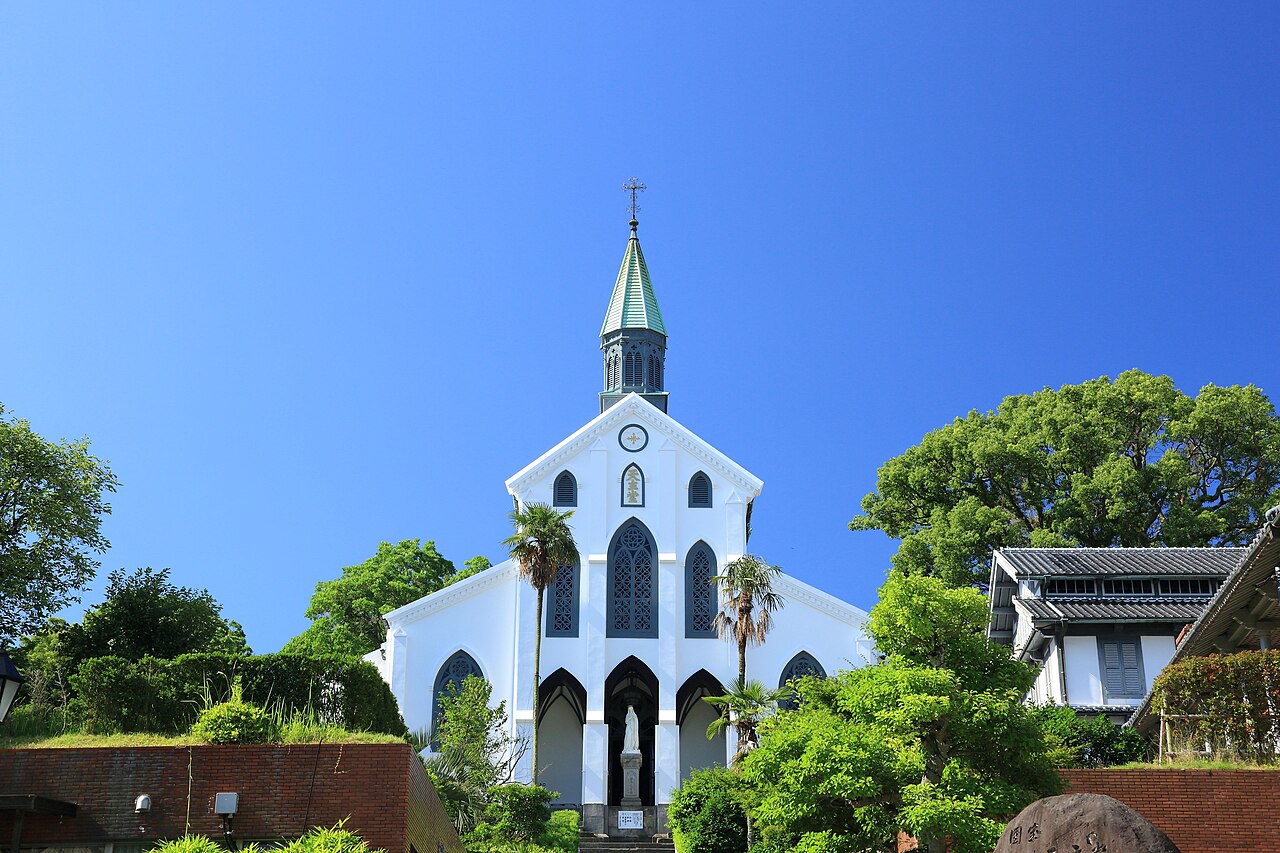
The Hidden Christian Sites in the Nagasaki Region, inscribed by UNESCO in 2018, preserves 12 properties across the Nagasaki Peninsula, the Goto Islands, and the Hirado Peninsula that document the formation, survival, and discovery of a community that maintained Christianity in secret for 250 years after the faith was outlawed in Japan in the 1620s. The community’s concealment strategy — embedding Christian practice within Buddhist ritual calendars and Shinto shrine forms — created a syncretic religious culture unique in world history. The Ooura Cathedral, completed in 1865 as the first Western-rite Gothic church in Japan and Japan’s only Western-style National Treasure, was the site where, in 1865, a group of Urakami villagers revealed their secret Christianity to a French priest — an event the Vatican documented as the “discovery of hidden Christians.”
The Nagasaki coast and the southwestern maritime corridor Hiroshima · Kagoshima · Kitakyushu — 180 to 350 km
One hundred eighty kilometres northeast of Nagasaki by Shinkansen from Nagasaki to Hakata and Sanyo Shinkansen to Hiroshima (approximately 2 hours), the Hiroshima Peace Memorial documents the 1945 atomic bombing of a city whose pre-war history intersected directly with Nagasaki’s Christian heritage geography. The 26 Christian martyrs executed in Nagasaki in 1597 — whose execution the Ooura Cathedral was built to commemorate in 1864 — were killed in the same decade that Toyotomi Hideyoshi was establishing the castle system that Hiroshima’s military complex later inherited. The Nagasaki atomic bomb of 9 August 1945 destroyed the Urakami Cathedral — the rebuilt centre of the discovered hidden Christian community — and killed an estimated 8,500 of the 12,000 Catholics in Nagasaki City. The rebuilt Urakami Cathedral stands 200 metres from the hypocenter marker, within sight of the Nagasaki Atomic Bomb Museum; the two catastrophes of 1945 — Hiroshima on 6 August and Nagasaki on 9 August — are separated by 180 kilometres of Shinkansen corridor that can be traversed in 2 hours. From Nagasaki, Hiroshima is reached by Kamome limited express to Hakata and Sanyo Shinkansen east.
Two hundred kilometres southwest of Nagasaki by ferry connections through the island chain, the Goto Islands contain five of the inscription’s 12 properties — the highest concentration of hidden Christian sites outside Nagasaki City. The Goto Islands’ remoteness made them a refuge for Christian communities expelled from Nagasaki by domain authorities in the late 18th and early 19th centuries: approximately 3,000 Christians were relocated to the uninhabited Goto Islands between 1797 and 1813, where they lived in forest clearings and maintained their practice undisturbed. The Dojima Cathedral on Fukue Island — built in 1908 and the most elaborately constructed Christian church in the archipelago — was built from sandstone and roofed with tiles from demolished Edo-period Buddhist temples on the same island. The Goto Islands are reached from Nagasaki by jet hydrofoil (90 minutes to Fukue) or by car ferry; the island chain has its own small airports connecting to Nagasaki and Fukuoka.
Two hundred fifty kilometres northeast of Nagasaki by Shinkansen from Hakata and Sanyo connections, the Itsukushima Shrine on Miyajima Island in Hiroshima Prefecture was built by the Taira clan in 1168 CE as a statement of maritime authority over the Seto Inland Sea. The same maritime geography that made the Seto Inland Sea the commercial corridor of Heian Japan also made Nagasaki the commercial frontier of Edo Japan: the Portuguese who first arrived in Japan in 1543 traded through the same western Japan coastal geography before concentrating at Nagasaki after 1571. The hidden Christian communities of the Nagasaki region maintained their faith through the Dutch East India Company period (1639–1853) using concealment techniques that borrowed from the same mixture of Shinto and Buddhist practice that governed the ritual landscape around Itsukushima Shrine. From Nagasaki, Miyajima is reached by Kamome express to Hakata, Shinkansen to Hiroshima, and JR-and-ferry connection to Miyajima (approximately 2.5 hours total).
Three hundred fifty kilometres northeast of Nagasaki by Shinkansen from Hakata to Kitakyushu (approximately 20 minutes from Hakata), the Sites of Japan’s Meiji Industrial Revolution — particularly the Yawata Steel Works’ Higashida First Blast Furnace and the Mitsubishi Nagasaki Shipyard components — represent the industrial successor to the maritime commercial economy that made Nagasaki’s Christian history possible. The Nagasaki port was the only Western-trade port in Japan during the isolation period (1639–1853), through which the Dutch East India Company conducted Japan’s sole legal foreign commerce; the same port facilities that handled the Dutch trade were modernized in the Meiji period into the Mitsubishi shipyard that became one of the principal naval shipbuilding facilities of the Japanese empire. The intersection of Nagasaki’s hidden-Christian heritage and its Meiji industrial heritage — both originating in the same bay — is documented in the Mitsubishi Nagasaki Shipyard Museum adjacent to the No. 3 Dry Dock, which is itself one of the 23 Meiji inscription components.
East to the Kumamoto and Kyushu heritage circuit Kumamoto · Kagoshima · Beppu — 130 to 250 km
One hundred thirty kilometres east of Nagasaki by Shinkansen to Hakata and limited express south (approximately 90 minutes), Kumamoto City’s castle and the Aso Volcanic Region give context to the same Kyushu island geography that produced the Nagasaki hidden Christian tradition. The Shimabara Rebellion of 1638 — the armed uprising of 37,000 Christians (or those labelled Christians by Tokugawa authorities) at Hara Castle on the Shimabara Peninsula — ended at Hara Castle with a siege and massacre that directly caused the Tokugawa government to impose the closed-country policy (sakoku) that isolated Japan for 215 years. Hara Castle ruins are one of the 12 UNESCO inscription components: the earthwork ramparts of the castle where the rebellion’s survivors made their last stand survive on the Shimabara Peninsula coast, accessible by ferry from Misumi Port near Kumamoto. The Shimabara Peninsula is 45 minutes from Nagasaki by bus and train, making the Hara Castle ruins the most historically charged component of the inscription — the physical location where the 250 years of secrecy began. From Nagasaki, Kumamoto Castle is reached by Kamome express to Hakata and Shinkansen to Kumamoto (approximately 100 minutes total).
Two hundred fifty kilometres south of Nagasaki by Shinkansen from Hakata to Kagoshima-Chuo (approximately 90 minutes), Kagoshima City holds the Shuseikan complex — part of Japan’s Meiji Industrial Revolution inscription — and the Sengan-en garden of the Shimazu domain. The Shimazu were the domain lords who governed southern Kyushu and whose Satsuma Rebellion of 1877 — the last samurai uprising in Japanese history — was both a response to and a symptom of the Meiji transformation. The Shimazu domain’s 1850s industrial programme (documented in the Shuseikan components) was conducted in the same period that Nagasaki’s hidden Christians were beginning to emerge from concealment — the two stories of Japan’s 19th-century transformation, industrial and religious, unfolded simultaneously in the same southwestern island geography. From Nagasaki, Kagoshima is reached by Kamome express to Hakata and Kyushu Shinkansen south to Kagoshima-Chuo (approximately 2.5 hours).
Practical information
Nagasaki City’s inscribed components — the Ooura Cathedral, the Oura Church ruins, and the Dejima Dutch trading post site — are within walking distance of central Nagasaki. The Ooura Cathedral, built by French missionaries of the Paris Foreign Missions between 1864 and 1865 and dedicated to the 26 martyrs executed in 1597, is at the top of the Glover Garden slope in the international district south of central Nagasaki; it is open for visits (entry paid) Tuesday through Sunday. The nearby Glover Garden (Thomas Glover’s 1863 estate, the oldest surviving Western-style wooden house in Japan) provides the architectural context for the foreign settlement that coexisted with the hidden Christian communities. The Dejima Dutch trading post, reconstructed on its original reclaimed-land footprint in the Nagasaki waterfront, is open daily and documents the commercial framework within which the hidden Christian communities maintained contact with the outside world through converted Dutch employees during the isolation period. The satellite components — the Goto Islands churches, the Hirado Island church (Tabira Church, 1918, visible from a Buddhist temple) and Kashimae Village site, and the Hara Castle ruins on the Shimabara Peninsula — require additional transport ranging from 45 minutes to 2 hours from central Nagasaki. Nagasaki is served by Nagasaki Airport (40 minutes from the city centre) and by JR Shinkansen from Hakata (approximately 25 minutes on the Kamome service). The city centre is compact and navigable by tram network.
Frequently Asked Questions
How did the hidden Christians conceal their faith for 250 years?
The concealment system evolved through two phases: an early phase of direct disguise (1620s–1780s) and a later phase of syncretic integration (1780s–1865). In the early phase, Christians used Buddhist memorial tablets (butsudan) as covers for secret altars, substituted Buddhist funeral rites for sacraments they could no longer perform openly, and adopted the outward practice of temple registration (terauke seido) — the Tokugawa system of requiring every family to register with a local Buddhist temple, which served as a population census and Christian-detection mechanism simultaneously. In the later phase, the communities developed a syncretic practice in which the attributes of the Virgin Mary were mapped onto Kannon (the Buddhist bodhisattva of compassion): Maria-Kannon figures — ostensibly Buddhist Kannon statues holding a child in the manner of Kannon holding a lotus — served as secret Christian icons, visually indistinguishable from Buddhist devotional objects. The communities also preserved an oral liturgy — prayers in a corrupted Portuguese-Japanese mixture called Orasho (from Portuguese “oração”) — transmitted across generations without written text. The practice required full community participation: one member’s defection could expose the entire community. The discovery of the Urakami community in 1865 came from within — a group of Urakami villagers approached the French priest at the newly completed Ooura Cathedral and disclosed their practice voluntarily, believing that the presence of the cathedral indicated that Japan had changed its laws. It had not; the Meiji government arrested and exiled 3,394 Urakami Christians to distant domains between 1867 and 1873, the last systematic Christian persecution in Japanese history.
Why is the Ooura Cathedral Japan’s only Western-style National Treasure?
The Ooura Cathedral’s designation as a National Treasure (the highest category of Japanese cultural property, covering objects of “especially high historical or artistic value”) reflects both its historical significance and its architectural quality. It is the only Western-style building to receive the designation — all other National Treasure buildings in Japan are in traditional Japanese or East Asian architectural styles. The cathedral was designed by Father Bernard Petitjean, a member of the Paris Foreign Missions Society, in a French Gothic style derived from the 13th-century Gothic cathedrals of the Ile-de-France: three naves, a western tower, rib-vaulted nave ceiling in stained plaster, and stained glass from France installed in the original 1865 construction. The building’s architectural quality is the work of Japanese craftsmen trained by Petitjean in Western masonry technique — the first application of Gothic structural principles by Japanese builders. The National Treasure designation was awarded in 1933, making it one of the earliest examples of Western-style heritage conservation in Japan. The cathedral remains an active place of worship under the Diocese of Nagasaki; Mass is celebrated daily. Visitors may enter the nave for a fee; photography is restricted within the liturgical space. The stained glass windows — depicting scenes from the life of Christ — are among the oldest surviving French stained glass in Asia.
What is the difference between the UNESCO-inscribed hidden Christian sites and the rebuilt Urakami Cathedral?
The UNESCO inscription covers 12 specific sites documenting the formation and survival of the hidden Christian tradition — all sites directly associated with the period of concealment and community structure before the 1865 discovery. The rebuilt Urakami Cathedral is not part of the UNESCO inscription. The original Urakami Cathedral was completed in 1925 and destroyed by the Nagasaki atomic bomb on 9 August 1945; the rebuilt cathedral, completed in 1959, stands on the same site but is not a preserved historic structure and does not document the hidden Christian period. The distinction is architecturally and historically significant: the UNESCO inscription is specifically about the 250 years of secrecy and the material culture that secrecy produced — the Maria-Kannon figures, the Orasho liturgy, the village sites where secret practice occurred. The Ooura Cathedral is inscribed because it was the site of the 1865 discovery that ended the period of secrecy. The Urakami Cathedral is a memorial to the 1945 bombing and to the Urakami Christian community as a whole — a community memory site rather than a hidden-period site. Visitors who wish to understand both dimensions of Nagasaki’s Christian history should visit the Ooura Cathedral (inscription, 1865 discovery, architectural quality), the Urakami Cathedral (community memory, atomic bombing), and the Nagasaki Atomic Bomb Museum (the bomb’s effects on the Urakami neighbourhood), all of which are accessible on foot or by tram from central Nagasaki within half a day.
Sources
- S1 — UNESCO World Heritage Centre — Hidden Christian Sites in the Nagasaki Region (Ref. 1495) — https://web.archive.org/web/20230601000000/https://whc.unesco.org/en/list/1495/
- S2 — UNESCO World Heritage Centre — Statement of Outstanding Universal Value (Ref. 1495) — https://whc.unesco.org/en/list/1495/
Spotted an error? Write to editorial@culturalheritageonline.com and we correct it the same day.