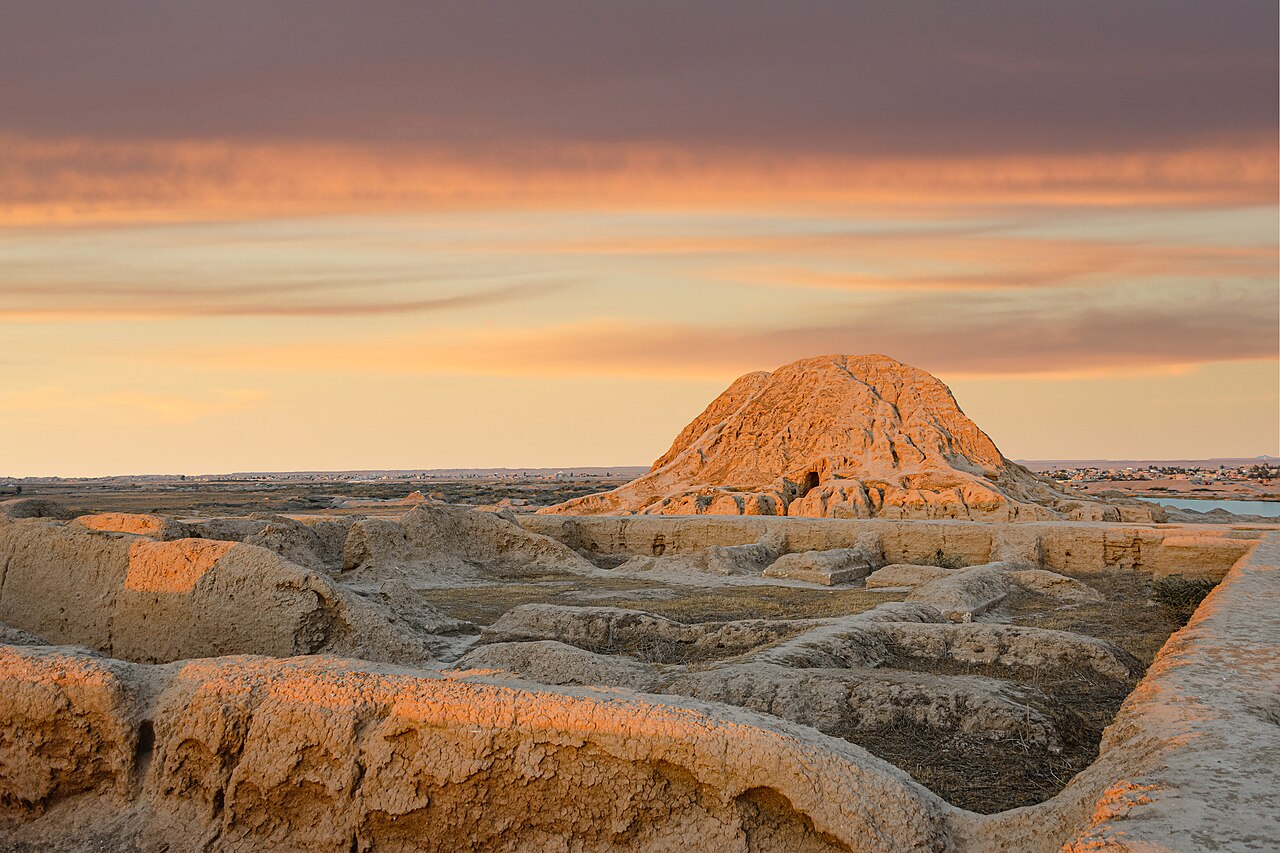
Ashur (Qal’at Sherqat), inscribed by UNESCO in 2003 and simultaneously placed on the List of World Heritage in Danger — where it has remained ever since — is the first capital and eternal sacred city of the Assyrian civilization, occupied continuously from approximately 2600 BCE until 614 BCE and briefly revived in the Parthian period. Located on the west bank of the Tigris River in present-day Saladin Governorate, Iraq, it is one of the longest-continuously-occupied single urban sites in the ancient world and the place where every Assyrian king was crowned and buried. The city, the supreme Assyrian god, and the Assyrian people all share the same name: Ashur.
The city as god: Ashur’s sacred geography West bank of the Tigris, ~250 km north of Baghdad, Saladin Governorate, Iraq
The identity of Ashur — city, deity and people — is not a coincidence of naming but the governing principle of Assyrian civilization. In Assyrian theology, the god Ashur was not merely the patron of the city in the way that Marduk was patron of Babylon or Athena of Athens: Ashur was the city. The city’s foundation was understood as the creation of the god’s earthly dwelling, and the god’s earthly dwelling was understood as coextensive with the Assyrian state itself. The Assyrian king held his office not as a sovereign in his own right but as the god Ashur’s representative on earth, his chief military commander, and the executive of the divine will. Every military campaign was conducted in Ashur’s name; every conquest brought tribute to Ashur’s temples; every king received his crown at Ashur and was eventually buried there, regardless of where he had ruled or built his administrative capital.
The site was occupied from at least the mid-third millennium BCE. The earliest archaeological levels, reached in excavations that required cutting through twenty to thirty meters of accumulated urban stratigraphy, date to approximately 2600 BCE — making the occupation of the site contemporary with the Early Dynastic period of Sumer. For the first several centuries of its existence, Ashur was a city-state of modest regional importance, its merchants active on the copper and tin trade routes connecting Anatolia with Mesopotamia (the famous Assyrian merchant colonies of Anatolia, known from the thousands of clay tablets excavated at Kültepe/Kaneš in modern Turkey, date to the early second millennium BCE and document a commercial diaspora originating in Ashur). The city became the capital of a territorial empire from approximately the fourteenth century BCE, when Assyrian kings began their campaigns of systematic expansion across northern Mesopotamia, Syria and eventually Egypt.
The temple complex that dominated Ashur was one of the most architecturally complex and long-lived in the ancient world. The Great Temple of Ashur — the national sanctuary — was rebuilt by almost every major Assyrian king over two thousand years, each reconstruction adding new construction phases while preserving the sacred ground plan. Beneath the later phases, excavators found the temple’s earliest levels extending to the third millennium BCE, making this one of the longest continuously used single religious sites in the ancient world. Adjacent to it stood the Temple of Anu-Adad — a double temple served by two paired ziggurats, the only example of a double-ziggurat known in Mesopotamian archaeology, built to honor both the sky god Anu and the storm god Adad. The Temple of Ishtar, Assyria’s principal goddess of war and love, had its own long occupation history with excavation levels reaching to 2600 BCE.
The archaeology of Ashur and the city’s fate In Danger since 2003; security assessment required before any visit
The German archaeological expedition to Ashur, led by Walter Andrae between 1903 and 1914, is considered one of the most important and methodologically rigorous excavations in the history of Mesopotamian archaeology. Andrae arrived at a moment when Mesopotamian excavation was transitioning from large-scale treasure hunting — the approach that had characterized the British expeditions to Nineveh and Nimrud in the 1840s and 1850s — toward systematic stratigraphic recording. He introduced methods for reading mudbrick architecture (one of the most technically demanding skills in field archaeology, since sun-dried bricks dissolve back into their clay substrate and are visible only as slight color or texture differences in the excavated soil), for documenting the vertical sequence of construction phases, and for recording small finds in their spatial context. The publication of his results, in a series of volumes issued over several decades, established standards of documentation that influenced the entire discipline. The objects excavated by Andrae — statues, inscribed bricks, cylinder seals, ivories, and architectural elements — were divided between the Berlin museums (where they remain in the Pergamon Museum and the Vorderasiatisches Museum) and the Iraq Museum in Baghdad.
Ashur remained the religious capital of the Assyrian Empire throughout the empire’s political history, even as successive kings moved their administrative headquarters to new cities: Ashurnasirpal II moved the political capital to Nimrud (Kalhu) in the ninth century BCE; Sargon II built an entirely new capital at Khorsabad (Dur-Sharrukin) in the eighth; Sennacherib made Nineveh his capital. But all three kings continued to crown themselves at Ashur and to be buried there. The city was destroyed by the Medes and Babylonians in 614 BCE — two years before the fall of Nineveh and the final collapse of the Assyrian Empire — and its population was massacred or dispersed. A Parthian revival of the site between approximately 100 BCE and 200 CE left a later stratum, including a Parthian palace and temples, above the Assyrian levels.
The modern threat to Ashur has been severe and multiple. The proposed Makhoul Dam on the Tigris, if constructed at the planned height, would have inundated the site entirely under a reservoir; this threat precipitated the simultaneous inscription and In Danger listing in 2003. The 2003 Iraq War and subsequent instability brought widespread looting to archaeological sites across Iraq, and Ashur suffered systematic theft of inscribed bricks, reliefs and smaller objects. Control of the site passed through multiple armed factions during the 2014–2017 period when the region was under the control of the Islamic State, which damaged sites with documented historical record at Nimrud, Hatra and elsewhere. The site is now under Iraqi government administration, but physical access requires security clearance and advance coordination with the Iraqi State Board of Antiquities and Heritage. The Makhoul Dam project has not been formally abandoned.
Practical information
Ashur (Qal’at Sherqat) is located approximately 250 km north of Baghdad on the west bank of the Tigris, near the town of Shirqat in Saladin Governorate. The site is technically reachable overland from Baghdad via the road to Mosul, but access requires current security assessment and coordination with the Iraqi State Board of Antiquities and Heritage (SBAH) in Baghdad. At the time of writing, independent tourist visits are not advisable without advance official clearance; organized heritage and academic tours through specialist operators with confirmed SBAH arrangements are the appropriate mode of access. Travellers should consult the travel advisories of their government before any visit to Iraq. For those able to visit, the site includes the remains of the ziggurat, the Great Temple, the Old Palace, the Tabira Gate, and substantial stretches of the ancient city wall. There is no on-site visitor infrastructure; bring water, food and appropriate footwear. The nearest city with accommodation is Tikrit (approximately 90 km south). Objects from the German excavations are on permanent display in the Vorderasiatisches Museum in Berlin and in the Iraq Museum in Baghdad.
Frequently Asked Questions
Why do the city, the god, and the Assyrian people all share the same name?
The identity of name between the city of Ashur, the god Ashur, and the Assyrian people (Ashuraye in ancient Assyrian) is one of the most distinctive features of Assyrian civilization and reflects a theological concept that has no precise parallel in other ancient Near Eastern religions. In Babylonian religion, for example, Marduk was the patron god of Babylon, but Marduk and Babylon were understood as distinct entities — the god existed independently of the city and could in principle be worshipped elsewhere, as happened when the Babylonian Exile brought his worship to distant communities. In Assyrian theology, by contrast, the god Ashur and the city were understood as coextensive: the city was the god’s earthly manifestation, and the god’s existence was inseparable from the city’s continued existence and prosperity. This identification was not merely a theological abstraction; it had profound practical consequences. The Assyrian king’s title was “viceroy of Ashur” — he did not rule in his own right but as the god’s appointed deputy. Every military campaign was described in the royal annals as carried out “at the command of Ashur.” The tribute and plunder of conquest flowed to Ashur’s temples. And when the Assyrian Empire expanded to encompass peoples far from the Tigris, those peoples were described as having been brought under “the yoke of Ashur” — meaning subjection to both the god and the state simultaneously. The destruction of the city of Ashur in 614 BCE by the Medes was therefore experienced not merely as a military defeat but as an eschatological catastrophe: the annihilation of the god’s earthly dwelling.
What made Walter Andrae’s excavations at Ashur historically significant?
Walter Andrae’s excavations at Ashur between 1903 and 1914, conducted for the Deutsche Orient-Gesellschaft, are considered a turning point in the methodology of Near Eastern archaeology for several reasons. Andrae worked at a time when the dominant model of Mesopotamian excavation — exemplified by Austen Henry Layard’s campaigns at Nimrud and Nineveh in the 1840s–50s — prioritized the extraction of large sculptural and inscribed objects for display in European museums, with minimal attention to the architectural context or stratigraphic sequence from which they came. Andrae’s approach was systematic in a way that had few precedents in the region: he developed and refined methods for reading mudbrick architecture, which is among the most challenging material in field archaeology because sun-dried brick structures dissolve back into the alluvial clay from which they are made, becoming visible only as subtle variations in color, texture and compaction that must be read in section and plan before they are disturbed. He recorded the vertical sequence of occupation phases at the site, establishing a stratigraphic column that allowed objects and structures to be placed in chronological relationship to each other. His team documented small finds — pottery, cylinder seals, inscribed bricks, metal objects — in their precise spatial contexts rather than removing them without record. The resulting publications, issued over several decades and eventually running to many volumes, set documentation standards that influenced Near Eastern archaeological practice for generations. Andrae himself later became Director of the Vorderasiatisches Museum in Berlin, where he continued to work on the Ashur material.
Why is Ashur on the UNESCO List of World Heritage in Danger, and what are the current threats?
Ashur was placed on the UNESCO List of World Heritage in Danger simultaneously with its inscription in 2003 — an unusual step that reflected the Iraqi government’s urgent request for international recognition of the threats the site faced. The immediate trigger was the proposed Makhoul Dam on the Tigris River: engineering plans envisaged a reservoir that would have submerged the site entirely under several meters of water, a threat described by archaeologists as the planned obliteration of one of the most important archaeological sites in the world. The dam project was delayed by the 2003 Iraq War and has not been formally cancelled, meaning the threat remains on the books. The 2003 war itself brought a second category of damage: the collapse of state authority led to widespread looting of Iraqi archaeological sites. Ashur, like dozens of other sites, suffered systematic theft of portable antiquities — inscribed bricks, cylinder seals, small sculptures — many of which entered the international antiquities market. A third phase of damage occurred between 2014 and 2017, when Islamic State controlled large parts of Saladin Governorate and carried out documented destruction at Assyrian sites including Nimrud, where unique relief sculptures were sledgehammered on video. Ashur’s fate during this period has not been fully assessed. Since the restoration of Iraqi government control, the Iraqi State Board of Antiquities and Heritage has worked with international partners to assess damage and resume site management, but the combination of infrastructure destruction, security challenges, and the ongoing formal threat from the Makhoul Dam has prevented the conditions for removal from the In Danger list from being met.
Sources
- S1 — Pedersén, Olof. Archives and Libraries in the City of Assur. Uppsala, 1985. ISBN 978-91-554-1812-0.
- S2 — Roaf, Michael. Cultural Atlas of Mesopotamia and the Ancient Near East. Facts on File, 1990. ISBN 978-0-8160-2218-2.
Spotted an error? Write to editorial@culturalheritageonline.com and we correct it the same day.