Bhutan has no inscribed UNESCO World Heritage Sites. This is one of the most surprising gaps in the UNESCO system — Bhutan’s dzong fortress-monasteries, its traditional architecture, its sacred Himalayan landscapes, and the Black Mountains national parks are among the finest surviving examples of Himalayan Buddhist heritage anywhere. Several sites are on the Tentative List. From Cultural Heritage Online.
Tashichho Dzong and the Dzong Architecture of Bhutan
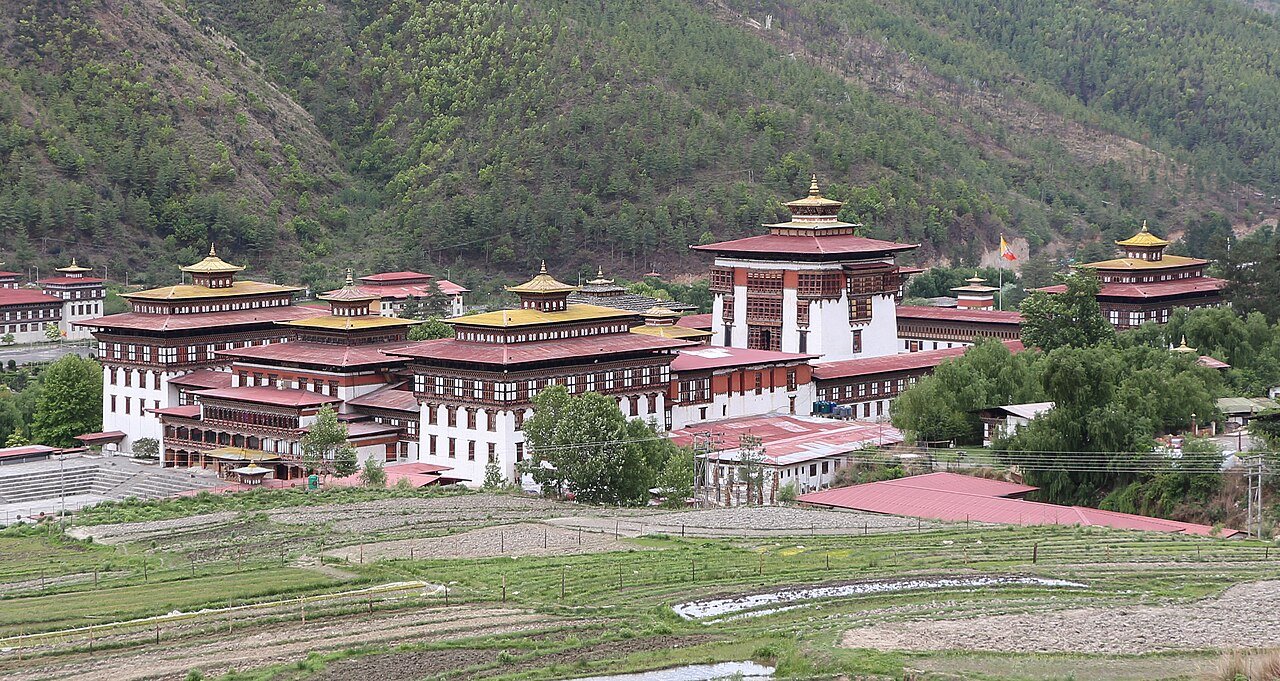
Bhutan’s most distinctive architectural tradition is the dzong — a fortress-monastery that serves simultaneously as administrative headquarters, monastic community, and sacred space. Every Bhutanese district (dzongkhag) has a dzong, and the tradition of combining religious and secular governance in a single fortified building dates to the seventeenth century, when Zhabdrung Ngawang Namgyal, the founder of the Bhutanese state, began using dzong architecture as a tool of political unification. The dzong form — white-plastered stone walls, tapering inward slightly, with a golden Bhutanese roofline and a central tower (utse) housing the most sacred shrine — has remained virtually unchanged for four centuries.
Tashichho Dzong in Thimphu was established in 1641, burnt in 1772, and substantially rebuilt in the 1960s to its present form by the third king, Jigme Dorji Wangchuck. It serves as the seat of the national government (the ministries of Home Affairs and Finance are housed here) and as the summer residence of the Je Khenpo, Bhutan’s chief abbot. The dzong can be visited outside government hours; the interior courtyards are open to visitors except during religious festivals.
The Sacred Sites of the Paro Valley
The Paro Valley, 65 km west of Thimphu, contains the most celebrated single building in Bhutan: the Taktsang Monastery (Tiger’s Nest), clinging to a 900-metre cliff face above the valley floor. According to Bhutanese tradition, the eighth-century master Padmasambhava flew to this cliff face on the back of a tigress and meditated in the cave that now forms the sacred inner sanctuary of the monastery. The existing buildings date from 1692 (and were substantially rebuilt after a 1998 fire). The hike from the valley floor to the monastery takes approximately 4 hours round trip; it is the single most visited site in Bhutan and is on the Tentative List for UNESCO inscription.
The Paro valley also contains Rinpung Dzong (1646) — one of the best-preserved dzong complexes in the country — and the ruins of Drugyel Dzong, destroyed by fire in 1951. Bhutan’s only international airport is in Paro.
Getting there from Thimphu: Tashichho Dzong is in the centre of Thimphu (walking distance from hotels). Paro (Taktsang Monastery) is 65 km west (1.5 hr by road). All foreign visitors to Bhutan require a visa and must travel through a registered Bhutanese tour operator; a daily Sustainable Development Fee ($200 per day in 2024) applies. Allow: Minimum 4–5 days for Thimphu and Paro. Best for: Himalayan Buddhist architecture; sacred landscape visitors; cultural heritage professionals.
Frequently Asked Questions
Does Bhutan have any UNESCO World Heritage Sites?
No. Bhutan has no inscribed UNESCO World Heritage Sites, which is remarkable given the outstanding quality of its heritage. The Bhutanese government has been cautious about UNESCO nomination for cultural sites, partly from concerns about the loss of management control and the potential impact of increased tourism on sacred and cultural sites. The Bhutanese Tentative List includes Dzongs and Choetens (the dzong fortresses and Buddhist stupas), Taktsang Monastery, and natural sites including the Royal Manas National Park (part of the transboundary Manas Wildlife Sanctuary, which is inscribed on the Indian side).
What is the Gross National Happiness policy and how does it relate to heritage?
Gross National Happiness (GNH) is the development philosophy adopted by Bhutan in the 1970s and formalised under the fourth king, Jigme Singye Wangchuck. The concept holds that development should be measured not by GDP alone but by a composite of material wellbeing, environmental sustainability, good governance, and — crucially — cultural preservation. GNH explicitly includes the preservation of Bhutanese cultural heritage, traditional architecture, language (Dzongkha), dress (the mandatory gho for men and kira for women), performing arts, and Buddhist practice as components of national development. The policy has been credited with preventing the rapid homogenisation of Bhutanese culture that has affected neighbouring Himalayan societies.
What is the mandatory minimum expenditure for tourists in Bhutan?
As of 2024, all international tourists visiting Bhutan must pay a Sustainable Development Fee of $200 USD per person per day, which covers accommodation, food, transport, and a government guide. The fee was introduced in its current form in 2022 (replacing the earlier Minimum Daily Package Rate of $250 per day that included accommodation). The SDF does not include airfares, internal flight costs, or the Bhutan visa fee. The policy deliberately limits visitor numbers and tourist profile to high-spending individuals, based on the Bhutanese principle of “high value, low volume” tourism.
What is a dzong and how does it differ from a monastery?
A dzong is a fortified complex that simultaneously houses monastic community, administrative government, and sacred spaces in a single architectural form. The combination of religious and secular power in one building reflects the traditional Bhutanese dual system of governance — the Zhabdrung (or, later, the King) exercising secular authority and the Je Khenpo exercising religious authority — which both used the dzong as their shared institutional home. A pure monastery (gompa) in the Tibetan Buddhist tradition, by contrast, is exclusively a religious community without administrative government functions. The dzong form is specific to Bhutan; comparable buildings elsewhere in the Himalayan world (in Sikkim, Ladakh, Tibet) are either pure monasteries or pure fortifications, not the integrated complex that the Bhutanese dzong represents.
Sources
- S1 — Aris, Michael. The Raven Crown: The Origins of Buddhist Monarchy in Bhutan. Serindia Publications, 1994. ISBN 978-0-906026-32-8.
- S2 — Pommaret, Françoise. Bhutan: Himalayan Mountain Kingdom. Odyssey, 2006. ISBN 978-962-217-757-4.
Spotted an error? Write to editorial@culturalheritageonline.com and we correct it the same day.