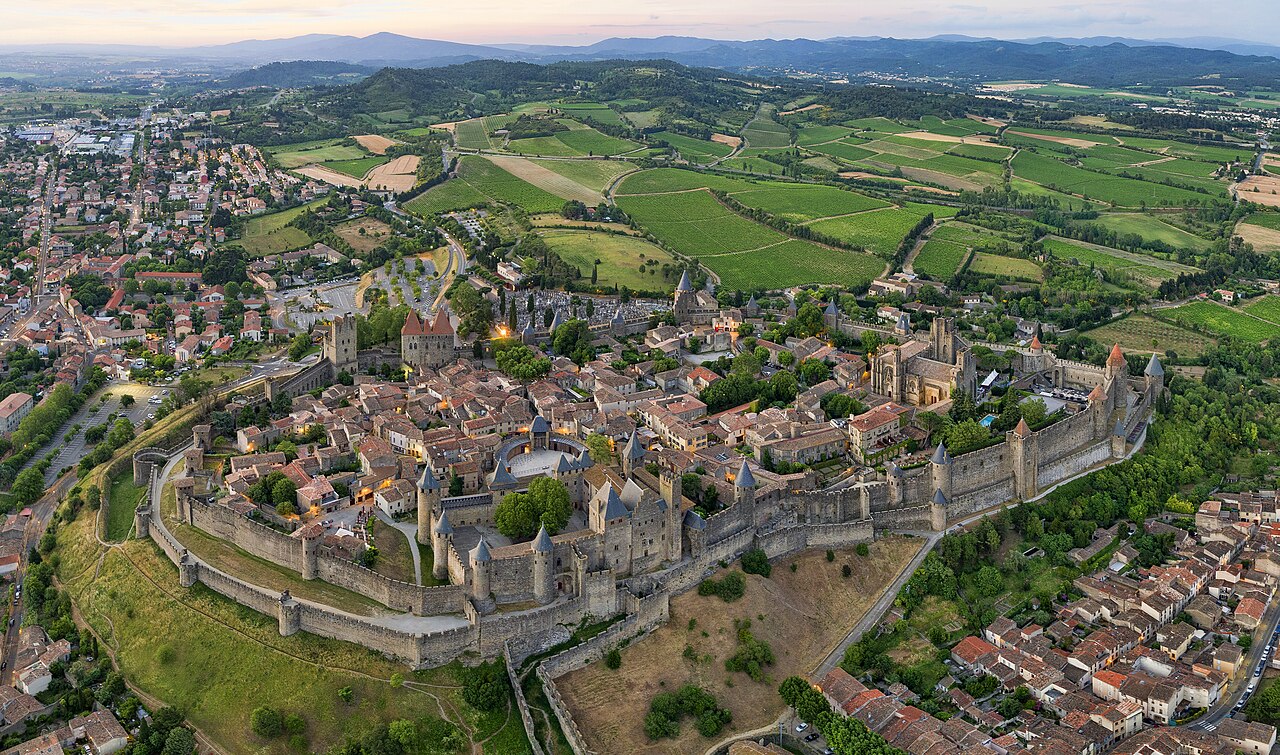
The Historic Fortified City of Carcassonne, inscribed in 1997, is the best-preserved double-walled medieval fortress city in Europe — 52 towers and 3 km of ramparts built in the Visigothic period and expanded under the French Crown after the Cathar Crusade, later controversially restored by Viollet-le-Duc. The Canal du Midi runs through the valley below, connecting the Atlantic to the Mediterranean.
Historic Fortified City of Carcassonne: Double Walls and the Cathar Legacy The Cité — hilltop above lower town
The Historic Fortified City of Carcassonne, inscribed in 1997 under criteria (ii) and (iv), preserves the most complete double-walled fortified city in Europe — an inner wall (Gallo-Roman foundations with Visigothic towers, fifth to sixth century CE) and an outer wall (constructed by the French Crown in the thirteenth century after the Cathar Crusade), creating a corridor (les lices) that allowed defenders to cover the inner wall and fire on attackers who had breached the outer. The city came to the attention of the world largely because of the Albigensian Crusade (1209–1229) — the campaign launched by Pope Innocent III against the Cathar heresy in the Languedoc, which Simon de Montfort’s crusading army conducted with systematic destruction of Cathar towns. Carcassonne surrendered to Simon de Montfort in August 1209 after a two-week siege; the townsfolk were expelled (without clothes, in legend) and the city given to de Montfort as a fief. The Château Comtal within the Cité, begun by the Trencavel viscounts in the twelfth century, was the administrative heart of the city and now houses the principal archaeological museum and access to the wall walk. The lower town (Ville Basse), founded by Louis IX (Saint Louis) in 1247 to house the population expelled from the Cité, is a planned Bastide town on a regular grid with its own Gothic church (Saint-Michel, 1253).
Canal du Midi: The Seventeenth-Century Engineering Wonder 🚶 10 mins from Carcassonne station
The Canal du Midi, inscribed in 1996 under criteria (i), (ii), (iv), and (vi), runs 240 km from Toulouse (where it meets the Canal de Garonne from Bordeaux) to the Étang de Thau on the Mediterranean coast — the engineering project of Pierre-Paul Riquet (1609–1680), a tax farmer who spent 14 years and his personal fortune building the canal, dying six months before its inauguration in 1681. The canal passes through or near Carcassonne (the town’s Canal du Midi section is 3 km from the railway station and is lined with 12,000 plane trees), crosses 65 lock chambers, 126 bridges, one tunnel (the Malpas Tunnel, the first canal tunnel in Europe, 173 m), and feeds from 45 km of feeder channels from the Black Mountain (Montagne Noire) to maintain constant water level. The canal represented the first large-scale European integration of topographic survey, hydrology, and engineering in a single continuous project; its technical innovations (the oval lock chamber, the pound lock, the automatic sluice) were studied by British, Dutch, and French engineers throughout the seventeenth and eighteenth centuries.
Pont du Gard: Roman Aqueduct Above the Gardon 🚗 ~2 hrs east
The Pont du Gard, inscribed in 1985 under criteria (i), (ii), (iii), and (iv), is the tallest surviving Roman aqueduct bridge in the world — a three-tiered stone bridge 49 metres high and 275 metres long, built around 40–60 CE to carry water from the springs of Uzès to the Roman city of Nemausus (Nîmes). The Pont du Gard is built from limestone blocks weighing up to 6 tonnes each, fitted without mortar; the Roman engineers achieved a gradient of 34 cm per kilometre over the entire 50-km aqueduct length, ensuring continuous flow by gravity. The aqueduct was abandoned in the sixth century CE when Roman municipal water management ended; the bridge was used as a toll bridge in the medieval period and partially dismantled for building material before being protected by Louis XIV in 1747. The visitor experience is organised on both banks of the Gardon river, with the lower tier accessible by foot and the upper channel walkable in summer.
Carcassonne Wine and Cathar Country: Corbieres and Minervois 🚗 30–60 mins
The Languedoc wine regions surrounding Carcassonne — the Corbières, Minervois, and Fitou AOC zones — produce some of France’s most characterful wines in the same landscape where the Cathar heresy flourished. The Corbières AOC (to the south and east of Carcassonne, named for the Corbières massif) grows Carignan, Grenache, and Mourvèdre in terraced limestone and schist soils; the Minervois (northwest, along the Aude and Cesse rivers) grows the same varieties with a slightly cooler influence. Many Cathar château ruins — Peyrepertuse, Quéribus, Puilaurens, Aguilar — stand on vertiginous limestone spurs in the Corbières, in a landscape that changes completely from the plain of the Aude to the garrigue-covered limestone massif within 20 km of Carcassonne. The combination of Cathar history, Roman and medieval architecture, AOC wine, and Canal du Midi cycling makes the Carcassonne region one of the most layered heritage tourism circuits in France.
Practical information
Carcassonne Airport (CCF) has seasonal Ryanair flights from several European cities; the TGV from Paris reaches Carcassonne in 4 hours, from Toulouse in 50 minutes. The Cité is 2 km from the railway station (20 minutes walking up the hill, or shuttle bus in summer). Entry to the outer walls (les lices) is free; the Château Comtal and wall walk require a ticket (€9.50 for adults). The Canal du Midi towpath from Carcassonne towards Toulouse is a cycling route (La Voie Verte); bicycles are rented near the canal bridge. Peyrepertuse and Quéribus Cathar castles are 50–60 km south on the D613 and D611; they require car access and a 15–30 minute climb on foot. Carcassonne hosts a summer festival in the Cité (Les Médiévales, typically July) and the Bastille Day fireworks display (July 14) is launched from the walls of the Cité in a tradition begun in 1738.
Frequently Asked Questions
Is Carcassonne a UNESCO World Heritage Site?
Yes. The Historic Fortified City of Carcassonne was inscribed in 1997 under criteria (ii) and (iv). The inscription covers the Cité — the double-walled medieval fortress city on the hill, including the Château Comtal and 52 towers — but not the Bastide town (Ville Basse) in the valley below, which was founded separately by Louis IX.
What is the controversy around Viollet-le-Duc’s restoration?
Viollet-le-Duc directed the restoration of Carcassonne between 1853 and his death in 1879, followed by his student Paul Gout until 1910 — the most ambitious medieval restoration project in nineteenth-century Europe. The controversy centres on whether his restoration documents what was there, or what Viollet-le-Duc believed should have been there. His characteristic pointed conical tower roofs (which appear in most photographs of Carcassonne) are not documented in medieval sources for this region; the northern French conical turrets he added are stylistically inconsistent with the flat-roofed Languedoc tower tradition. His defenders argue that without the restoration the walls would have been demolished; his critics argue that the Carcassonne we see is partly Viollet-le-Duc’s medieval fantasy rather than authentic remains. UNESCO recognised the site’s outstanding value despite this complexity.
What were the Cathars?
The Cathars (also called Albigensians after the town of Albi) were a Christian sect that flourished in the Languedoc region of southern France from the twelfth to fourteenth centuries — a dualist religion that held that the material world was the creation of an evil deity and that salvation required the renunciation of material things. The Cathar parfaits (the initiated) practiced radical asceticism; their credentes (ordinary adherents) lived normal lives but received the consolamentum (sacrament of spirit) on their deathbeds. Pope Innocent III declared a crusade against the Cathars in 1209; the subsequent Albigensian Crusade killed hundreds of thousands of people in the Languedoc and effectively destroyed the distinctive Occitan culture of southern France.
Sources
- S1 — Poux, Joseph. La Cité de Carcassonne: Histoire et description. Édouard Privat, 1938. ISBN 978-2-84373-010-8.
- S2 — Hearn, M. F. The Architectural Theory of Viollet-le-Duc. MIT Press, 1990. ISBN 978-0-262-58102-8.
Spotted an error? Write to editorial@culturalheritageonline.com and we correct it the same day.