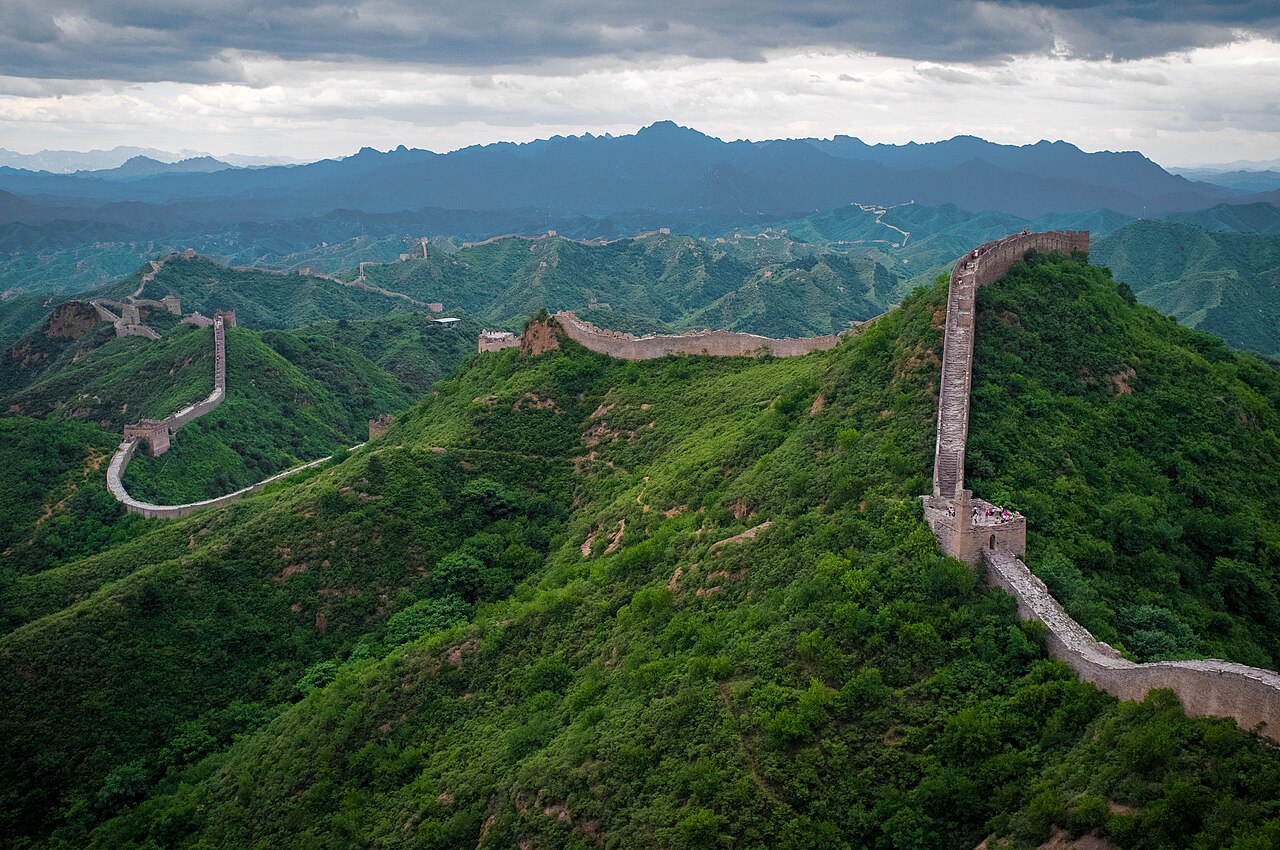
The Great Wall of China was inscribed as a UNESCO World Heritage Site in 1987. Construction across successive dynasties produced a total of 21,196 kilometres of wall, trench and natural barrier, of which the Qin dynasty (221–206 BCE) built the first connected system using forced labour estimated at 500,000 soldiers and convicts. The Ming dynasty (1368–1644) rebuilt and extended the most recognisable sections, mobilising over 1 million labourers and erecting roughly 7,000 signal towers at intervals calculated so a fire-relay message could reach Beijing from the eastern frontier in under two hours. The Jinshanling section, 130 kilometres northeast of Beijing, preserves 10.5 kilometres of Ming wall in a state of partial decay with 67 towers intact; Badaling, 75 kilometres northwest, is the most-visited restored section.
Beijing area: four inscriptions within 130 kilometres 50–130 km by car or bus, 1–2 hours
The Imperial Palaces of the Ming and Qing Dynasties—the Forbidden City—was inscribed by UNESCO in 1987 and sits at the geographic and political centre of Beijing. Built between 1406 and 1420 under the Yongle Emperor, the complex covers 720,000 square metres with 980 surviving buildings and a total of 8,886 rooms by traditional count (modern surveys put the number slightly lower). The surrounding moat is 52 metres wide; the outer perimeter wall measures 3.4 kilometres per side. From Badaling, the Forbidden City is approximately 75 kilometres south via the G6 expressway, around 90 minutes by car or two hours by the S2 suburban rail line combined with Beijing subway Line 2 to the Tiananmen East stop. From Jinshanling, the drive is roughly 130 kilometres and two hours. The palace is closed on Mondays; timed tickets sell out days in advance online, so booking before departure from the Wall is essential. The main north-to-south axis from Meridian Gate to the Gate of Divine Prowess, approximately 960 metres, is the structural spine of the entire complex; the lateral courtyards on both sides contain the residential palaces and the treasury, which holds the imperial collection and requires a separate ticket.
The Summer Palace, inscribed in 1998, occupies 290 hectares on the northwestern fringe of Beijing, 50 kilometres from Badaling. Longevity Hill (58 metres) anchors the northern shore of Kunming Lake, which covers roughly three-quarters of the site area. The original imperial gardens on this site date to the Jin dynasty (12th century), but the dominant structures are from the Qing dynasty: the Empress Dowager Cixi ordered the complex rebuilt in 1888 using funds originally allocated to modernise the Chinese navy, a decision that contributed to the naval defeat of 1894 against Japan. The 728-metre Long Corridor running along the northern shore of the lake was designed so the empress could walk between buildings without exposure to sun or rain; its beams and eaves carry roughly 14,000 painted scenic panels. From Beijing city centre, metro Line 4 reaches Beigongmen station in 40 minutes. Combined with the Forbidden City, the two palaces document the formal and informal sides of Qing court life and can be visited on consecutive days from a Beijing base.
The Ming Tombs, inscribed in 2003 as part of the Imperial Tombs of the Ming and Qing Dynasties, sit in a valley 50 kilometres north of Beijing and 60 kilometres from Badaling. Thirteen of the sixteen Ming emperors (1368–1644) are buried here. The Spirit Road (Shendao) leading to the tombs is 7 kilometres long, flanked by 36 stone sculptures of animals and officials. Of the thirteen tombs, three are open to the public: Changling (the largest, tomb of the Yongle Emperor, whose above-ground ceremonial halls survive intact), Dingling (the only excavated tomb, opened 1956–1958, yielding gold crowns and silk grave goods now displayed in an on-site museum), and Zhaoling. The 1956 Dingling excavation has been criticised by later archaeologists for the irreversible damage caused by inadequate preservation technology; the artifacts deteriorated rapidly on exposure to air, and the episode is cited in Chinese heritage circles as a cautionary precedent against opening the First Qin Emperor’s mausoleum before adequate conservation methods exist. Buses from Badaling reach Changling in under 30 minutes; the two sites are usefully combined in a single day.
The Peking Man Site at Zhoukoudian was inscribed in 1987 and lies 50 kilometres southwest of Beijing, about 120 kilometres from Badaling. The site preserves the discovery location of Homo erectus pekinensis fossils dated between 770,000 and 230,000 years ago, excavated between 1921 and 1937. The original fossils—which constituted the largest collection of Homo erectus remains in the world at the time—disappeared during the Second World War while being transported for safekeeping in November 1941 and have never been recovered; only casts remain. Ongoing excavations continue: 2009 digs yielded further stone tools and faunal remains. A small on-site museum displays the site’s scientific history and the methods used to date the sediment layers. From Badaling, the most practical route is a drive south through Beijing on the G6 and G4 expressways (approximately two hours including city traffic). Zhoukoudian extends the chronological range of a Beijing itinerary from the present back 700,000 years.
Same-trip extensions: two inscriptions by high-speed rail 350–500 km, 3–4 hours by high-speed rail from Beijing
The Yungang Grottoes, inscribed in 2001, are 350 kilometres west of Beijing in Datong, Shanxi Province, reachable in approximately three hours by high-speed D-series train from Beijing South station (daily departures throughout the morning). The site comprises 252 caves cut into a sandstone cliff face over roughly 60 years, from 460 to 525 CE, under the Northern Wei dynasty. Cave 20, the most photographed, contains an exposed seated Buddha 13.7 metres high; its surrounding walls collapsed in antiquity, leaving the figure open to the sky. Caves 16 through 20, commissioned by the monk Tanyao, are the earliest and largest; Caves 5 and 6, carved later, are covered in dense relief carvings reaching floor to ceiling with no undecorated surface. The total count of sculpted figures across the site is approximately 51,000. The earliest sculptures show strong Central Asian and South Asian formal influence—fuller faces, more rounded modeling—before transitioning to a more linear Chinese style in later decades. Datong also has the Hanging Monastery (Xuankong Si), built against a cliff face 75 kilometres south, which is not a UNESCO site but is included in most regional itineraries. An overnight or two-night stay in Datong allows for both sites and reduces travel time on a Beijing departure.
The Ancient City of Pingyao, inscribed in 1997, is 500 kilometres southwest of Beijing in Shanxi Province, approximately four hours by high-speed rail from Beijing West station with a change at Taiyuan or direct on some D-train services. The city preserves a 14th-century Ming-period urban plan within 6.4 kilometres of original rammed-earth walls, with an interior street grid, 3,797 traditional courtyard residences (mingjian) and two major axis streets still in commercial use. Pingyao was a centre of Chinese banking from the 19th century; the Rishengchang Exchange Shop (Rishengchang Piaohao), founded in 1823, is credited as the first institution in China to issue banknotes against deposits at branches in multiple cities. The walled city is compact enough to walk fully in a day; the main heritage zone inside the walls is closed to private vehicles. From Yungang/Datong, Pingyao is two hours further south by train, making a logical Datong–Pingyao sequence on a three-day inland Shanxi circuit before returning to Beijing or continuing south toward Xi’an and the Terracotta Army.
Practical information
The Jinshanling section of the Great Wall is the recommended choice for visitors combining the Wall with other Beijing-area UNESCO sites: the restored-but-uncrowded 10.5-kilometre stretch allows a 4–5 hour ridge walk, and the midpoint can be reached from Beijing in 90 minutes by organised transport. Buses depart from Dongzhimen bus station daily; dedicated tourist coaches operate on weekends. Badaling, by contrast, handles over 10 million visitors annually and is more conveniently connected to Beijing by the S2 suburban train (80 minutes from Beijing North station), but restoration to a uniform appearance means much of the historical fabric visible at Jinshanling has been replaced. Mutianyu, 90 kilometres from Beijing, offers a partial cable car, making it accessible for visitors with limited mobility.
April, May, September and October are the preferred months for all Beijing-area sites; July and August bring high heat and the greatest visitor volumes. The Ming Tombs and Badaling are often combined in a single organised day trip departing from Beijing at 07:00 and returning by 18:00. For Jinshanling, a private transfer or dedicated day is more practical. The high-speed rail network makes Yungang and Pingyao viable on two additional days from the same Beijing accommodation; no internal flight is required for the full circuit described above.
Frequently Asked Questions
Which section of the Great Wall is best to visit alongside other Beijing UNESCO sites?
The answer depends on transport and how much of the Wall you want to walk. Badaling, 75 kilometres northwest of Beijing, is served by the S2 suburban train from Beijing North station (80 minutes, departs roughly every two hours) and can be combined in a single day with the Ming Tombs 60 kilometres to its south, provided you use a hired car or organised day tour between the two sites—there is no direct public bus linking them. This combination is the most logistically efficient for visitors whose priority is the Ming Tombs Dingling excavation site and the Forbidden City. Jinshanling, 130 kilometres northeast, requires either a private transfer (90 minutes from Beijing by car) or the Gubei Water Town shuttle from Wangjing West metro station (approximately 2 hours). Jinshanling is preferred by those who want a longer ridge walk over a greater variety of tower types and states of preservation, including unreconstructed sections where the original Ming brickwork is exposed and the interior passage is partially collapsed. Mutianyu, 90 kilometres from Beijing, offers a cable car ascent and a toboggan descent and is the section most frequently chosen by families. All three sections are closed on nights with heavy snow or ice accumulation; check the official Jinshanling scenic area website for real-time conditions. Whichever section you choose, an early arrival—before 09:00—reduces both crowd density and the harshest midday sun on the ridgeline.
Can the Yungang Grottoes and the Ancient City of Pingyao be combined with a Beijing Great Wall trip?
Yes, with three or four days beyond the Beijing-area sites. The most practical sequence is: Day 1, Great Wall (Jinshanling or Badaling); Day 2, Forbidden City and Summer Palace by metro; Day 3, Ming Tombs and optional Peking Man at Zhoukoudian by car; Day 4, high-speed train from Beijing West or Beijing South to Datong (3 hours), afternoon at Yungang Grottoes; Day 5, train from Datong south to Pingyao (2 hours via Taiyuan); Day 6, Pingyao walled city full day; Day 7, return to Beijing or continue to Xi’an. The Shanxi Province leg can be shortened to two days by choosing Yungang or Pingyao alone, not both. Note that Datong is on the G6 expressway corridor and can also be reached by coach from Beijing (4–5 hours) at lower cost than high-speed rail; however, the train is recommended for the time saving on a schedule that includes multiple UNESCO sites. Pingyao has significant accommodation inside the old city walls in converted courtyard buildings; booking at least two weeks in advance for weekends is advisable because the walled city’s hotel capacity is finite and demand from domestic visitors is high year-round.
What is the historical significance of the signal tower system at Jinshanling?
The Ming Great Wall’s signal tower network was designed as a military communications system capable of transmitting a threat alert over hundreds of kilometres faster than any mounted messenger. At Jinshanling, 67 towers survive across 10.5 kilometres, spaced at intervals of roughly 150 to 500 metres depending on terrain. Each tower was garrisoned and equipped with a prescribed set of signal materials: smoke (from wolf dung, which produced a dense visible column) by day, and fire by night. The number of simultaneous signal fires corresponded to the size of the enemy force: one fire indicated up to 100 soldiers, two fires 500, three fires 1,000, four fires 5,000, and five fires more than 10,000. This five-level encoding system, standardised in the Ming military code, allowed commanders at Beijing to receive information about the scale of an incursion within hours of the initial sighting, before the main force reached the inner wall lines. The relay time from the Jinshanling area to Beijing was documented in Ming military records as achievable in under two hours under clear atmospheric conditions. Jinshanling’s towers include several double-storey examples with vaulted interiors, accessible via internal staircases, that give a clear sense of the working conditions for the garrison troops who maintained permanent watch posts along the ridge year-round.
Sources
- S1 — UNESCO World Heritage Centre — The Great Wall (Ref. 438) — https://web.archive.org/web/20230601000000/https://whc.unesco.org/en/list/438/
- S2 — National Cultural Heritage Administration China — https://whc.unesco.org/en/list/438/
- S3 — Kuhn, Dieter. <em>The Age of Confucian Rule: The Song Transformation of China</em>. Harvard University Press, 2009. ISBN: 978-0-674-03661-1.
Spotted an error? Write to editorial@culturalheritageonline.com and we correct it the same day.