
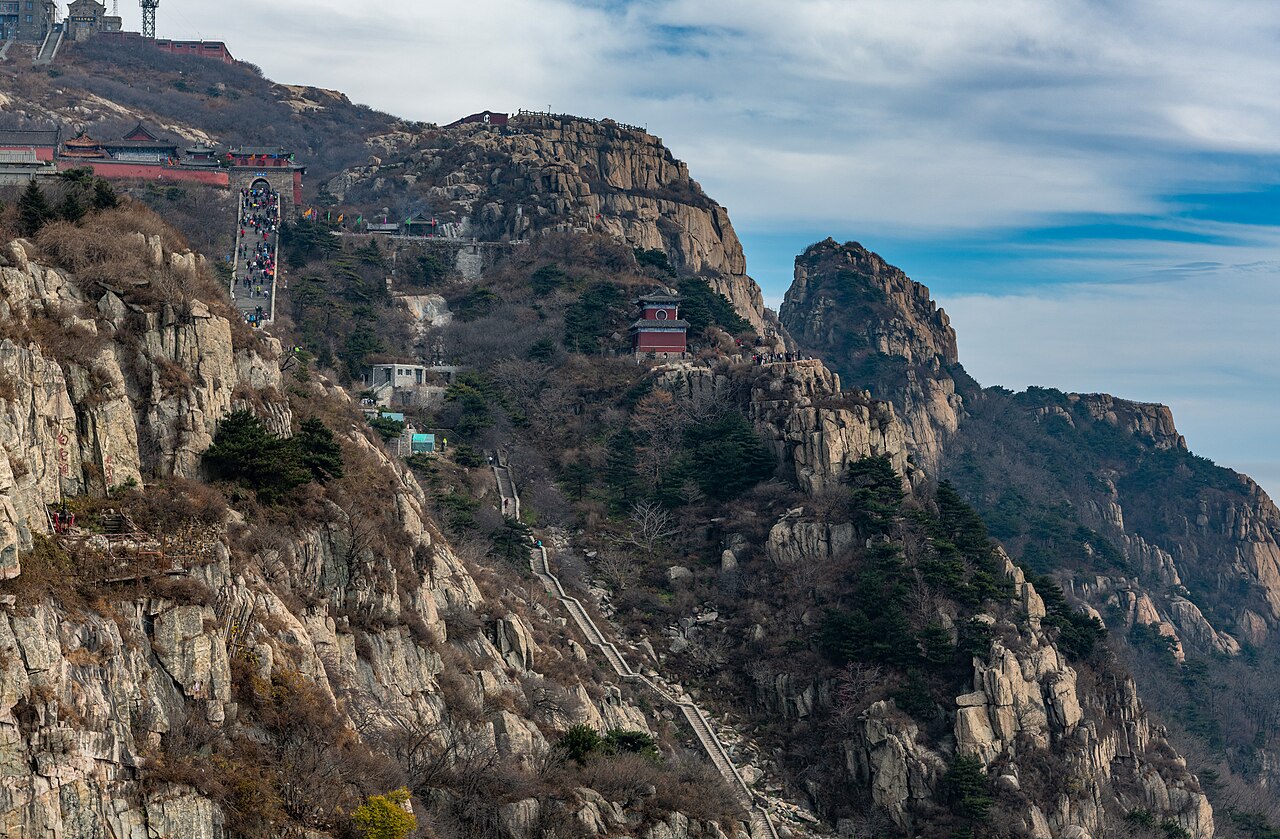
Mount Taishan (Tai Shan) was inscribed as a UNESCO World Heritage Site in 1987 under both cultural and natural criteria, making it one of the first mixed inscriptions in China. The mountain rises to 1,545 metres in Shandong Province and has served as a site of imperial ritual since the Han dynasty; 72 emperors are recorded as having performed the Feng and Shan ceremonies here to assert the legitimacy of their rule, with the oldest verifiable accounts dating to the Han emperor Wu (141–87 BCE). The ascent to the South Gate of Heaven follows 6,293 stone steps cut into the mountain face; Emperor Xuanzong of Tang personally composed a 1,008-character inscription in 726 CE and ordered the cliff face sealed after carving so that no subsequent emperor could place a longer text above it.
Shandong Province: two inscriptions within 100 kilometres 75–100 km, 1 hour by rail or bus
The Temple and Cemetery of Confucius and the Kong Family Mansion in Qufu were inscribed by UNESCO in 1994. Qufu lies 75 kilometres south of Tai’an city, reachable in approximately one hour by bus from Tai’an long-distance bus station, or by train to Yanzhou station followed by a 20-minute bus connection. Confucius was born in Qufu in 551 BCE and died there in 479 BCE; the cemetery contains his tomb alongside the graves of over 100,000 descendants across 76 generations, making it the largest family burial ground in continuous use in the world. The Kongmiao (Temple of Confucius) was first built in 478 BCE, the year after his death, on the site of his original residence, and has been rebuilt and expanded by successive dynasties. Its current form reflects mainly Ming and Qing construction; the complex covers 21.8 hectares with 466 rooms in a series of gated courtyards. The central Dacheng Hall (Hall of Great Achievement), rebuilt 1724–1730 after a lightning fire, has 28 stone columns on its facade carved with dragon relief that are covered with red fabric during imperial visits to prevent their surpassing the carved columns of the Forbidden City in Beijing—a protocol that continued into the Qing period. The Kong Family Mansion (Kongfu) immediately beside the temple was the residence of the direct descendants of Confucius, who held the hereditary title of Yansheng Duke; the mansion’s 463 rooms across a north-south axis document nine centuries of aristocratic domestic life from the Song dynasty onward. The Qufu UNESCO zone is compact and walkable; all three components (temple, cemetery, mansion) can be covered in a single full day, with the cemetery requiring 2–3 hours alone for a thorough walk among the memorial stelae and arboretum of roughly 20,000 ancient cypress trees.
The Grand Canal of China was inscribed in 2014 as a serial property covering 27 component sites across eight provinces. The canal passes through Jining, 100 kilometres south of Tai’an in southern Shandong, where a section of the active canal and associated sluice infrastructure from the Yuan and Ming periods remains in use for freight transport. The Jining stretch is not a major visitor destination in itself, but travellers moving between Tai’an and Qufu by road pass through or near the canal corridor; a stop at Jining’s canal heritage zone adds a working industrial-heritage dimension to the inland Shandong route. The Grand Canal in Shandong was one of the most technically demanding sections of the entire system: the watershed summit at Nanwang required four reservoirs and a series of water-management weirs to maintain navigable depth across the divide between rivers flowing north to the Yellow River and south to the Yangtze basin. The engineering solution, completed in the 14th century, kept the canal operational for bulk grain transport from southern China to Beijing for over 500 years. The full canal route—1,776 kilometres from Beijing to Hangzhou—is not practical as a single tourist itinerary, but understanding the Shandong hydraulics places the Jining section in its correct context as the most technically constrained segment of a system that carried millions of tonnes of rice and tax grain northward annually for the better part of a millennium.
Regional extensions: two inscriptions by high-speed rail 100–400 km, 1–3 hours by high-speed rail
The Ruins of Yin in Anyang were inscribed in 2006 and document the last capital of the Shang dynasty (roughly 1300–1046 BCE), excavated from 1928 onward in Henan Province, 400 kilometres southwest of Tai’an. Anyang is reachable from Tai’an by high-speed rail via Jinan and Zhengzhou in approximately three hours. The site is the source of oracle bones—turtle plastrons and ox scapulae used for divination by the Shang court, with the results inscribed in a script that is the direct ancestor of modern Chinese writing. Over 150,000 oracle bone fragments have been recovered from the Anyang site since 1899, when the first pieces were identified by scholars; the inscriptions document royal genealogies, military campaigns, crop yields and astronomical observations that have allowed historians to date Shang reign sequences with considerable precision. The on-site museum, the Yin Xu Museum, displays bronze ritual vessels, jade objects and the oracle bone collection in an institution that opened in 2005 specifically to consolidate the dispersed finds from decades of excavation. The royal tomb of Lady Fu Hao (died c. 1200 BCE), discovered intact in 1976, is the best-preserved royal burial from the site: it yielded 468 bronze objects, 755 jade pieces and 6,900 cowrie shells alongside the skeletal remains of 16 human sacrifices. Fu Hao is documented in oracle bone texts as a military commander who led campaigns of up to 13,000 soldiers, making her the earliest named female military leader whose existence is independently confirmed by contemporary documents rather than later historical accounts.
The Great Wall sections accessible from Jinan, the capital of Shandong Province, extend the wall-related component of a Taishan itinerary at 100 kilometres north of Tai’an, reachable in one hour by high-speed rail. While the major Ming wall sections most associated with the UNESCO inscription lie in Hebei, Beijing and Liaoning, Shandong contains the Qi Long Wall: an earlier, pre-Qin defensive barrier built by the state of Qi between the 7th and 4th centuries BCE, predating the unified Qin wall by several hundred years. Sections of the Qi wall survive in fragmented form across Shandong’s central mountains and are accessible via hiking trails near Laiwu and Zibo. These earthen walls, generally 2–4 metres high where they survive, are not the UNESCO-inscribed wall—that inscription covers the post-Qin unified system—but they contextualise the inscription by showing that the Great Wall concept developed independently across multiple warring states before Qin standardised and connected the northern frontier. For visitors whose primary interest in Taishan is the history of Chinese imperial ritual rather than military architecture, the Qufu–Tai’an corridor alone provides a more coherent thematic sequence; the Jinan connection is recommended primarily for travellers building a Shandong-wide circuit that includes the city’s Song-era spring gardens (Daming Lake, Baotu Spring) as supplementary non-UNESCO heritage.
Practical information
Tai’an city is served by Tai’an station on the Beijing–Shanghai high-speed rail corridor, approximately two hours south of Beijing and 90 minutes north of Nanjing. From Jinan, the connection is 30 minutes by high-speed rail. The mountain itself is accessed via two main routes: the traditional eastern route of 6,293 steps from Dai Temple at the mountain base to the South Gate of Heaven summit area (5–7 hours ascent on foot); or the western cable car from Zhongtian Gate (mid-mountain, reached by bus from Tai’an) to the South Gate of Heaven (cable car, 8 minutes). Most visitors combine the two: ascending the full steps one way for the experience of the imperial processional route, and returning by cable car and bus.
March to May and September to November are preferred months. July and August bring thunderstorms and cloud cover that can obscure the summit views for days at a time. Sunrise from the summit is the single most-photographed moment at Taishan; summit hotels and simple guesthouses allow overnight stays near the peak for predawn positioning. Book these well in advance for weekends and Chinese public holidays, when tens of thousands of Chinese visitors make the ascent and summit accommodation sells out weeks ahead. The Dai Temple (Daimiao) at the mountain base, a large-scale Tang and Song period complex, serves as the orientation point for the Taishan UNESCO inscription at ground level and is worth two hours before beginning the ascent.
Frequently Asked Questions
How do I travel between Mount Taishan and the Temple of Confucius in Qufu?
From Tai’an city, buses to Qufu depart from Tai’an long-distance bus station (Tai’an keyun zhan) approximately every 30 minutes throughout the morning and early afternoon. The journey takes 60–80 minutes depending on traffic. Alternatively, take the high-speed train from Tai’an station south to Yanzhou station (15–20 minutes on G- or D-series trains, multiple daily departures) and then a bus or taxi from Yanzhou to Qufu city centre (20 minutes, 20 kilometres). The train option is faster total journey time and less dependent on road conditions but involves more transfers. A private car or driver hired for the day in Tai’an is the most flexible option if you are combining Taishan (morning ascent by cable car), Qufu (afternoon), and wish to return to Tai’an or continue south the same day. The three components of the Qufu inscription—the temple, mansion and cemetery—require a combined ticket purchasable at the main gate. The cemetery alone takes 90 minutes for a walk through the main allée to Confucius’s tomb and back; allow three hours for a fuller circuit including the outer burial areas. There is no direct public bus from Mount Taishan’s summit to Qufu; descend fully to Tai’an city before connecting.
What is the significance of the Feng and Shan ceremonies performed on Mount Taishan?
The Feng and Shan were two separate rituals performed by emperors at Taishan to communicate directly with Heaven and announce their legitimacy to rule. The Feng ceremony was performed on the summit: a mound of earth was raised, and the emperor inscribed tablets with the text of the communication and buried them under the mound, addressed to Heaven (Tian). The Shan ceremony was performed at a secondary peak nearby, addressed to Earth. The rationale combined cosmological and political functions: the mountain was regarded as the meeting point between Heaven and Earth because of its prominence over the surrounding North China Plain, and the act of reaching the summit was treated as proof that Heaven had accepted the dynasty. The Records of the Grand Historian (Shiji) by Sima Qian, compiled around 100 BCE, document earlier attempts at the ceremony by pre-Han rulers and note that the specific texts inscribed on the tablets were secret even from the accompanying ministers; Sima Qian explicitly states that the content of the summit tablets was unknown to him. Emperor Qin Shi Huang performed the Feng ceremony in 219 BCE, the third year after unifying China; a severe storm that trapped him on the mountain during the descent was recorded but officially suppressed in the imperial account. Tang Emperor Xuanzong’s 726 CE inscription on the cliff face at the Inscribed Rock Valley (Jingshi Valley) is 1,008 characters in large regular script; the order to seal the cliff after carving is documented in Tang records.
How much time should I plan for Mount Taishan, and what does the ascent involve?
Two days is the standard recommendation: one full day for the ascent and summit area, one day for Dai Temple at the base and recovery. The full eastern route on foot from the First Gate of Heaven (Yitianmen) at the mountain base to the South Gate of Heaven (Nantianmen) at the summit is approximately 7.5 kilometres with an elevation gain of 1,400 metres, all on stone steps. The 6,293 steps are uneven in height and spacing; the steepest section, the 18 Bends (Shiba Pan), covers 400 metres of elevation gain in roughly 700 metres of horizontal distance, with step heights frequently exceeding 35 centimetres. Fit adults complete the ascent in 4–6 hours; porters carrying equipment and supplies for summit hotels use the route daily and set the pace in the steepest sections. The cable car from Zhongtian Gate (mid-mountain) reduces the ascent to an 8-minute ride, covering the upper 600 metres of elevation; a bus runs from Tai’an city to Zhongtian Gate in 30 minutes. Most first-time visitors take the cable car up and walk part of the steps down to experience the stone architecture and inscribed stelae along the traditional route at a manageable pace. Summit temperature is typically 7–10°C cooler than the base; a windproof layer is necessary year-round. The summit area has hotels, canteen-style restaurants and a small convenience infrastructure.
Sources
- S1 — UNESCO World Heritage Centre — Mount Taishan (Ref. 437) — https://web.archive.org/web/20230601000000/https://whc.unesco.org/en/list/437/
- S2 — Taishan Scenic Area Management Committee — https://whc.unesco.org/en/list/437/
- S3 — Kuhn, Dieter. <em>The Age of Confucian Rule: The Song Transformation of China</em>. Harvard University Press, 2009. ISBN: 978-0-674-03661-1.
Spotted an error? Write to editorial@culturalheritageonline.com and we correct it the same day.
.jpg)