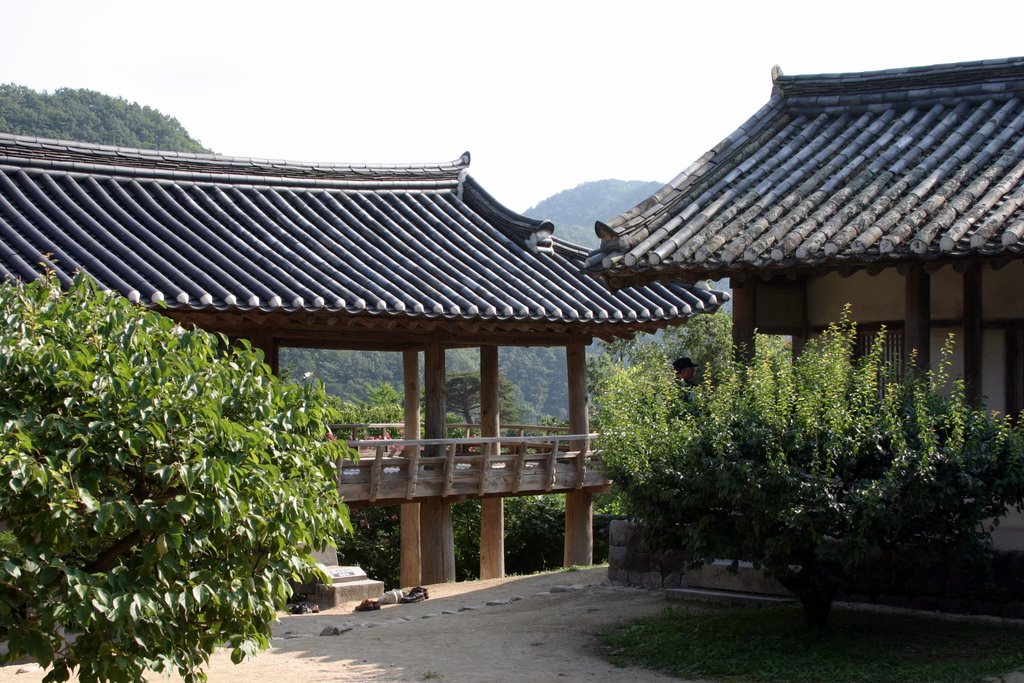
The Seowon, Korean Neo-Confucian Academies, inscribed by UNESCO in 2019, protect nine representative academies (서원, seowon) of the Joseon dynasty — Sosuseowon (소수서원, Yeongju, North Gyeongsang), Namgye Seowon (남계서원, Hamyang, South Gyeongsang), Oksan Seowon (옥산서원, Gyeongju, North Gyeongsang), Dosan Seowon (도산서원, Andong, North Gyeongsang), Piram Seowon (필암서원, Jangseong, South Jeolla), Byeongsan Seowon (병산서원, Andong, North Gyeongsang), Museong Seowon (무성서원, Jeongeup, North Jeolla), Dodong Seowon (도동서원, Dalseong, Daegu), and Chungnyeol Seowon (충렬서원, Miryang, South Gyeongsang) — that represent the educational, architectural, and landscape tradition of the Joseon-period private Confucian academy system from its founding in 1543 CE through the 19th-century abolition of most Seowon by the Joseon regent Heungseon Daewongun in 1871 CE. The Seowon (literally “Western Garden”, a term adapted from the Chinese private academy shuyuan) was the primary institution of advanced Confucian education in Joseon Korea — a private academy sponsored by local aristocratic clan networks, dedicated to the memory of a founding Confucian scholar-official, providing preparation for the civil service examinations (과거, gwageo) that determined appointment to government office, and conducting seasonal memorial ceremonies for the founding scholar’s spirit. The nine inscribed Seowon were selected as the most architecturally intact and historically significant representatives of the approximately 650 Seowon that operated at various points during the Joseon period (with approximately 47 surviving after Daewongun’s 1871 abolition order, which spared only those 47 with the most distinguished historical reputations).
The nine Seowon distributed across South Korea’s Confucian landscape Andong cluster · Gyeongju axis · Chungcheong plains — 30 to 400 km
Four of the nine inscribed Seowon are concentrated in the Andong area of North Gyeongsang Province — the geographic core of the Korean Neo-Confucian tradition — within a 55-km radius that also includes the Hahoe and Yangdong villages UNESCO inscription and the Bongjeongsa Sansa monastery, making the Andong region the most concentrated Neo-Confucian heritage landscape in Korea. Dosan Seowon (도산서원, “Dosan Academy”, approximately 40 km northeast of Andong city by road, founded 1574 CE two years after the death of Yi Hwang/Toegye, the greatest Neo-Confucian philosopher of the Joseon period, whose image appears on the 1,000-won banknote) is the most visited Seowon in Korea and the most comprehensively interpreted for international visitors: the academy’s complex of buildings, arranged in a hillside above the Nakdong River opposite the forested mountain of Dosan, includes the private study hall (도산서당, Dosanseodang) that Yi Hwang built for his own retirement study circa 1561 CE — the oldest surviving building in the complex and the physical core around which the posthumous academy was constructed. The philosophical significance of Toegye’s thought (his four-seven debate with Ki Daeseung on the metaphysical structure of moral emotions — whether the “Four Beginnings” of Confucian virtue and the “Seven Emotions” of human psychology derive from principle (이, li, the inherent moral order of the universe) or from material force (기, ki, the physical substance of existing things) — is the defining intellectual exchange of Korean Neo-Confucianism and established the Korean philosophical tradition’s distinctiveness from both Chinese and Japanese Neo-Confucianism) makes Dosan Seowon a site of intellectual heritage significance comparable to the academies of the great European university traditions. Byeongsan Seowon (병산서원, “Byeongsan Academy”, approximately 15 km southwest of Andong city along the Nakdong River, accessible by bus in 35 minutes from Andong city centre or by riverbank walking path from Hahoe village in approximately 45 minutes), dedicated to Ryu Seong-ryong (류성룡, 1542–1607 CE, chief minister during the Imjin War and author of the war memoir Jingbirok), is architecturally the most celebrated of the nine Seowon: its Mandaeru pavilion (만대루, “Pavilion for Viewing Ten Thousand Views”), a two-storey open-sided wooden gallery running the entire width of the academy’s front courtyard, frames a view of the Nakdong River and the Byeongsan cliffs through its seven structural pillars — a composition in which the river, cliffs, and sky become the “painting” that the pavilion architecture frames, representing the Korean aesthetic principle of 借景 (borrowed landscape).
The Andong Seowon cluster is complemented by three geographically dispersed Seowon that together illustrate the national reach of the Joseon educational system. Sosuseowon (소수서원, “Sosu Academy”, in Yeongju, North Gyeongsang Province, approximately 80 km north of Andong) was the first private academy in Korea to receive royal charter (사액서원, saaek seowon — an academy authorised by the king to administer the civil service examination preparation curriculum and to receive land and state labour grants), established in 1543 CE by the governor Ju Sebung on the site of an earlier Buddhist temple, and dedicated to the Confucian scholar An Hyang (안향, 1243–1306 CE, the Goryeo-period scholar credited with introducing Neo-Confucianism to Korea from Yuan-dynasty China). Sosuseowon is architecturally notable for its integration of Buddhist temple buildings (the original temple structures on the site were repurposed as academy buildings, preserving the stone pagoda and the 13th-century carved stone Buddha images within the Neo-Confucian academy complex — a visible record of the 15th-century cultural transition from Buddhist to Confucian institutional dominance in Korea). Oksan Seowon (옥산서원, “Oksan Academy”, near Gyeongju, approximately 8 km from Yangdong village, 23 km from the Gyeongju city centre), dedicated to the philosopher Yi Eon-jeok (이언적, 1491–1553 CE, the first Korean Neo-Confucian thinker to be posthumously enrolled in the royal Confucian shrine Munmyo — the highest posthumous honour in the Joseon academic tradition), occupies a mountain valley setting with a creek, bamboo grove, and ancient oak trees that is the standard reference landscape for Korean Seowon environmental aesthetics. Dodong Seowon (도동서원, “Dodong Academy”, in Dalseong, now within the Daegu metropolitan area), dedicated to Kim Gwengpil (김굉필, 1454–1504 CE, the teacher of the reformer Jo Gwangjo), is notable for the earthen outer wall (장담, jangdam, 100 m long, 2.7 m high, and 1.5 m thick — one of the longest surviving earthen walls in Korea) that encloses the academy on three sides.
Practical information
The nine inscribed Seowon are distributed across seven Korean cities and provinces and require separate visits; a comprehensive circuit of all nine is a multi-day undertaking. The Andong cluster (Dosan + Byeongsan, combinable with Hahoe village and Bongjeongsa in a 2-day Andong itinerary) is the recommended starting point. All Seowon maintain regular visiting hours (typically 09:00–18:00 or to sunset, closed Monday at several locations); most charge a small admission fee. Andong is accessible from Seoul by KTX in approximately 2 hours; Dosan Seowon is 40 km from Andong Station by bus (50 minutes, buses approximately every 30 minutes on weekdays, less frequently on weekends). Byeongsan Seowon has no direct public bus service from Andong city centre — taxi from Andong (approximately 25 minutes, 25,000–30,000 KRW) or bus to Hahoe village then 45-minute riverside walk. The Andong Folk Museum (안동민속박물관) in the Andong Hahoe Folk Village area provides English-language interpretation of the Andong aristocratic culture that produced both the village UNESCO site and the Seowon cluster. Sosuseowon in Yeongju is accessible by bus from Yeongju city (approximately 30 minutes), with Yeongju connected to Andong by bus (approximately 1 hour) and to Seoul Cheongnyangni Station by train (approximately 2.5 hours). Oksan Seowon is most efficiently combined with Yangdong village (8 km distant) and the Gyeongju Historic Areas (23 km from Gyeongju city). The Seowon Heritage Centre in Andong (안동 서원문화원, Andong Seowon Cultural Centre) operates English-language guided tours of the Andong-area Seowon (Dosan, Byeongsan, Bongjeongsa, Hahoe) by advance booking.
Frequently Asked Questions
What was the Seowon’s role in Joseon society and how did it differ from the state’s own educational institutions?
The Seowon occupied a specific institutional niche in the Joseon educational system between the state-administered schools (향교, hyanggyo, government-funded Confucian schools in each county capital, open to all yangban and some commoner students, with a fixed curriculum and government-appointed teachers) and the purely private household tutoring (서당, seodang, basic literacy and Confucian primer instruction in rural villages). The Seowon’s distinctive character derived from three features: private sponsorship (Seowon were established by local yangban clan networks, funded by clan land grants and voluntary contributions rather than by government tax revenue, giving them a degree of independence from government educational policy), commemorative identity (each Seowon was dedicated to the memory of a specific Confucian scholar-official — typically a local figure of national significance — whose portrait and ritual vessels were maintained in the academy’s shrine hall and whose thought and writings formed the core of the curriculum, giving the Seowon a specific philosophical orientation that the generic state schools lacked), and examination preparation specialisation (Seowon were specifically designed for advanced preparation for the civil service literary examination (문과, mungwa), the most prestigious of the three Joseon examination tracks, which required mastery of the Chinese classical canon and the ability to compose essays and poetry in classical Chinese at a standard comparable to the best Chinese examination candidates). The Seowon’s political significance was as much as educational: because government appointment required examination success, and because the Seowon’s private educational networks were controlled by specific clan lineages and philosophical schools, the Seowon system became a mechanism through which regional aristocratic factions maintained political influence through educational patronage — a parallel educational infrastructure that rivalled the state school system in prestige (a Seowon diploma was often more valuable than a hyanggyo certificate for signalling cultural capital to examination examiners) and in social function (the Seowon’s seasonal ceremonies for the founding scholar’s memorial were significant social events in the local aristocratic community, reinforcing clan networks and philosophical allegiances). The 1871 abolition order by Daewongun (which reduced the Seowon from approximately 650 to 47) was motivated by this political dimension: the Seowon had become strongholds of conservative factional opposition to the Joseon state’s reform attempts, and their exemption from military tax (a privilege granted by royal charter) was economically disruptive.
What is the four-seven debate and why does it matter for Korean Neo-Confucian philosophy?
The four-seven debate (사단칠정논변, Sadan-chiljeong nonbyeon, “debate on the Four Beginnings and Seven Emotions”) was a philosophical exchange conducted through letters between Yi Hwang (Toegye) and Ki Daeseung (기대승, 1527–1572 CE) between 1559 and 1566 CE — a series of twelve letters debating the metaphysical structure of the human capacity for moral emotion in Neo-Confucian terms, that became the defining philosophical controversy of Korean Confucianism and shaped Korean intellectual history for the next 300 years. The debate’s technical content concerns the relationship between two fundamental Neo-Confucian concepts: li (이, principle — the abstract moral order inherent in all things, the “why” of existence), and ki (기, material force or vital energy — the physical substance that gives concrete existence to things, the “what” of existence). The problem they debated was: do the “Four Beginnings” (사단, sadan — the four nascent moral emotions identified by Mencius as natural to all human beings: compassion, shame, modesty, and the sense of right and wrong) and the “Seven Emotions” (칠정, chiljeong — the seven general human emotions identified in the Confucian canon: joy, anger, sorrow, fear, love, hate, desire) originate from different metaphysical sources? Yi Hwang’s initial position was that the Four Beginnings derive from principle (li) while the Seven Emotions derive from material force (ki) — a dualistic position that assigned the Four Beginnings a purer, more certain moral status than the Seven Emotions. Ki Daeseung objected that li and ki cannot be separated in actual experience (ki is always the medium through which li manifests, and li is always the ordering principle of ki), so assigning the Four Beginnings to li-alone would imply that moral emotions exist independently of the physical human body — a philosophically untenable abstraction. The debate’s significance for Korean intellectual history lies in what it generated: the Yi Hwang–Ki Daeseung exchange initiated a 200-year tradition of Korean Neo-Confucian philosophical disputation (continued in the debate between Yi Hwang’s student Yi I/Yulgok and Yi Hwang’s position, and then in the subsequent school disputes between the Southerner and Westerner factions of the late Joseon period) that was more philosophically sophisticated than contemporaneous Chinese Neo-Confucian discourse and that produced a distinctly Korean philosophical tradition recognised as such by modern scholars of comparative philosophy. Yi Hwang’s final position (after eight years of correspondence with Ki Daeseung) was a nuanced reformulation maintaining the moral priority of the Four Beginnings without the crude separation from ki that his original formulation implied — a position still debated among Korean and international scholars of Confucian philosophy.
How did Daewongun’s 1871 abolition of most Seowon change Korean society?
Heungseon Daewongun’s (흥선대원군, 1820–1898 CE, regent for his son King Gojong from 1863 to 1873 CE) abolition of all but 47 Seowon in 1871 CE was one of the most dramatic administrative actions in late Joseon history — the dismantling of approximately 600 private educational institutions that had been the primary mechanism of aristocratic clan political and cultural power for three centuries. Daewongun’s motivation was economic and political: the approximately 650 Seowon had accumulated substantial land grants (from both royal charter gifts and clan endowments), exempted their resident scholars from military tax and corvée labour obligations, and in many cases functioned as de facto tax havens for aristocratic landholding — a significant drain on the Joseon state’s fiscal base at a time when the state was desperately seeking revenue to fund military modernisation in response to the French and American military expeditions of 1866 and 1871. Politically, the Seowon had become strongholds of the conservative Confucian faction (noron, 老論, “Old Learning”) opposition to Daewongun’s reforms: local aristocratic scholars organised Seowon-based petitions against the regent’s attempts to rebuild the Gyeongbokgung Palace (a major construction expenditure financed by a forced levy that alienated the merchant class) and against his suppression of Catholic Christianity (which had its primary support among reform-minded scholars). The abolition order, which confiscated the Seowon’s land grants and returned the buildings to clan ownership without state support, provoked massive protest from the Confucian establishment — the strongest single public protest movement of the late Joseon period — but Daewongun enforced it regardless, reportedly telling the petitioners: “Even if Confucius himself were to return to life, I would still abolish them.” The 47 Seowon that were spared the abolition (including the nine inscribed in the 2019 UNESCO inscription) were those with the most distinguished historical reputations and the most direct connection to the founding scholars’ philosophical significance — a selection that inadvertently created a curated heritage canon of the finest Korean Neo-Confucian academy sites, which is why the UNESCO inscription could be built from the surviving 47 rather than requiring the full 650.
Sources
- S1 — UNESCO World Heritage Centre — Seowon, Korean Neo-Confucian Academies (Ref. 1498) — https://web.archive.org/web/20230601000000/https://whc.unesco.org/en/list/1498/
- S2 — UNESCO World Heritage Centre — Statement of Outstanding Universal Value (Ref. 1498) — https://whc.unesco.org/en/list/1498/
Spotted an error? Write to editorial@culturalheritageonline.com and we correct it the same day.